Article
Future Gas Strategy Discussion Paper

Media release – Guy Barnett, Minister for Energy and Emissions Reduction, 12 November 2021
Discussing the future for gas in Tasmania
Gas is an important energy source for both industrial and domestic users in Tasmania and today the Government is releasing the Tasmanian Future Gas Strategy Discussion Paper for public comment.
Australian gas markets are experiencing a period of rapid transition, and to better understand the future role gas will play in Tasmania’s energy mix it is important that we start planning now and hear from the community and industry.
The Discussion Paper outlines the key issues in developing a future pathway for gas in Tasmania and sets out a series of questions to consider.
This includes potential decarbonisation of the gas industry over the medium to longer term, which is firmly aligned with Tasmania’s goals, and the direction of international and domestic gas markets.
The final Future Gas Strategy will include a gas decarbonisation pathway study to look at options for using locally produced hydrogen, renewable methane or biogas.
The Government is approaching this work with an open view on what the future of gas should look like in Tasmania.
Maintaining jobs, encouraging growth and investment, and protecting the interests of Tasmanian consumers while ensuring energy remains affordable and reliable remain key priorities for the Government.
The Discussion Paper is available from the Renewables, Climate and Future Industries Tasmania website at https://recfit.tas.gov.au/consultation_and_community and submissions are invited to address all or any part of the discussion.
Comments will close on 21 January 2022 and the Final Strategy is expected to be released in 2022.
Future Gas Strategy – Discussion Paper
The Government is developing a Future Gas Strategy (Strategy) that will aim to better understand the future role of gas in Tasmania over the next 20-30 years.
A Working Group has been established to support the development of the Strategy which includes key industry and consumer representatives.
This Discussion Paper is the first phase of a consultation process to understand the views of business, households, and the community about the future role of gas in Tasmania. The Government is seeking to engage with all interested parties on their perspectives.
The Discussion Paper sets out the current state of the gas market in Tasmania and some of the policy and market factors that are likely to influence its future. At the end of the paper, a set of guiding questions are provided for you to consider when providing feedback.
In response to feedback received on the draft Tasmanian Renewable Energy Action Plan, the Government also committed to undertake a gas decarbonisation pathway study. This work is incorporated as part of this strategy.
After considering the feedback received on this Discussion Paper, a draft gas strategy will be released in the first half of 2022 for further consultation. The Government is aiming to release the final strategy later in 2022.
Australian gas markets are experiencing a period of rapid transition relating to all aspects of the gas supply chain.
We are also seeing Australia’s energy systems undergoing a transition from fossil fuels to renewable energy generation. Globally, countries are looking to use cleaner, renewable forms of energy to decarbonise their economies and there is growing domestic and international interest to decarbonise gas.
The Government recognises that those in the gas supply chain in Tasmania are looking to better understand the future role of gas in Tasmania. This is why we are developing a Strategy that will help all Tasmania’s gas market participants including gas customers, network operators, shippers, and retailers, to better plan for the future of gas.
The Tasmanian Government understands the importance of starting to build a plan now that will support the future direction of gas in Tasmania over the next 20-30 years. To help inform the Strategy, the Government is seeking the views of the community and industry to better understand the opportunities and challenges that a changing gas sector will bring.
The final Strategy will:
- consider the current challenges facing the Tasmanian gas market;
- identify possible options for the Tasmanian gas market;
- consider the risks and opportunities to gas consumers in moving towards net zero emissions and renewable fuels; and
- start exploring the most promising pathways to decarbonisation.
Maintaining jobs, encouraging growth and investment, and protecting the interests of Tasmanian consumers while ensuring energy remains affordable and reliable remain key priorities for the Government.
We intend to engage with all interested stakeholders to seek input, guidance and perspectives to help our thinking on key issues. This Discussion Paper and its supporting documents have been released to support this engagement.
We have designed this Discussion Paper to provide a succinct outline of the key issues that we will be examining, and to encourage submissions on all or any part of our scope. There are a series of questions at the end of the Paper that we ask you to consider in providing your feedback.
Key milestones for the development of the gas strategy include:
- 12 November 2021 – Discussion Paper released
- 21 January 2022 – Submissions close on Discussion Paper
- First half of 2022 – Consultation on Draft Future Gas Strategy
- 2022 – Public Release of Final Future Gas Strategy
Tasmanian Government Policy Settings
The Tasmanian Government has a number of existing policy settings that will influence the future role of gas in Tasmania.
The Tasmanian Renewable Energy Target
The Government legislated the Tasmanian Renewable Energy Target (TRET) in November 2020. The TRET aims to increase the state’s renewable energy output to the equivalent of 200 per cent of its 2020 renewable electricity generation levels (set at a baseline of 10,500 GWh). This means that by 2040, Tasmania will produce 21,000 GWh of electricity from renewables.
The Tasmanian Renewable Energy Action Plan
In December 2020, the Government launched the final version of the Tasmanian Renewable Energy Action Plan (the TREAP). The TREAP details the Government’s vision for our renewable energy future. It sets targets and identifies actions designed to grow and expand Tasmania’s renewable energy sector into the future.
The TREAP includes an action to undertake a gas decarbonisation pathway study in 2021. This study involves examining various pathways for decarbonising our gas networks, such as the utilisation of locally produced renewable hydrogen or biogas. The outcome of this study will form a key part of the final Future Gas Strategy. Further information about this study is set out below under the “Pathway to decarbonisation” section.
The Tasmanian Renewable Hydrogen Action Plan
In March 2020, the Tasmanian Government released the Tasmanian Renewable Hydrogen Action Plan, with a vision for our island to become a world leader in large-scale renewable hydrogen production for domestic use and export.
As outlined in the TRHAP, the Government has committed to work with the incumbent natural gas distribution network infrastructure owner to explore opportunities for hydrogen blending at 10 per cent and to investigate potential trials of higher hydrogen blends in Tasmania’s hydrogen compatible gas distribution networks.
The Tasmanian Government is supporting a number of hydrogen projects, including Grange Resource’s facility at Port Latta, which is exploring the potential to use hydrogen to replace natural gas for industrial heating.
The Government is developing a Bioenergy Vision in consultation with industry and stakeholders which will identify how the State can unlock private sector investment in bioenergy in Tasmania.
Renewables, Climate and Future Industries Tasmania (ReCFIT) will explore options to use bioenergy to decarbonise its economy by displacing fossil fuels used in heat generation and the production of transport fuels. ReCFIT will also examine the feasibility of replacing boilers in Government buildings that currently run on fossil fuels, with renewable energy sources including boilers that use biomass as their feedstock.
The Climate Change Action Plan and Tasmania’s commitment to net zero emissions
Tasmania’s Climate Change Action Plan 2017-2021 (Climate Action 21) sets the Tasmanian Government’s agenda for action on climate change, and the next action plan is currently under development. It reflects the Government’s commitment to address the critical issues of climate change and articulates how Tasmania will play its role in the global response to climate change.
The Government has recently announced its intention to legislate a target of net zero emissions from 2030. The target was recommended as part of the Independent Review of the Climate Change (State Action) Act 2008 and supported by Tasmania’s Emissions Pathway Review and a detailed economic analysis of the impact on jobs, industry, and growth. 1 This target will be nation-leading and one of the most ambitious in the world.
To support business, industry and the community to transition to a low emissions economy, the Tasmanian Government has also committed to establish a legislative framework for the development of Emissions Reduction and Resilience Plans for key industry sectors. This work will be developed in partnership with industry to ensure a practical and balanced approach to sector-based planning for a low emissions future.
Tasmania’s Renewable Energy Coordination Framework
In early 2021, the Government published for consultation its Renewable Energy Coordination Framework (the Framework) which sets out the actions to support the renewable energy growth required to achieve our TRET. Central to the Framework is ensuring that the benefits from renewable energy projects, such as jobs and investment, are maximised for local communities.
The final Framework is being progressed.
The Tasmanian Natural Gas Network
Since 2003, natural gas has been supplied to Tasmania through an underwater pipeline from Victoria.
The Tasmanian Gas Pipeline (TGP) is the only transmission pipeline operating and transporting gas to Tasmania. The pipeline runs from Longford in Victoria to Five Mile Bluff (near Bell Bay), then west to Port Latta and south to Bridgewater.
Some major industrial customers are supplied directly from the transmission pipeline, with smaller industrial customers and commercial and residential customers being supplied via the distribution network.
The distribution network transports gas at lower pressures than the transmission network. It is 840 km in length and delivers around 3.54 PJ per annum of natural gas to approximately 15 000 customers.
There are four gas retailers in Tasmania licenced to sell natural gas into the gas network: Aurora Energy, Tas Gas Retail, Weston Energy and GloBird Energy.
The gas supply industry in Tasmania is a fully contestable, and predominantly consists of private market participants.
There are currently 501 licenced gas-fitter practitioners in Tasmania (including 39 automotive gas fitters).
There are some areas of Tasmania that are not connected to the main gas network and instead use Liquid Petroleum Gas (LPG), Liquified Natural Gas (LNG) or Compressed Natural Gas (CNG) supplied in bottles or cylinders.
Tasmania has an LNG plant at Westbury that currently supplies natural gas fuel to a range of customers across several industries including agriculture and transport. The plant takes natural gas from the TGP, which is processed and then liquefied to be stored in tanks and transported to road tankers for distribution around Tasmania.
LPG is a combination of flammable hydrocarbon gases, primarily butane and propane. This gas becomes liquefied when it is pressurised and is then transported in tanks or large cylinders.
LPG is imported into Tasmania via sea transport and to households and businesses via road transport around Tasmania.
LPG and LNG are used for similar purposes, but natural gas is comprised mostly of methane, while LPG is predominately butane and propane.
The price of LPG can vary and is dependent on the global market supply and exchange rates.
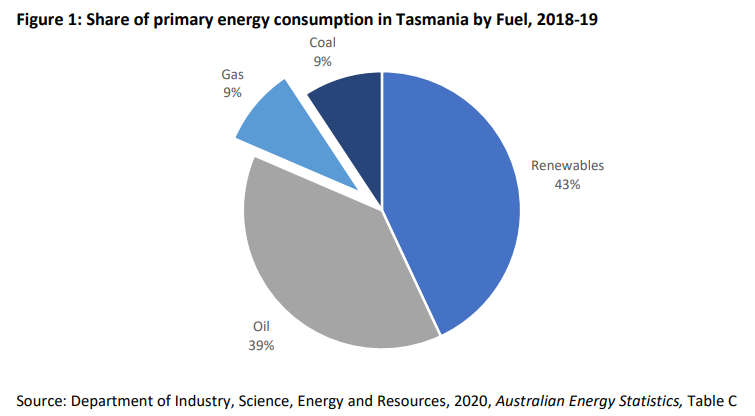
Gas consumption in Tasmania is very low compared to electricity consumption, accounting for only nine per cent of Tasmanian energy consumption.

There are around 15 000 natural gas customers in Tasmania.
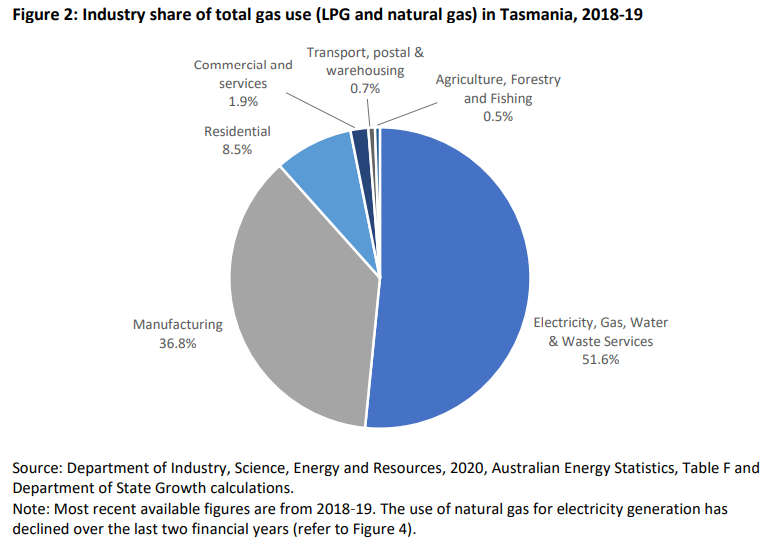
Despite the comparatively small size of the sector, natural gas plays an important role in Tasmania’s energy mix. Tasmanian homes and businesses use natural gas for heating, hot water and cooking; major industries rely on it across a range of sectors such as manufacturing, mining, and agriculture; and from time to time, it has an important role in electricity generation. In developing the Strategy, the Government will be considering the interests of all these gas users and working to address their key concerns and challenges.

Tasmania’s first residential natural gas consumer was connected on 27 August 2004 and since then, approximately 13 500 residential customers have connected to the natural gas network.
The Tasmanian natural gas network has limited reach, passing by around 60 000 premises.
There is comparatively high residential use of LPG in Tasmania with nine times as much LPG being consumed by households than natural gas.
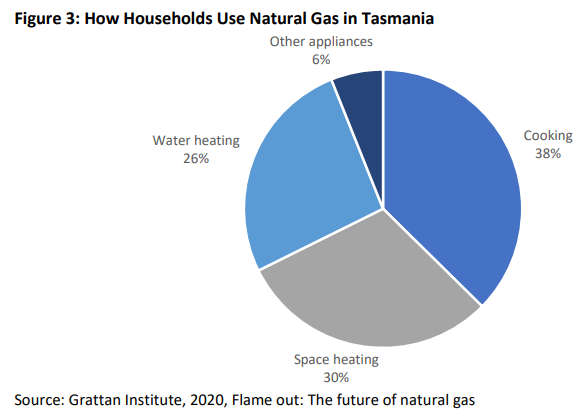
Households commonly use gas for space heating, water heating and cooking. LPG is also used as a fuel for barbecues and vehicles.

The first commercial natural gas consumer was connected in May 2004. Approximately 1000 commercial and industrial customers are estimated to be connected to the natural gas network.
The commercial sector includes premises such as hospitals, accommodation, schools, office buildings, hotels, restaurants, laundromats and government buildings. Similar to households, the main uses of gas by commercial users include space heating, water heating, cooking and cooling. Gas boilers are often used to heat large premises.
Marine use of LNG is a potential area of growth for natural gas use in Tasmania. In early 2021, the Tasmanian Government contracted with Finnish shipbuilder Rauma Marine Constructions to build two LNG-powered car and passenger ferries for Tasmanian shipping company TT-Line. The ferries will replace the Spirit of Tasmania vessels.
A number of Tasmania’s largest industrial customers rely heavily on natural gas.
Bell Bay Aluminium and Grange Resources are connected directly to the main transmission pipeline. Other major industries such as TEMCO, Boags, Tasmanian Alkaloids, Simplot, Fonterra, Nyrstar, Cascade and Cadburys are connected via the distribution network.
Many of the major industrial users use gas as a fuel source for heat purposes. Natural gas can also be used as a feedstock for the manufacturing of plastics or other organic chemicals.
Gas Powered Electricity Generation
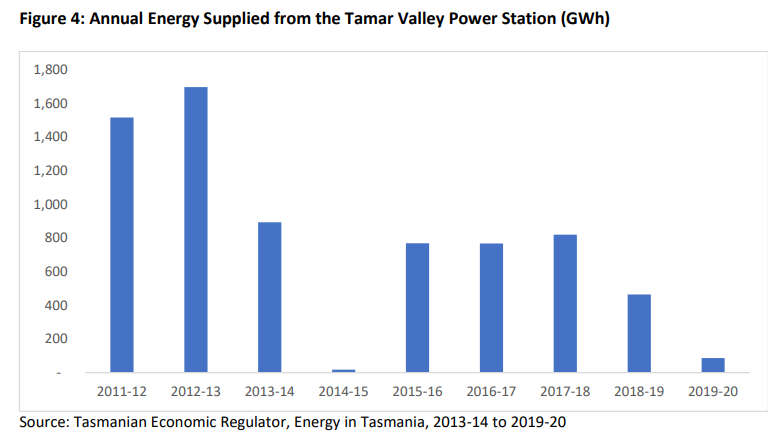
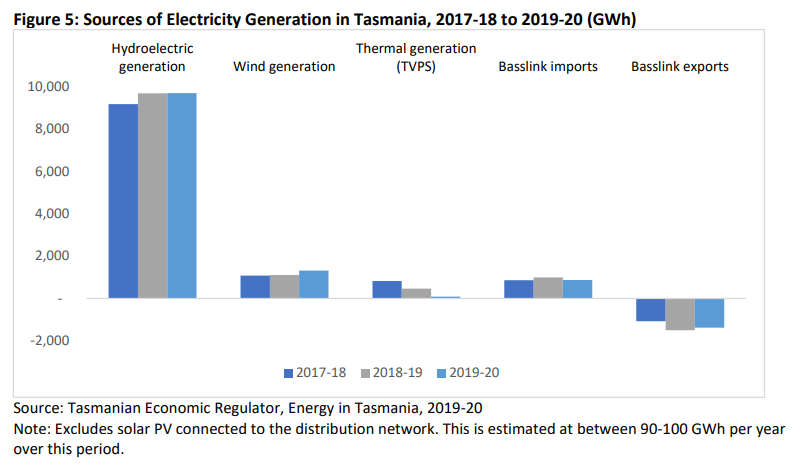
Gas has played an important role as a back-up source of energy for power generation in Tasmania. The Tamar Valley Power Station (TVPS) is the largest single gas consumer in Tasmania when in operation. AETV, a subsidiary of Hydro Tasmania, operates the TVPS. It consists of a combined cycle gas turbine (CCGT) and four open cycle gas turbine units (OCGT) with a combined generating capacity of 372 MW.
Gas fired power generation in Tasmania is highly variable. The variation is dependent on a range of factors including the availability of hydro and wind generation, relative power prices and demand in Tasmania and Victoria, drought and the availability of the Basslink interconnector.
During 2015-16, Tasmania experienced energy security challenges, with the combined impact of two extreme events – record low rainfall during spring, combined with the Basslink interconnector being out of service – resulting in Hydro Tasmania’s water storage levels falling to historically low levels. The operation of the TVPS played an important role in mitigating this risk and allowing energy storage levels to be rebuilt.
At the 2021 election, the Government reaffirmed its position that it will not sell the Tamar Valley Power Station, given its important role in energy security.


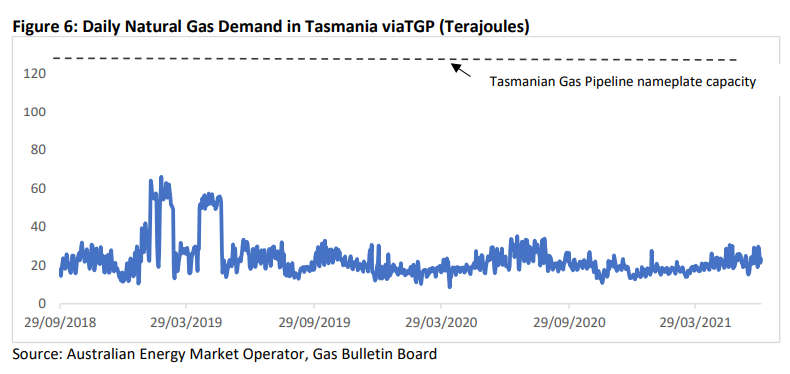
The natural gas market in Tasmania is relatively small compared to mainland states and territories, reflecting the reasonably recent introduction of natural gas into the State and the limited reach of the reticulation network.
The take-up rate for gas, particularly by small business and residential users, has been relatively slow since the pipeline was built in the early 2000s. Electricity remains the primary fuel source in Tasmania.
The low take-up rate of gas has led to limited expansion of the distribution network in Tasmania. While the gas distribution network is available to some 60 000 premises, the uptake has been only incremental, at around 15 000 customers.
As a result of Tasmanian’s small market and modest growth, the TGP is underutilised relative to its physical capacity. Lower levels of gas-fired generation at the TVPS also have the potential to further reduce utilisation of the TGP.

Gas prices are higher in Tasmania compared to other jurisdictions.
Full retail contestability applies to the Tasmanian gas retail market and there are currently five licensed gas retailers in Tasmania.
Aurora Energy and Tas Gas Retail are the two largest natural gas retailers, with Weston Energy retailing gas to commercial and industrial customers in the State. GloBird Energy is a licensed retailer; however it is understood that it has no current Tasmanian customers. Origin Energy Retail retails Liquid Propane Gas (LPG) within the Glenara Lakes complex in Launceston.
The two largest licensed gas retailers in Tasmania, Tas Gas Retail and Aurora Energy, offer a single residential tariff and a single business tariff.2
Transmission costs for gas in Tasmania are the highest in Australia and distribution costs are significantly higher than the national average.3 There are a number of reasons for this including:
- Tasmania’s location in relation to the gas fields
- the small market where fixed costs have to be recovered from a small number of customers, most of whom consume a low volume of gas.
The gas commodity prices in Tasmania (determined by the east coast market price) are expected to remain high, depending on the supply-demand balance.
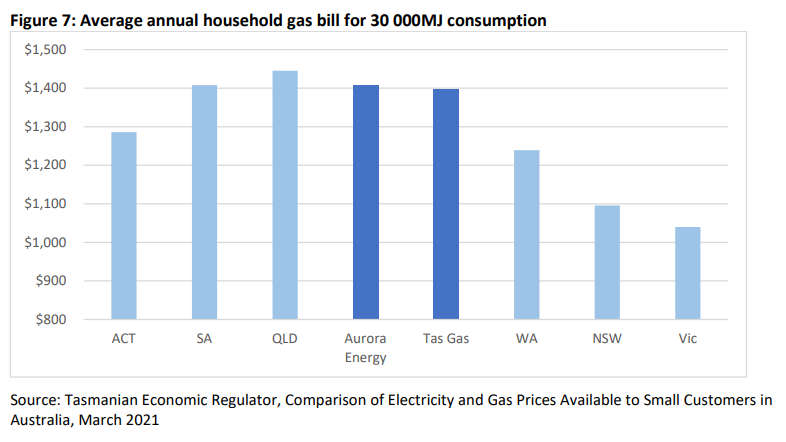
Tasmania’s gas retailers offer gas to residential customers on tariffs that result in higher annual bills than the tariffs available in most other mainland jurisdictions. For an annual consumption of 30,000 MJs, a Tasmanian household would receive an annual bill of approximately $1 400. In some other jurisdictions, households can receive an annual bill of under $1 100 for the same consumption.

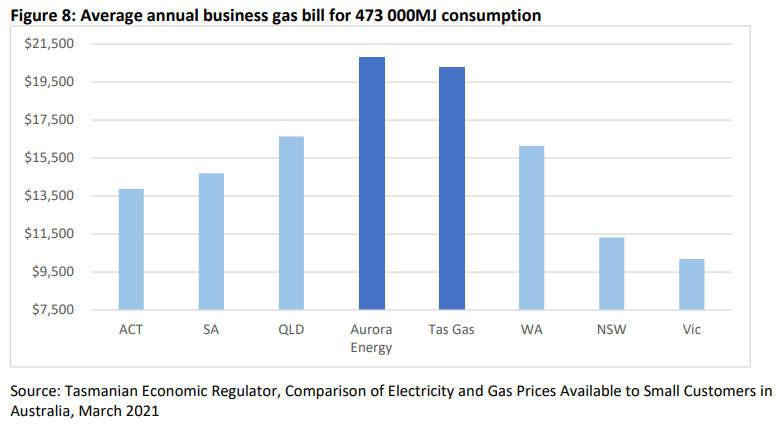
Business customers in Tasmania have some of the highest gas bills in Australia. For an annual consumption of 473 000 MJ, a Tasmanian business would receive a bill of approximately $20 500. In other jurisdictions, business customers can receive an annual bill of under $11 000 for the same consumption.4

The Government is working to help Tasmanian households deal with energy affordability challenges and it recognises that any increase in an already high gas price would exacerbate these challenges.
Higher gas prices are also particularly challenging for commercial and industrial gas customers. Many of the major industry users use gas as a fuel source for heat purposes, for which an alternate heat product is not currently economically viable.
At present, the availability of gas at a competitive price is critical to these users.
Gas Supply Security in Tasmania
The TGP is a single gas transmission pipeline supplying all Tasmanian gas consumers. Tasmania has no local gas reserves. As a result, there are very few redundancies should gas supplies into Tasmania fail or suffer major disruption, for example from a pipeline outage or a gas supply issue in Victoria. However, TGP has operated for the past 20 years with no major disruptions or supply failures.
In 2017, the Tasmanian Energy Security Taskforce found that the viability of the Tasmanian gas market appears “susceptible” given its scale and increasing supply and price risks associated with both gas commodity and pipeline access. 5
The Australian Energy Market Operator’s 2021 Gas Statement of Opportunities (GSOO) forecasts an improved gas supply outlook compared to the 2020 GSOO which predicted a supply shortfall in Victoria as early as 2023. Provided the Port Kembla Gas Terminal delivers gas ahead of winter 2023 and other committed projects go ahead, the projected shortfalls will be deferred to 2026. However, there remains a risk of a supply shortfall as early as 2023 in certain circumstances, particularly if committed projects are delayed.
The energy sector is on the verge of transformation. As the global push to decarbonise gathers pace, energy systems in Australia and globally are looking to transition away from fossils fuels.
Countries across the world are exploring pathways to decarbonise their economies and there is growing domestic and international pressure to decarbonise gas. Significantly, a number of Australia’s key LNG export markets have all recently made net zero commitments: Japan 2050, China 2060 and South Korea 2050.
Australia, as a signatory to the Paris Climate Agreement, has committed to reducing its own carbon emissions by 26-28 per cent on 2005 levels by 2030. All Australian states and territories have set ambitious renewable energy or emissions reduction targets to drive investment in renewables and move to clean energy systems.
Tasmania, as Australia’s leading renewable energy state, has set a clear policy agenda that reflects its commitment to reducing carbon emissions, promoting renewable energy and transitioning away from fossil fuels.
Decarbonising our gas sector is firmly aligned with our energy and climate change goals.
Natural gas in Tasmania has been a valuable energy source for the past 20 years. It is now timely to look at a pathway that will allow us to decarbonise our gas network.
If Tasmania is to transition to a decarbonised gas network, it will be critical to consider what this pathway should look like.
As part of the development of the Future Gas Strategy the Government commissioned a report by Oakley Greenwood to provide advice on what the future of gas in Tasmania could look.
Oakley Greenwood are experts in the gas sector and have extensive experience providing advice to government and industry on a range of areas related to gas. The report is not representative of any final positions the Government will adopt, rather it is published to assist and support discussion and feedback on the issues. If you wish to read more, a full copy of the report has been made available with this Discussion Paper on the ReCFIT website.
The report notes three possible options for the future of gas in Tasmania:
- a ‘do nothing’ approach
- growth in natural gas
- decarbonisation.
As the first two options are not consistent with both local and international policy settings, the advice focuses on the best options to decarbonise the energy use in Tasmania currently supplied by natural gas.
The report assesses the value proposition of the different options for decarbonising the gas grid: electrification, hydrogen and renewable methane. The advice is that electrification will be the most cost-effective transition for many users. This would include electrifying most households and some commercial customers. However, electrification may not be suitable, or may be cost prohibitive, for a range of industrial heating purposes, especially where flash heating, high temperatures, and precise control is required. For these remaining users, the advice considered three main alternatives:
- renewable hydrogen
- biogas
- renewable/synthetic methane.
The best long-term choice is not clear today and each technology has its challenges. The Government is interested in hearing your views on the best path forward, including what role the Government should play in supporting the transition.
Hydrogen
Renewable energy can be used to electrolyse water to produce hydrogen and oxygen. Hydrogen produced in this way is commonly termed renewable hydrogen or ‘green hydrogen’ and has no carbon emissions associated with its production or use.
Hydrogen can be blended with natural gas or used in place of natural gas for a range of uses including heating in homes and businesses, in heavy industry, for electricity generation and as a chemical feedstock.
Tasmania has an advantage in that its relatively new gas distribution network is compatible with hydrogen and could potentially allow for hydrogen gas blends of up to 100 per cent. This may not be possible in older steel-based gas networks, such as Tasmania’s main transmission network.
There are also significant technical and regulatory challenges associated with blending hydrogen into gas networks that will require further investigation. If hydrogen is blended into the natural gas network, particularly at high levels, the costs necessary to convert pipelines, meters and end use appliances will need to be considered.
Biogas
Biogas is also predominantly methane and can be produced from raw materials such as waste from agricultural, municipal, and forestry sources, including sewage, garden and food organics, sawdust, straw, and manufacturing organic waste. Biogas emits net zero carbon emissions and is classified as part of the natural carbon cycle under the Australian National Greenhouse Gas Accounting Framework.
Biogas is a source of energy that can be converted into heat, electricity, or transport fuels. Biogas can be burned in boilers or reciprocating engines behind the meter to provide energy to industrial processes. Biogas can also be upgraded into methane (by removing carbon dioxide and other gases), which is the same molecule as natural gas. Biomethane can therefore be directly substituted for natural gas and injected into the gas grid and serve several uses for consumers such as heating, industrial purposes, or fuel for gas vehicles.
Renewable methane
Methane is already the principal constituent of natural gas but is currently derived from fossil fuels.
Producing renewable methane involves a further step to hydrogen electrolysis to extract carbon from the air and form methane (CH3). This technology is still in the relatively early stages of development.
Renewable methane may have some advantages over hydrogen as a replacement fuel for natural gas. Methane is already the principal constituent of natural gas and therefore converting to renewable methane has much lower conversion costs as existing appliances can be used. It may also be injected into steel transmission pipelines (such as TGP).
The commodity cost of renewable methane however is likely to always be higher than hydrogen given that it involves an additional process using additional energy.
Electrification
Given Tasmania has met its target to be 100 per cent self-sufficient in renewable electricity generation, electrification provides another pathway to switch to lower emissions energy sources.
While an electrification strategy would increase electricity load in Tasmania, the TRET is expected to drive further uptake of renewable energy so that by 2040 Tasmania will be producing twice as much renewable electricity as its 10 500 GWh baseline.
Switching from gas appliances to electricity is likely to have efficiency benefits, particularly for households and businesses who use gas for space heating, hot water and cooking, noting that there will be associated conversion costs.
Electrification however is not an appropriate substitute for a range of industrial heating purposes especially where flash heating, high temperatures and precise control are required.
The Tasmanian Government welcomes evidence-based submissions or comments from all interested parties on any matter within the scope of this Discussion Paper. To assist with the preparation of submissions, we have included questions relating to important issues of particular interest to us. Refer to “Prompts for discussion” on the following page.
Respondents need not feel obliged to comment on all questions, as we will also welcome responses to selected questions.
Please note that to promote transparency, we intend to publish submissions on the ReCFIT website. ReCFIT may decline to publish certain submissions (or parts of submissions) where there are issues concerning appropriateness or confidentiality. If the author of a submission wishes to claim confidentiality in relation to a submission or a part of a submission, this should be clearly indicated and justified, and will be respected. Where only parts of a submission are requested to be confidential, they should be submitted as an attachment to that part suitable for publication.
To facilitate the publication of submissions on the website, submissions should be electronic where possible.
Submissions should be lodged by close of business on 21 January 2022 and emailed to:
renewableenergy@stategrowth.tas.gov.au
or marked confidential and posted to:
Renewables, Climate and Future Industries Tasmania
GPO Box 147
Hobart TAS 7001
Drivers influencing our gas industry
- What factors do you think the need to be considered in developing a strategy for the future of gas in Tasmania?
- What changes are you, or members of your industry, observing related to global and domestic market settings for fossil fuels that could potentially impact on the outlook for gas in Tasmania?
Who uses gas and for what?
- If you use gas in the home, what do you use it for? Are you connected to the natural gas network or do you have LPG delivered?
- If you are a business that uses gas, what industry are you in? What do you use gas for?
- Are your gas appliances coming up for replacement? Are you considering switching to electricity or another alternative?
Outlook for gas
- What do you see as the key opportunities and concerns as a gas user in Tasmania?
- What is your view on the outlook for the pricing of gas in Tasmania?
- Given the forecast supply shortfalls and reliance on importing gas, do you think there is any risk of supply of gas from mainland Australia?
- If natural gas was unavailable in Tasmania, what would you do? Would you be considering moving to LPG, or to another alternative?
Decarbonisation pathway
- Should Tasmania be transitioning to a decarbonised gas network?
- If Tasmania is to transition to a decarbonised gas network what should the transition pathway look like?
- Would a switch to a renewable fuel need to be cost-equivalent or would you be willing to pay more for a carbon free fuel?
- What risks do you see with decarbonising the Tasmanian gas network (technical, economic, social)?
- If you are a commercial gas user in Tasmania that would not be able to switch to renewable alternatives, what are the key barriers?
- What is the role for the Tasmanian Government in a decarbonisation transition for the gas sector? What should the Government’s priority measures be?
1 You can find information about the Jacobs review of the Act, which includes Point Advisory’s NZE Pathway Options for Tasmania Background Paper at http://www.dpac.tas.gov.au/divisions/climatechange/Climate_Change_Priorities/review_of_the_climate_change_act
2 Tasmanian Economic Regulator, Comparison of Electricity and Gas Prices Available to Smaller Customers in September 2020, page 24
3 The Tasmanian Gas Market, Building the Pipeline to Opportunities, Goanna Energy Consulting Pty Ltd, August 2016
4 Tasmanian Economic Regulator, Comparison of Electricity and Gas Prices Available to Smaller Customers in September 2020
5 The Tasmanian Energy Security Taskforce’s Final Report was released on 16 August 2017.