Current Affairs
Toothfish Under Pressure from Commercial Fishing

Interview with Alistair Allan, Antarctic Campaigner for the Bob Brown Foundation, PW1 Wharf, Hobart, 14 July 2021.
Alistair Allan
My name is Alistair Allan. I’m the Antarctic Campaigner at the Bob Brown Foundation. We’re here today in front of the Antarctic Aurora, which is an Australian-owned long-line toothfish vessel. This vessel is part of a global long-line fleet that targets a species called Antarctic or Patagonian toothfish, sometimes known in supermarkets as Chilean sea bass. It is a deep water fish, it lives up to two kilometres deep in the Southern Ocean, it’s found around the sub-Antarctic islands and off the continent of Antarctica.
It’s a fish that we don’t know a huge amount about. It’s been fished since I think… I believe the fishery started around the 70s or the 80s. And it’s suffered from fairly prolific, illegal, unreported and unregulated fisheries. So there was a big gold rush, the price of this fish went up. And investors from all around the world went down and started taking this fish in incredible numbers. There was then a clamp-down through industry and through NGOs and through governments to try and regulate these fisheries. And the illegal element has somewhat been stamped out; there are some remaining vessels, but it’s pretty much gone.
And what we’re left with now is what we call the legal toothfish industry, which is what this vessel is like behind us. It’s a very lucrative fishery. But it’s a fishery that doesn’t contribute anything at all to global food security, it’s a luxury fishery. These fish don’t go to the Philippines or to Vietnam or contribute to the global seafood market. They go to high end restaurants in New York, LA, Tokyo as a sort of luxury item. So it’s a fishery that in my opinion shouldn’t exist, because why are we going so far down to the ends of the earth to pull the fish out of a pristine area like Antarctica, that should be protected, for a useless product that’s just for luxury? I think that it’s a fishery that doesn’t have a place in our in our global seafood market.
Tasmanian Times
What sort of role does the Patagonian toothfish play in the ecosystems of those marine areas?
Alistair Allan
The Patagonian toothfish is a predator, it is a quite integral part of the marine ecosystem down there, as all predators are part of the chain. They are also food, a food source themselves for larger predators, such as seals and orcas. But again, it’s a fish that … we’re starting to understand more about it now, but we don’t really know. They take a very long time to mature, to get to a sexual maturity and give birth. And so they are, they would be regulator down in the Southern Ocean, for sure.
Tasmanian Times
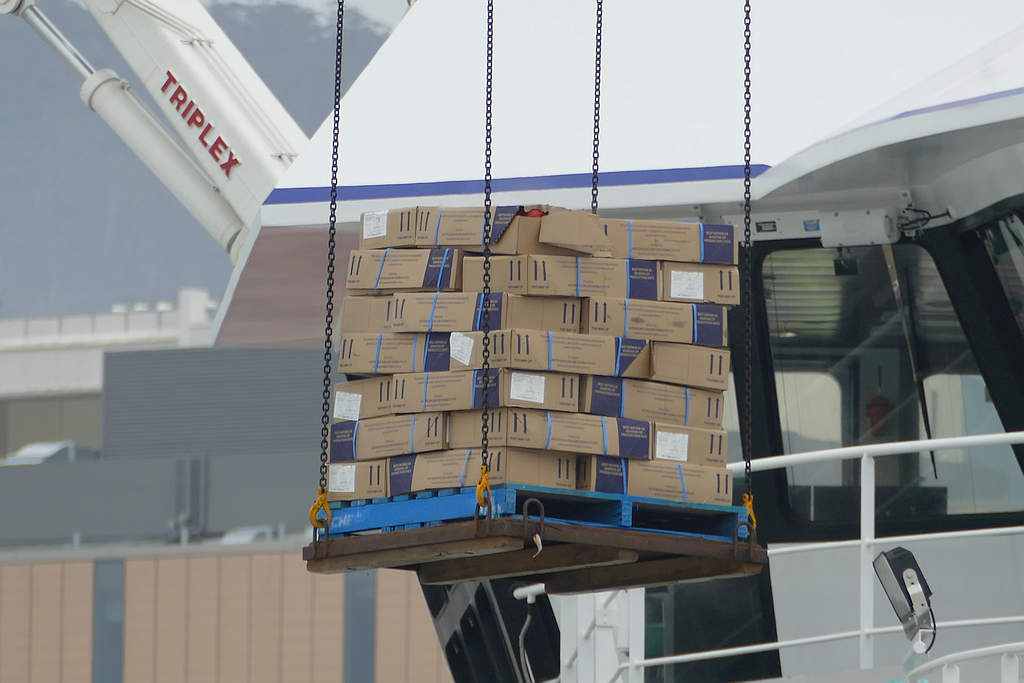
This boat’s here and unloading their catch today. Why should this issue matter to the residents of Hobart and Tasmania?
Alistair Allan
So for me, I think Hobart has a wonderful Antarctic history, and we have a wonderful Antarctic future.
We are a gateway city, we’re recognised as a gateway city. And we should be pushing for the protection and responsible stewardship of Antarctica. I think Hobart can play a really good role in that.
What we’re not is a port for an Antarctic plunderer like the Antarctic Aurora to arrive, unload its catch, and continue to exploit the Antarctic ecosystem. That’s just not what Hobart should be. We should be about protecting and conserving Antarctica, because it certainly faces challenges. And I think Hobart can play a great role in helping protect Antarctica
Tasmanian Times
So what’s next in this campaign? What else do you do to try to halt this currently legal but as you say should-be-ended fishery?
Alistair Allan
So the legal toothfish industry is regulated by two different bodies. There’s AFMA which is the Australian Fisheries Management Authority. And there’s also CAAMLR, which is the global governments of marine and living resources down in Antarctica. To see these fisheries end, we really need to put pressure on both of those those regulators to say, ‘Look, this is a fishery that contributes nothing to global food security, and we should be protecting them and protecting as much as we can of Antarctica’. For our campaign that’s going to be keeping pressure on the Australian operators. It’s not just this company. There’s another company called Austral Fisheries as well that operates primarily out of Fremantle, and we’ll be just letting them know that Hobart is not the place that we want them to unload their plunder.
Tasmanian Times
Within CAAMLR, has Australia been arguing for or against the continuation of this fishery?
Alistair Allan
So in CAAMLR, actually Australia has been pushing to say that ‘Yes, this is a well regulated and a well managed fishery’. There’s a lot of effort that goes into saying that it is, they do science and other work. The question isn’t really is it well regulated and is it controlled? The question for us is to say is, should this be taking place in Antarctica at all? Does this fishery have a need or a place? Or is it simply just a profit-making exercise of something that should be protected?
Tasmanian Times
If we can go to Japan. After a hiatus it appears Japan now has an interest in resuming whaling operations in Southern Ocean around the edge of Antarctica, what’s your position on that?
Alistair Allan
So for me personally – I actually worked for Sea Shepherd before I did this role, so I’ve actually gone down and confronted the illegal Japanese as well as when they were doing whaling previously – much like toothfishing, whaling has no place in Antarctica. Our position as a foundation would be adamantly opposed to Japan resuming whaling down in Antarctica. It is a whale sanctuary. It is critical for for whales and their habitat. Whales are only just recovering from the huge plunder that was a hundred years ago, those numbers are only just coming back. So it’s crucial for the the Antarctic ecosystem to have that left well alone; like toothfish, like krill, like whaling, Antarctica just needs us to back off.