Featured - Row 1
Tas That Was – The Old Curiosity Shop
Learn all about the Old Curiosity Shop at Port Arthur!

If you’ve visited Port Arthur, you’ve probably seen some of the convict-era relics that were once housed in the ‘Old Curiosity Shop’, owned and operated by William Radcliffe and his wife, Dora.
Even though it was called a shop, none of its artefacts were for sale. It was purely a museum.
*
William was born in 1894 at Montagu Bay and grew up in the Richmond area.
His grandfather, James Radcliffe, was a convict, transported for fourteen years for “stealing from a person” (date unknown). It was probably because of this that William developed a keen interest in Tasmania’s convict system.
He cut sugar cane in Queensland for a period of time before moving in 1924 to the Tasman Peninsula, where worked at a saw mill before accepting a pastry cook position at Gathercole’s Bake House. He eventually bought a plot of land next to the Penitentiary at Port Arthur and opened his own pie shop on it.
Port Arthur was stripped bare by government auctions and souvenir hunters shortly after it closed, so the site hardly any objects and equipment from the convict days during the early twentieth century. When William was digging the foundations of his pie shop, though, he uncovered a number of leg irons. Later, some of his customers expressed interest in these relics, giving him the idea for a museum.

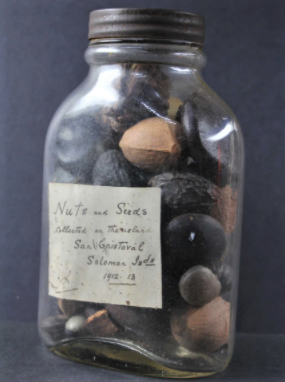
Nuts and seeds from the Pacific ended up in the Radcliffe Collection.
He collected more artefacts from the convict period (buying most of them from estate sales) and built the Curiosity Shop (a four-room building at the back of his house) himself. Before the introduction of electricity to the Tasman Peninsula, the museum was provided with constant light from a diesel engine and a dynamo.
William was assisted in his endeavour by “a little divvy” from Tattersall’s Lottery.
The Curiosity Shop became quite a major drawcard for visitors to the former prison settlement. Its relics included leg irons, chains, and guns. It also boasted exotic items like Chinese soya sauce bottles, seeds from the Pacific, and even a chunk of rock from Pompeii!
While operating the museum in the 1930s, William tended to fictionalise historical facts for reasons of discretion. Tour guides at Port Arthur today do no such thing. Historical accuracy is paramount to them.
William died of Peritonitis in 1943, aged just forty-nine. His wife was pregnant with their sixth child at the time.
During the 1950s, the museum was relocated to the growing township outside the historic site.
*
Dora Radcliffe was born in 1907. She lived with her family in a cottage that was once the home of William Smith O’Brien, who served time at Port Arthur as an Irish political prisoner.

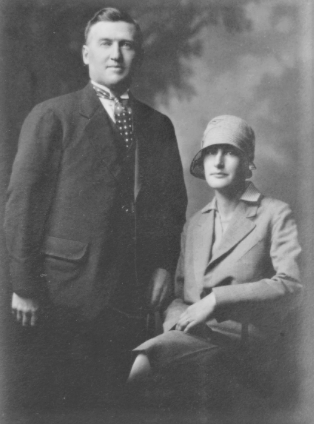
William and Dora Radcliffe.
As a young woman, she used to row three miles (4.8 kilometres) across the bay at Port Arthur to take her father to work at the sawmill — and then rowed back!
She met William at a local dance when she was sixteen-years-old. They fell in love and entered into a relationship, but waited till Dora turned twenty-one to marry.
After William died in 1943, Dora ran the Curiosity Shop by herself.
Her son, Stuart, said in 2019:
“Mum had no idea how to run the museum, and when Dad died, she had a very steep learning curve.”
“She just rolled up her sleeves and took on what needed to be done.”
Dora eventually started struggling to maintain the Curiosity Shop. She ended up closing it in 1972. Only a portion of its artefacts went to the Port Arthur Historic Site. The rest was put to auction and bought by multiple state entities.
The museum was the longest-running tourism business in the Port Arthur area at the time it closed.
Dora actively participated in the Port Arthur Conservation and Development Project before passing away in 1985.
Legacy
William and Dora played a vital role in building Port Arthur up as a tourism destination. Their legacy lives on throughout the historic site today.
I’ve been a frequent visitor to Port Arthur since 2010, so you can trust me when I say that you can’t turn a corner there without seeing the name ‘Radcliffe’.
You can view convict-era artefacts from the Radcliffe Collection in the two current museums at Port Arthur.
Fun fact
William Radcliffe wrote an historical guide to Port Arthur, which you can read here.

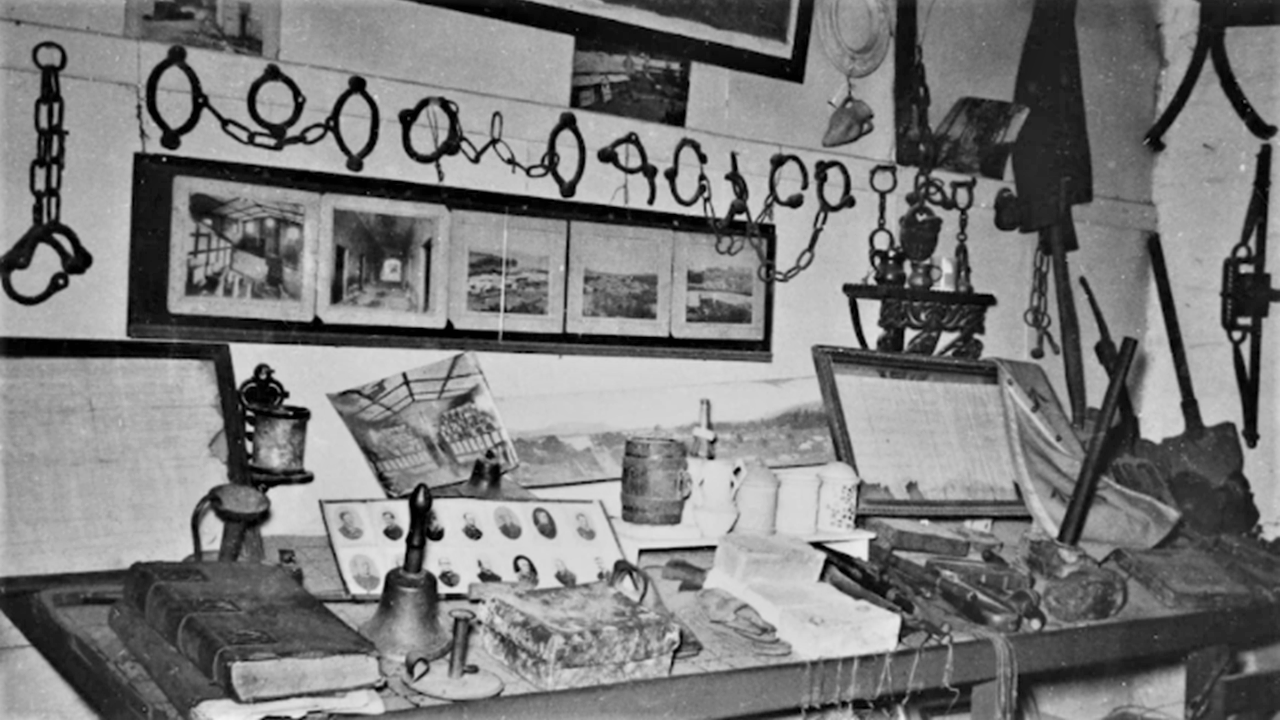
The Old Curiosity Shop was cluttered with exotic and convict-era items.
Acknowledgement
Susan Hood, the manager of Port Arthur’s Resource Centre, kindly provided me with useful information about the Radcliffes and the Old Curiosity Shop. Thank you, Susan.
Bibliography
- Burgess, Georgie (2019) ‘Port Arthur tourism legacy is proud product of Radcliffe family collection’, ABC News, viewed 15 March 2021.
- Thomas J. Nevin | Tasmanian Photographer (2007), ‘The Old Curiosity Shop’, Thomas J. Nevin | Tasmanian Photographer, viewed 15 March 2021.
- Weidenhofer, Maggie (1990), Port Arthur: A Place of Misery (second edition), Oxford University Press, Tasmania.
- Allison, Brian (1995), ‘Radcliffe’s Curiosity Shop: Exhibition Notes’.
* * * *
Tas That Was is a column that includes:
- anecdotes of life in Tasmania in the past;
- historical photographs of locations in Tasmania; and/or
- documentaries about locations in Tasmania.
If you have an anecdote or photograph you’d like to share with us, please send it to submit@tasmaniantimes.com.