History
The Federation of Australia
Learn all about Australia’s federation movement!

The federation movement in Tasmania was a politicians’ movement. They were the ones who drove it. The public simply voted for the new constitution.
Before federation, all Australian states were British colonies. They each operated like six separate countries: they had their own government, laws, and defence force. Tariffs were even collected on goods that crossed the borders. The system was inefficient, and many colonists had realised this by the 1880s. They believed that a national government was needed to put an end to it.

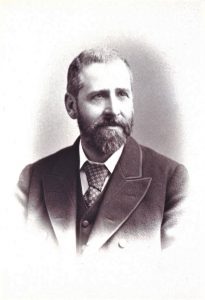
Andrew Inglis Clark.
Tasmanian interest in Australian federation began in 1856, when self-government was achieved.*
In 1857, the Tasmanian government appointed delegates to an intercolonial conference on federation, but it was never held.
In 1889, New South Wales premier Henry Parkes made the now famous Tenterfield speech (see below). In it, he called for a federal convention to draft a constitution for Australia.
A convention was eventually held in Sydney in 1891. Among the delegates was Tasmanian Andrew Inglis Clark, who came prepared with a draft constitution of his own. He said of Australian independence:
“We are proud to have sprung from the same race as the inhabitants of the British Isles. I believe, however, that it is our destiny to produce a different type of manhood from that which exists in those Islands. It is political autonomy we are now asking for Australia as a whole.”
The delegates took Clark’s draft constitution back to their colonial parliaments for consideration and approval, but enthusiasm for federation was eventually lost due to an Australia-wide economic depression. This led the Mercury to declare in 1891 that the movement was dead.
People must have regained their enthusiasm for federation, however, because three more federal conventions took place. A new constitution was written and put to referendum in 1898. Though it failed, Tasmania achieved an affirmative vote of 81 percent.

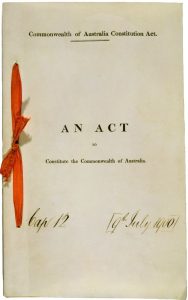
The Constitution of Australia.
The constitution was amended and put to a second referendum. This time it was successful, with Tasmania achieving an affirmative vote of 94 percent – the highest in the Australian colonies! Of the 96 sections in Andrew Clarke’s draft constitution, only ten failed to find a recognisable counterpart in the final constitution.
The ‘Commonwealth of Australia Constitution Act’ was passed by the British Parliament in 1900. The Commonwealth of Australia was officially established in a ceremony at Centennial Park in Sydney on 1 January 1901.
Tasmania struggled financially after federation. It eventually became the first state to seek financial assistance from the commonwealth. Section 96 of the Constitution permitted it to do so.
* According to Merriam-Webster’s Unabridged Dictionary, self-government is when a government is under the control and direction of the inhabitants of a political unit instead of an outside authority.
The Tenterfield Speech
“I can not find words with which to acknowledge your toast to the Ministry and myself, without remembering the time when I stood for a short period in intimate relationships with you, as the Member for Tenterfield. This was one of the passages of my life that is not likely to fade away as I remember how generously you elected me within a few hours of my defeat for East Sydney in 1884. I also remember the generous confidence you showed in refusing to accept my resignation on the occasion of my thirteen-month visit to England.
There are two important questions towards which your attention ought to be directed. You must have heard something of the Federal Council, on which NSW has not yet taken a place. It sat in Tasmania and held sessions which never appeared to interest any one. But if we are to carry out the recommendations of General Edwards on matters military, it will be absolutely necessary for us to have a central authority, which could bring all the forces of the different colonies into one army.
Some colony statesmen have said that this might be done by means of the Federal Council. But this Federal Council has no power to do anything of the sort. It is not be an elective body, but merely a body appointed by the governments of the various colonies. Their argument, therefore, is necessarily weak, and under the Imperial Act which appointed it, the Federal Council has no power to set up or control a great Australian Army. The Federal Council has no executive power. It may propose but not execute. I would like to know what would become of an army without a central executive power to guide its movements. One way which has been suggested out of the difficulty is that the Imperial Parliament be asked to pass a measure authorising the troops of the colonies to unite in one federal army. But still, even if this were done, there would be an absence of the necessary executive government. The colonies would object to the armies being under the control of the Imperial Government and none of these colonies could direct it.

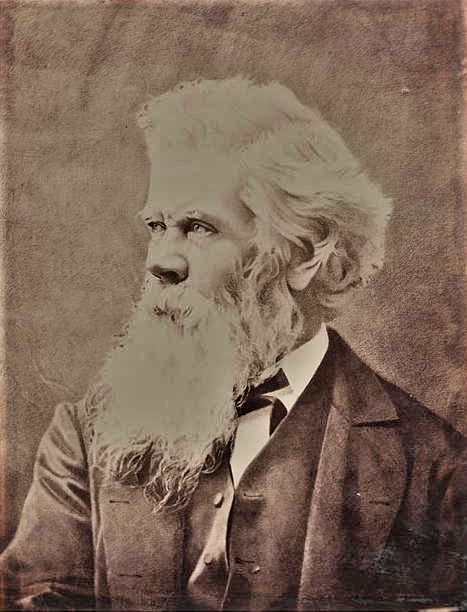
Henry Parkes, orator of the Tenterfield Speech.
The great question which we have to consider is, whether the time has not now arisen for the creation on this Australian continent of an Australian government and an Australian parliament.
To make myself as plain as possible, Australia has now a population of three and a half millions, and the American people numbered only between three and four millions when they formed the great Commonwealth of the United States. The numbers are about the same. Surely what the Americans have done by war, Australians can bring about in peace. Believing, as I do, that it is essential to preserve the security and integrity of these colonies, then the whole of our forces should be amalgamated into one great Federal army. Seeing no other means of obtaining these ends, it seems to me that the time is close at hand when we ought to set about creating this great national Government for all Australia.
This subject brings us face to face with another subject. We have now, from South Australia to Queensland, a stretch of about two thousand miles of railways and if the four colonies could only combine to adopt a uniform gauge, it would be an immense advantage in the movement of troops. These are two great national questions which I wish to lay before you: one great federal army and a nation wide uniform gauge railway line.
I have just returned from Brisbane, and the object of my business has been not to force my advice on the authorities there, but to discuss with them these matters. Unfortunately, owing to the illness of the Head of Ministry, our communications were rather of a private character than otherwise. But without disclosing any confidences, I think that both sides of politics sympathised warmly and closely with the views, which I expressed to them. As to the steps, which should be taken to bring about the foregoing, a conference of authorities has been suggested but we must take a broader and more powerful action on the initiation of this great council. We must appoint a convention of leading men from all the colonies. Delegates should be appointed by the authority of Parliament and fully represent the opinion of the different parliaments of the colonies. This Convention will have to devise the Constitution which will be necessary for bringing into existence a Federal Government with a Federal Parliament for the conduct of this great national undertaking.
The only argument which could be advanced in opposition to the views I have put forward, is that the time has not come and that we must remain isolated colonies, just in the same way as we are now. I believe, however, that the time has come; and that, in the words of Brunton Stephens, the Queensland poet: – I ask:
“Not yet her day! How long? Not yet!
There comes her flush of violet!
And heavenward faces all aflame,
With sanguine imminence of morn,
Wait but the sun’s kiss to proclaim
The day of the Dominion born.”
I believe that the time has come, and if two Governments set an example, the others must soon of necessity follow. There will be an uprising in this fair land of a goodly fabric of free Government, and all great national questions of magnitude affecting the welfare of the colonies will be disposed of by a fully authorised constitutional authority. This means a distinct executive and a distinct parliamentary power for the whole of Australia, and it means a Parliament of two Houses, a House of Commons and a Senate, which will legislate on these great subjects.
The Government and Parliament of New South Wales would be just as effective as now in all local matters, and so would the Parliament of Queensland. All great questions will be dealt with in a broad manner just as the Congress deals with the national affairs of the United States and as the Parliament of the Dominion of Canada deals with similar questions.
The opportunity has arisen for the consideration of this great subject and I believe that the time is at hand… when this thing will be done. Indeed, this great thing will have to be done, and to put it off will only tend to make the difficulties which stand in the way, greater.”