Article
Tribute – Dr John Hargrave

Dr John Hargrave MBE, AO, a true legend and a pioneer in the development of Health Services and Microsurgery in the Northern Territory, passed away peacefully in Hobart on 6 August 6, 2020.
He was well-known to many in Tasmania and the Territory, among the medical community, and of course by the many people whose lives he touched.
A truly humble and modest man, Dr Hargrave never spoke about his awards. On Australia Day 1995, he was appointed an Officer of the Order of Australia. He had previously been appointed as a Member of the British Empire.
The citation on the Australian Honour read: “For service in the treatment of Leprosy and in the fields of Reconstructive Surgery and Microsurgery.”
Dr Len Notaras who was the CEO of the Royal Darwin Hospital during Dr Hargrave’ s time in the Territory, writes: “If ever there was a living saint and icon of surgery, it was John… A reserved and unassuming man who epitomised humility and a genuine commitment to the Northern Territory and to Aboriginal Health. A true humanitarian uninterested in recognition or reward. Almost single handedly, as a pioneer in vascular and microsurgery, he worked selflessly to reverse procedures that had seen such interventions as sterilisation in young women.”
Dr John Hargrave was born in Perth in 1931. He graduated in Medicine from South Australia.
A new chapter in the history of the Northern Territory began when Dr Hargrave arrived as a Medical Officer at Darwin Hospital in 1956. He enthusiastically took up the task of carrying out the health surveys in all the Aboriginal settlements and Missions in the NT He was the first to record at a population level the crises in Aboriginal Health which included a vast amount of treatable medical and surgical conditions. He was referred to as the first Aboriginal Health Medical Officer. Many years later in 1985, Dr Hargrave was appointed as the first Director for Aboriginal Health in the Northern Territory.
Back in 1957, during his health survey in Maningrida, Dr Hargrave diagnosed a large number of people with leprosy. This led to his keen interest in combatting leprosy. In 1959 Dr Hargrave was appointed as the Medical Superintendent of the East Arm Leprosarium, which was run by the NT Administration of the Commonwealth government and staffed with nuns from the Daughters of our Lady of the Sacred Heart (DOLSH).
Dr Hargrave emphasised that people with leprosy were merely sick and should not be considered criminals.
He changed the policy of forcing such people into isolation, sometimes even using police.
This change of attitude resulted in many more people being diagnosed and treated for leprosy. He established a Leprosy Register, set up an operating theatre and in 1962, introduced reconstructive surgery for leprosy patients, the very first in Australia.
In 1962 Dr Hargrave was granted a World Health Organization Fellowship to study leprosy in Southeast Asia. During this time, he trained with the world-famous leprologist and hand surgeon Dr Paul Brand, who was working at the Christian Medical College, Vellore, India. He learned reconstructive surgery there, transplanting tendons to correct foot drop, and restoring movement in fingers and thumbs. He was soon able to use these surgical skills in the East Arm Leprosarium.
New treatments, curative drugs and surgical reconstructive procedures led to the closure of the East Arm Hospital in 1982. People were now getting treated in regular clinics and hospitals. Leprosy has been controlled and maybe even eradicated in the Northern Territory.
The history of the Leprosarium written by the sisters of DOLSH states: “His personal drive and dedicated interest have been responsible for much of what has been achieved with regard to advances in treatment and liberalisation of policy regarding segregation.”
Dr Hargrave trained a number of Aboriginal health care workers in the screening and treatment of leprosy which was a significant step in its understanding and control. Dr Hargrave’s education and training of patients and Aboriginal health care workers was an impetus for the Territory-wide Aboriginal Health Worker Training Program that was formalised by the Department of Health in 1976.
Dr Hargrave set up a sophisticated research laboratory to develop new blood tests for leprosy. He also used the lab to train young doctors in microsurgery starting with operating on rabbits. He trained several Aboriginal health workers in microsurgical techniques using the operating microscope. The Aboriginal health workers often assisted Dr Hargrave in the surgical theatre.
A lesser known aspect of Dr Hargrave’s great contribution was the formation of ASEA Rehab (Australia South East Asia Rehabilitation Foundation) comprising medical specialists and small volunteer teams of doctors and nurses led by Dr Hargrave. This Foundation carried out reconstructive surgery in Timor and eastern Indonesia. Here they were able to treat disabilities arising from leprosy, burns, poliomyelitis and congenital defects.
Aboriginal Health and surgical work in Timor and Indonesia were Dr. Hargrave’s passion till he retired and moved to Tasmania in 2000. Dr. Hargrave’s heart remained in the Northern Territory.
Dr. Hargrave not only promoted Aboriginal Health but had close ties and friendships which he cherished. The Eric Johnston lecture delivered by him in 1992 clearly shows his admiration for Aboriginal people.
“There are distinguished Aborigines like Gatjil Djerrkurr, Wesley Lanhupuy, the late Stanley Tipiloura, Galarwuyy Yunupingu, and the Reverend Djinniyinni, Jack Little from Bulla Camp, Eleanor Brooks, Daisy Yarmirr, Miriam Rose, Mathias Nemarluk, Charlie Gunabara and a whole host of others, warm, friendly, outstanding people … all of whom compete successfully with the world on its own terms and excel in their own right, and are still patently Aboriginal. Anyone who has worked with them will know all about the joy and all about the brilliant rays of light they shed on life.
These are the people who capture our imagination and set the world on fire. They don’t cry, ‘Poor Blackfella’. Instead their actions shout for all the world to hear: ‘Hey, look, I’m pretty good and I can do without your charity.’ But why are they so successful and what is the secret of their survival?
I am convinced that it is their unique ability to live by their own wits, without subsidy or favours, at the same time in both the ancient and a modern world. I am also convinced that it is now the only way Aboriginal Australia will ever achieve what it so much needs and what it so much deserves, which is, in fact, the best of both worlds.”
The Northern Territory Department of Welfare which was responsible for Aboriginal Affairs sent Dr Hargrave along with Ted Evans, a Senior Welfare Officer, and Jeremy Long, a Patrol Officer, to find the last of the desert dwelling Pintubi people. They feared they were riddled with disease, like the others who were now in government settlements.
At the end of an epic journey through the desert, where he met and examined several Pintubi people, Dr. Hargrave reported: “The nomadic Pintubi we saw are in no need of help.
We recommend that they should be left alone, and no attempt be made to induce them to come into more settled parts.”

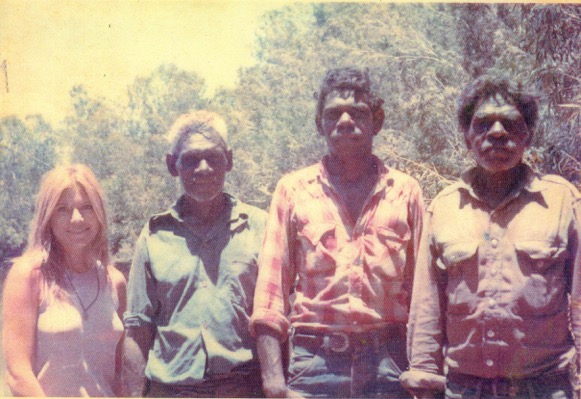
Bulla Camp mob back in Hargrave’s day. Jan, Bobby Widitburu, son Laurie, and Dickie. Image courtesy Rob Wesley-Smith.
In closing, we quote Jack Little, Senior Elder from Bulla Camp, and a close friend of Dr Hargrave… as recorded in Margaret Carroll’s book Ordinary people, Extraordinary Lives.
Jack’s hand went numb in 1958 when he was 29 years old. After Dr Hargrave operated on his hand at the East Arm Leprosarium, Jack Little said: “This hand, a hand of help. It can do anything now.”
Under Dr Hargrave’s guidance, Jack specialised in Leprosy Care. “If it wasn’t for Dr Hargrave, I would not know how to look after my own people. I never saw a doctor doing such wonderful things to help Aboriginal people. Not only that, he can talk half a dozen languages, my language too.”
It opened up a way to see Aboriginal people working with government departments and turned around attitudes to medication (and health).
The work and legacy of this remarkable man: doctor; surgeon; educator; and humanitarian who transformed attitudes and lives of Territorians, will live on.
This obituary was compiled by Dr Dayalan Devanesen, AM and Heather Boulden.