Economy
Criteria for Stimulus & Structural Support Needed for Economic Recovery

Having spent $200 billion to stabilise the economy during the COVID-19 crisis, new research shows it is now time for the federal government to roll out structural supports—projects that are labour intensive, rely heavily on local supply chains and deliver lasting benefits.
The Australia Institute has released a new report, detailing key economic criteria to help assess the effectiveness of the future stimulus measures and structural support needed to recover from the COVID-19 economic crisis.
“Despite the wage subsidy, cash grants and loans to business, the number of unemployed people in Australia is expected to rise sharply—a wide range of government programs will be needed to create jobs for all of those people,” said Matt Grudnoff, Senior Economist at The Australia Institute.
Because tourism and international education have been badly impacted, he aruges, Tasmania is going to need some stimulus from the federal government that is targeted in affected areas.
“What’s interesting is that this is not a traditional economic crisis,” he told Tasmanian Times. “Usually at this time in a downturn the government would be encouraging people to spend, go out and inflate demand. They’re doing the exact opposite – shutting everything down – which I completely agree with for very good health reasons.”
He observed that workers in areas like local government are being laid off just like people in other industries. “This takes dollars out of the Tasmanian economy at a time when demand is falling.”
“This is a great time for the government to target tourism infrastructure and carry out upgrades,” Grudnoff suggested. “Right now we have the advantage that ‘how much will it cost and where will the money come from’ are not the issues at the moment.”
Their research examined the best way to create jobs now, and a better economy for the country in the future. A key conclusion is that governments should focus on projects that are labour intensive, rely heavily on local supply chains, and that deliver long lasting benefits.
He said projects that are labour-intensive make very good stimulus. “If you put a $100 million into the resource sector compared versus the same amount into upgrading tourism, you would get a lot more job creation out of the latter,” he stated.
He said the key will be to think creative, be targeted, and focus on things that will create lots of jobs and have lasting benefits. An oversight body should adopt ‘a principled structure by which projects can be assessed’, which is why TAI had demonstrated an approach.
“Governments generally don’t have a great track record on handing out money; sports rorts was an example of that, so you don’t want to be leaving too much to ‘discretion’ of ministers.
And there should be a lot of local government input because they are the organisations that know which areas are hurting the most and where to get the best bang for your buck.
Rather than a top down thing, it would be good to have state-level committees looking at impacted sectors and working out how to get most benefits.”
He gave the example of art deco beach bars that were constructed around Australia during the Great Depression to create work, and had provided a lasting social and cultural impact.
What did we learn from the Rudd stimulus package?

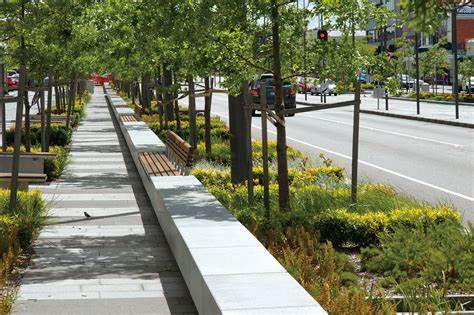
Urban beautification ticks a lot of boxes.
“That stimulus spending worked brilliantly well, from an economist’s point of view,” he said. “What we learnt is that projects need to be short, medium and long term. The government’s focus has been short term so far, but I don’t they have turned their mind yet to longer need for stimulus spending. That’s an important part of it.”
Some big infrastructure projects will be too slow and rely on too much heavy equipment to create many jobs, he noted, while some job creation programs keep people busy but deliver no lasting benefits to the community. “Spending lots of money is a lot easier than creating a lot of jobs, and a stringent criteria to evaluate spending measures would ensure that taxpayers get value in both the short term and in the long term.”
“If the jobs that governments create in the coming year deliver lasting benefits, as we have outlined, Australia won’t be ‘saddled with debt’ it will be blessed with new assets, and the public can be certain that taxpayer money is being well spent with long-term benefits.”
The paper argues that, in designing subsequent rounds of fiscal stimulus, governments should consider these principles:
- Go early: timeliness of the stimulus is key
- Go hard: size of the stimulus is important
- Go households: tut purchasing power with households who are more likely to spend it
- Target domestic production
- Target activities with high direct employment intensities
- Target those most impacted by the crisis
- Target useful projects that deliver co-benefits
- Target regional disadvantage
Read the full report: Design Principles for Fiscal Policy in a Pandemic.

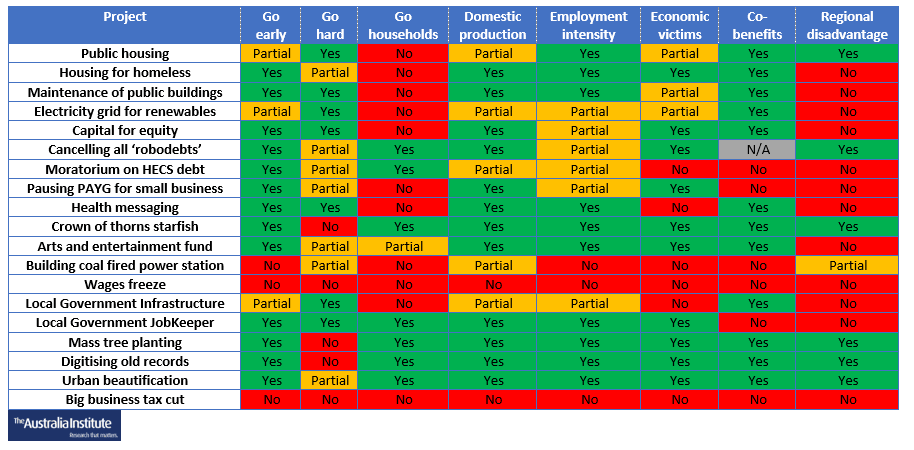
The Australia Institute looked at 19 hypothetical stimulus projects and compared them against key criteria, listed in the report, to evaluate how effective each of them would be.