

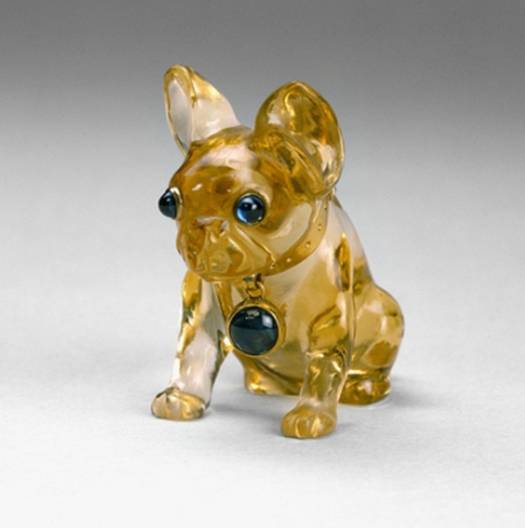
*Pic: Female French bat eared bulldog figurine Saint Petersburg, circa 1914. Possibly the House of Fabergé. Citrine, sapphires, gold; 4 x 2cm. The Moscow Kremlin State Historical and Cultural Museum and Heritage Site.
Part IV. Fabergé Hardstone French bulldogs from Imperial Collections. It is all in the ears. (Part 2) Ortipo
…
Ortipo
A third portrait statuette of a French Bulldog, this time a female puppy with bat-ears survives with a Russian probably Imperial provenance from 1922.

Female French bat eared bulldog figurine Saint Petersburg, circa 1914. Possibly the House of Fabergé. Citrine, sapphires, gold; 4 x 2cm. The Moscow Kremlin State Historical and Cultural Museum and Heritage Site.
This citrine bat-eared female French Bulldog set with sapphires was exhibited, along with a selection of magnificent Fabergé objects, at the Kunsthistoriche Museum in Vienna between February and May 2014. In an exhibition curated by Paulus Rainier (Vienna) and Tatjana Muntain (Moscow) this object is recorded in the catalogue as being seized by the Bolsheviks in 1922.
Although this bulldog statuette could have been owned by any of the wealthy members of the Saint Petersburg elite, I suggest it could represent Ortipo, the dog given to the Grand Duchess Tatiana by Dimitri Malama, bayoneted by the Bolsheviks along with the Imperial Family in 1916. It is understood that Ortipo, once full grown received a jewelled collar made especially for her by Carl Fabergé. This collar if found with a similar shape would provide a key to possible ownership.

Photograph: Spring 1917. The last known photograph of the Romanov daughters working in the garden, Ortipo is in front of the Grand Duchess Tatiana extreme right and Jimmy a King Charles Spaniel centre with Anastasia.
If indeed the statuette belonged to Tatiana, it may have been a gift from a family member, possibly Prince Felix Yusupov and his wife, Tatiana’s cousin Princess Irina. Yusupov, on visiting Elizabeth Balletta would have seen the statuette of Cody. He also had plenty of time on his hands during 1915/16, whilst most of his peers where serving the war effort at the front or at home. Felix was able to avoid military service, taking advantage of a law exempting only-sons from serving. The Yusupov dynasty was plagued by the belief in a curse that stated only one male heir in every generation would survive. This had been the case for generations, Felix’s mother being the exception, and after the death of Felix’s brother, it is understandable that his family was wary of sending him to fight. He was to more than make up for this omission
Tatiana’s sister the Grand Duchess Olga, on visiting her cousin Princess Irina Yusupov in March 1915, writes to her father,
Felix is a ‘downright civilian’, dressed all in brown, walked to a fro about the room, searching in some bookcases with magazines and virtually doing nothing; an utterly unpleasant impression he makes – a man idling in such times’.
The citrine bulldog statuette is not of the same quality as Cody and Custer. Either, it was produced by Fabergé during wartime, the better carvers been absent, or more likely was ordered by Yusupov for another purpose and made by Cartier in Paris before the outbreak of war in 1914.
Prince Felix Yusupov poisoned and then shot Rasputin at his St Petersburg Palace on the Moika in December 1916 resulting in his immediate dismissal from court where he became persona non grata and was banished from St Petersburg. He and his wife finally escaped from Russia with the sister of Queen Alexandra of England, the Dowager Empress Maria Feodorovana, who was grandmother to Tatiana and his wife.
Two additional French Bulldog statuettes are worthy mention.
The two statuettes below are again French, tulip-eared Bulldogs by Fabergé and possibly part of a series. The first once part of the Hermitage Museum collection, whereabouts currently unknown and believed stolen. As with Custer, the dog wears a Romanov collar indicative of either commission or ownership. It is possibly the same size as Custer and Cody if so the colour of the stone used to create all three of these larger statuettes suggests that the firm was working closely towards a representation indicative of the colouring of each dog. It is again wearing a Romanoff collar.

The unsigned bulldog pictured below belongs to the collection of the Virginia Museum of Fine Arts. It does not appear to fit comfortably in the case, the collar does not seem correct for scale and the body is somewhat lifeless and the neck to large when compared to the larger studies. The fitted case has a lining stamped with ‘Imperial Warrant, St. Petersburg, Moscow, London’. It is of interest that many objects made for the personal use of the Romanov family are in cases without the imperial warrant, as with Custer.


Circa 1910. Aventurine, gold, enamel, emeralds. No provenance is given and a continuous and early documented provenance is important in such matters. Dimensions: Overall: 1 3/4 × 2 1/4 × 1 1/8 in. (4.45 × 5.72 × 2.86 cm). Object Number: 2003.188. Gift of Ernest J. Hillman Jnr. Collection Virginia Museum of Fine Arts
Further research by scholars from within the Russian archives will contribute to this most interesting subject as we move towards the centenary of the murder of the Imperial family and the bayoneting of Ortipo on the night of the 16/17th July 1918.
It was the end of an era for the creation of bespoke whimsical luxury objects made, irrespective of cost, by the incredibly skilful artisans employed by the House of Fabergé.
Custer and Cody, as portrait hardstone sculptures of favoured pets with their complete and important provenance will always send shivers down the spines of Romanov historians, Fabergé collectors and all connoisseurs of truly beautiful objects.
*John Hawkins was born and educated in England. He has lived in Tasmania for 13 years. He is the author of “Australian Silver 1800–1900” and “Thomas Cole and Victorian Clockmaking” and “The Hawkins Zoomorphic Collection” as well as “The Al Tajir Collection of Silver and Gold” and nearly 100 articles on the Australian Decorative Arts. He is a Past President and Life Member of The Australian Art & Antique Dealers Association. John has lived in Australia for 50 years and is 75 this year. In two of the world’s longest endurance marathons and in the only teams to ever complete these two events, he drove his four-in-hand team from Melbourne to Sydney in 1985 and from Sydney to Brisbane in 1988.










