Coroner & Legal
Smartphone addiction … are you hooked?

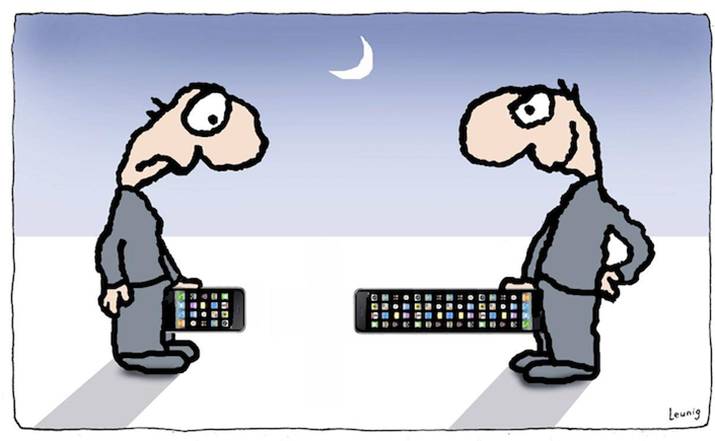

Satire: Leunig, http://www.leunig.com.au/ used with permission …
Are you feeling increasingly lonely, anxious and depressed?
Well it may be a sign that your device is controlling your life. So here we are in the 21st century, and suddenly modern society is faced with a phenomenal shift in the way we think, act and socialise using electronic communication.
However not all of it is good.
How long is it since you used your smartphone? There is a good chance that you are using it right now to read this article
The smartphone hasn’t been with us for very long, but on a human evolutionary timeline nothing has altered our thinking and interaction so dramatically than our neo-tech digital devices.
Clinical experts have defined screen addiction as digital heroin, which is having a devastating effect on many, particularly the young age group up to adulthood. Adulthood addiction is prominent, and this affliction is explained through limbic resonance.
https://www.psychologytoday.com/us/blog/digital-addiction/201112/the-online-social-experience-and-limbic-resonance
According to the new Mobile Consumer Habits Study, digital addiction goes beyond youth, and 9% adults admit that they use their phone whilst having sex, 12% during the shower, and 19% during times of worship.
And it expands through our everyday activities when up to 55% continue to do so whilst driving regardless of the law. 72% of people claim they are never more than a hand’s reach from their phone, and sexting appears to becoming rampant with older teenagers.
https://www.bulldogreporter.com/smartphone-mania-americans-cant-put-down-their-smartphones-even-during-sex-from-the/
Whilst most children in the developed world are now exposed to some form of digital screening at an early age, about 1 in 10 become strongly addicted, which changes their normal demeanour and character over a very short period.
Dr Nicholas Karadas, an addiction expert says, “Recent brain-imaging research confirms that glowing screens affect the brain’s frontal cortex, which controls executive functioning, including impulse control in exactly the same way that drugs like cocaine and heroin do.
Thanks to research from the US military, we also know that screens and video games can literally affect the brain like digital morphine”.
If screens are indeed digital drugs, then schools have become drug dealers. Under misguided notions that they are ‘educational’, the entire classroom landscape has been transformed over the past 10 years into a digital playground that includes chromebooks, ipads, smart boards, tablets, smartphones, learning apps and a never-ending variety of “edu-games”.
https://www.news.com.au/technology/online/kids-turn-violent-as-parents-battle-digital-heroin-addiction/news-story/12292c2f5a1b779a56697594b871f57b
Digital connection through social media has exacerbated FoMO, Fear of missing Out. This is a pervasive apprehension that others might be having rewarding experiences from which one is absent. This social anxiety is characterized by ‘a desire to stay continually connected with what others are doing’.
The FoMO epidemic has apparently exhausted so many that there is now a convergence for some to a new phase called JoMO. Joy of Missing Out, whereby, if possible, people shut off their devices and just chill out at home.
As with many forms of addiction, smartphone addiction is also something that often stems from other underlying emotional and psychological issues. It can be a side effect of depression or obsessive-compulsive disorder. Overuse of a handset can be a crutch that people with post-traumatic stress, attention deficit and social anxiety lean on too.
A recent Hong Kong study has revealed that 420 million people across the globe are addicted to the internet. Smartphone activity, particularly amongst the young is the main transmission.


The future
This whole new digital era has hit humans like a force 12 storm and without doubt it has set our social/interactive activity in a direction we have seemingly no control over.
Some countries have already reached broad-scale social disintegration through digital addiction, and this wave of neo-evolution is set to be a global epidemic throughout developed countries.
Many developed countries are attempting to address digital addiction issues but it seem the cause is moving at a much faster pace than the rehabilitation processes.
Technology addiction rehabilitation detox centres do exist in Australia, so if you want to plug back into life then there are available clinics, but there is nothing so effective and rewarding as downing the device and heading out amidst nature for a therapeutic walk.
*Ted Mead doesn’t have a smartphone but admits he spends more time online than he should. Fortunately for Ted he passes a great deal of his life outdoors without a device in tow. Ted is particularly concerned about the worldly digital connection having a negative effect on the natural connection, because the more that humans get alienated from the natural world the less likely they are to advocate for its preservation.