Economy
Wattle and Daub …




Chapter 4 of Katherine Boland’s Hippy Days, Arabian Nights …
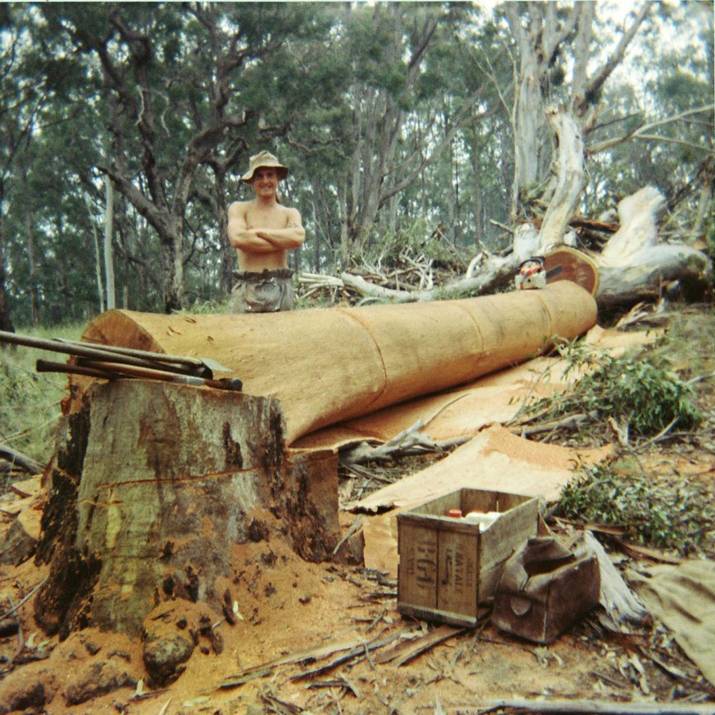
John Boland and tree …

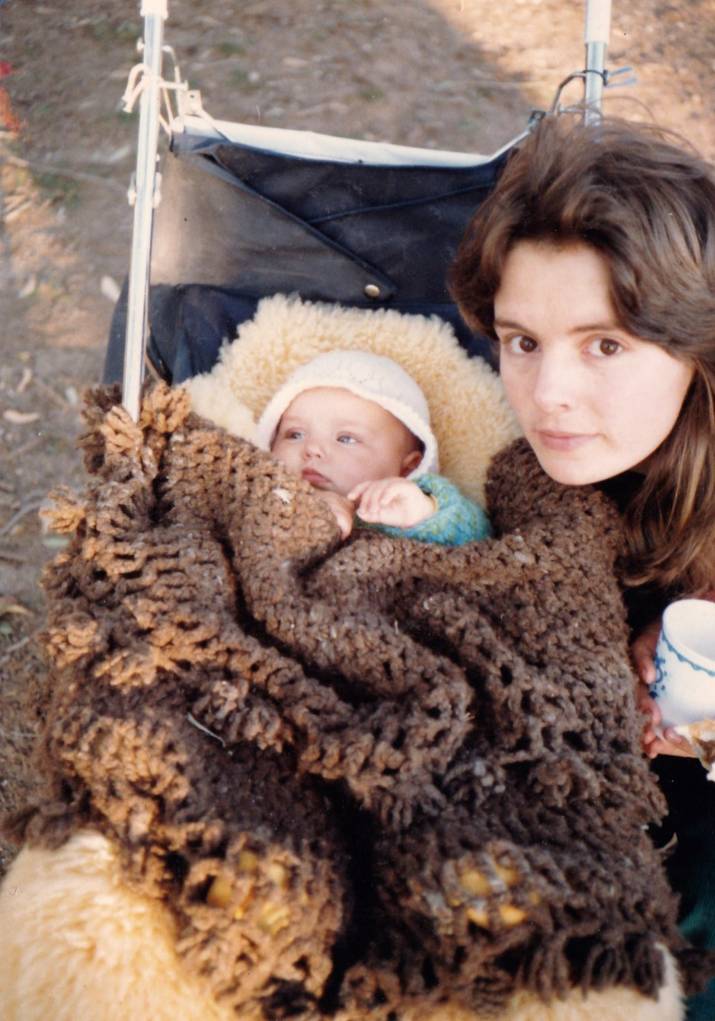
Katherine, Eva and a crocheted handspun wool blanket at Brogo in 1983 …

First published June 8
Wading knee-deep through a sea of tussocks and dead bracken, the dusky purple profile of Mumbulla Mountain was barely visible through the dense layering of trees. The whip-crack call of an unseen bird rang in our ears. After so long in the city, the yearned-for scent of the bush was intoxicating. Here we were. Actually walking on our land. Our land, we’d say at every opportunity, like lovers who can’t stop mentioning each other’s name. Back in Hopetoun Avenue, John and I had sat up in bed talking into the night about what we’d do and how it would be when we moved to the country. It was hard to believe we’d made it; that this hundred acres of bush in the Bega Valley, actually belonged to us.
We set to work within moments of arriving on the property, scraping back the undergrowth with our new tools, setting up the campsite and pitching the tent. This, we decided, was where we’d live until we constructed something more substantial further up the ridge. John connected the gas cooktop to its cylinder while I made up the bed and stocked our wood crates with canisters of tea, brown rice, lentils, oats, raw sugar and wholemeal flour. Our next priority was water and we filled four twenty-five litre plastic containers at the Brogo Dam, located a few minutes’ drive down Warrigal Range Road, and carted them home in the back of the ute.
It was late afternoon when John built the campfire, our limbs pleasantly aching from our labours and our hearts full with a sense of achievement. As the sun set behind the stringy barks, casting slender shadows over our small clearing, I heated a saucepan of water on the flames. With my back to the chilly autumn breeze and shivering with cold, I stepped naked and goose-pimpled into the basin of warm water, giving my face, armpits and crotch a cursory wipe with a wet cloth before quickly dressing again.
By now, we were ravenously hungry.
‘So hungry I could eat the arse out of a low flying duck,’ John joked as he threw a gnarled wattle stump on the fire.
Dinner was a few blackened potatoes and burnt-beyond-recognition sausages. On that first night on our land, land that only two hundred years ago was occupied by the Dyiringanj people, we sat in silence in the dancing firelight, eating our food and sipping our tea, watching as darkness fell over our magnificent domain.
‘We did it,’ I said turning to John, my eyes shining with tears.
‘Yes, we did,’ he said softly, putting his arm around my shoulders and planting a kiss on my smudged, still-grubby brow.
Our next job was to clear the bush to make way for a house site, an orchard, the vegetable garden, a workshop and, more importantly, with winter coming, some kind of shelter. A bulldozer and operator could have cleared the area in a week. But bulldozers were an expense we couldn’t afford and a gung-ho operator could wreak havoc in minutes. Our budget and ecological ideology demanded a thrifty and environmentally sensitive approach to land clearing. Blissfully unaware of what we were about to get ourselves into, we decided to undertake the mammoth task ourselves.
…
The new Stihl chainsaw (christened Stephen after Stephen Stills from the 70s rock band Crosby, Stills, Nash and Young) sat squarely on the ground. Like a bullfighter facing his opponent, my husband circled it warily, preparing for the moment of truth. Finally, donning his ear muffs and goggles, John gave me a confident thumbs-up, picked up the lethal weapon and marched over to a young sapling on the perimeter of the house-site. With my fingers in my ears, I stood out of the way, willing the beast to start, watching as John failed in his fervent attempts to engage the engine. At last, Stephen sprang violently to life. John placed the whirring bar against the base of the tree. Instantly, with a surprisingly loud crash for such a small and spindly structure, the sapling toppled to the ground.
‘Come and feel this!’ John yelled above the din of the chainsaw and reaching his side, he placed my hand on his chest. Despite the thick woollen sweater, I could easily detect the wild thumping of his heart.
Suddenly, I was overcome with grief. We’d just killed our first tree; a tree that up until we’d arrived on the scene was looking forward to a long and healthy life in its pristine environment. I looked around at the hundreds of trees we’d be chopping down in the following weeks and wanted to cry.
‘What’s wrong?’ my partner-in-crime asked when he saw my face. But when I told him how I was feeling, John just laughed.
‘Don’t worry,’ he said, slapping me reassuringly on the back. ‘I promise we’ll make good use of the timber.’
For the next few months, John and I spent every day from sunrise to sunset clearing the land and in time, I became inured to the sight of toppling trees. My lumberjack partner quickly graduated from lopping reedy saplings to felling huge stringy barks, yellow box and red gums, the constant whine of Stephen dominating the previously peaceful bush. Once felled, John cut up the crown of the tree into sections light enough for us to drag to the nearest stack of superfluous branches at the edge of the clearing. Attaching one end of a steel chain to a bush pole, we’d wrap the other end round our waists and, like human beasts of burden, haul the log to the stockpile at the top of the ridge. With the canopy of a fallen tree often covering an area the size of a basketball court, it could take all day to clear the leafy debris from just one casualty.
Next, we’d turn our attention to the tree trunk. The Skills of the Australian Bushman advised removing the bark as quickly as possible. First, you bash the bark with the butt of an axe, then perforate it with the axe blade. Ramming the crowbar into the perforation you prise, with all your might, the bark away from the timber and if it’s your lucky day, a miracle occurs. All of a sudden, the bark pops from the wood; before you lies an immaculate, virgin, ivory white pole, so beautiful you can’t help but touch its damp, milky flesh or bend to smell its tannin perfume.
If left too long, however, moisture evaporates from the log and the bark fibres stick like glue to the timber. That’s when the dreaded ‘draw knife’, a thirty-centimetre-long blade with handles at right angles on either end, came into its own. Standing astride the trunk, I’d hack the blade into the bark, then, drawing the knife towards me, strip it like giant curls of potato peel. It was a tedious and frustrating process and, as I was soon to discover, dangerous too.
One day, the draw knife jumped unexpectedly out of the bark and into my knee. Toppling sideways off the log onto my back, I clasped my wounded leg, rocking and howling on the saw-dust carpeted ground in agony. Once I realised I wasn’t going to die, trembling and in shock I got up to inspect the damage––an inch-long, clean-cut tear in my overalls. I couldn’t bring myself to roll up my trouser leg to see how seriously I was hurt but I could tell it was bad from the amount of ruby-red blood saturating my sock. This is going to need stiches, I thought. John was chain-sawing a log in the gully and hadn’t heard my screams so I hobbled, whimpering and snivelling down the hill to place myself in his range of vision. As I stood flapping my arms like a fledgling wedge-tailed eagle, he caught sight of me and switched off his machine.
‘I barked my knee,’ I squawked pitifully.
‘Shit,’ he said when he saw my blood-soaked sock. ‘Let’s go and see Charlie. It’ll take too long to get to the hospital.’
As luck would have it, we’d met the doctor from Sydney in the laundromat in Bega the week before. With a fervent desire to escape the city and get back to nature, Charlie had just moved with his young family into a run-down dairy on a neighbouring property. Clearing the breakfast dishes from the kitchen table when we turned up unexpectedly at his ramshackle residence, he asked his wife to fetch a needle and thread. As I lay on the table top, clenching a rolled-up tea towel between my teeth, the neighbourly medic dabbed my knee with Dettol, sutured the wound with a few rough stitches of black cotton and wrapped it with a muslin bandage. Charlie’s wife made me a cup of chamomile tea while the men smoked a joint and then John and I drove home. That afternoon, albeit with a bit of a limp, I was stripping the bark from another stringybark log.
‘You’re a legend,’ said John with a grin as he picked up the chainsaw and headed back into the bush, my feathers ruffling with pride.
Ripping out fence posts from a barked log takes skill. However, following a few aborted attempts that produced some weird and wonderful configurations, John was able to churn out straight and true specimens in rapid fire succession. Expertly, he’d score the length of a pole with the chainsaw, placing three or four large iron wedges along the groove. Wielding the sledge hammer, John would drive the wedges into the heart of the timber and in two or three strikes, you’d hear it––the satisfying crack of splintering wood. A beautiful new fence post was born.
A gruelling three months later, we’d cleared approximately two acres of bush, our immediate reward being a panoramic view of Mumbulla Mountain. But there was incriminating evidence all over the murder scene; a minefield of tree stumps contaminated the landscape. This was a job for Dynamite Man.
Ray Wheeler was one of those elderly, stocky, bow-legged blokes with chapped, sausage-fingered hands and a paunch belly.
‘You’ve got some pretty big stumps here,’ he declared, stating the bleeding obvious as he scanned the clearing.
Ray set about the delicate task of laying sticks of dynamite around the base of each stump, John trotting around behind him, picking the old-timer’s brains about anything and everything to do with explosives. After a few hours of concentrated effort, it was time to blow things up. Ray directed us to take cover and, like a pair of excited little kids, John and I hid behind a stack of fence posts. The explosions were tremendous. Looking up, we watched as a shower of wood and earth particles rained down on the land, the caustic smell of gunpowder infusing the air. Ray gave us the thumbs-up and we stepped out to survey the considerably altered landscape. The dynamite had worked a treat. Where there’d been unsightly stumps protruding from the ground, now there were large craters pockmarking the slope.
…
Before we knew it, the winter of 1980 was upon us and we were cold and fed-up. In the blustering icy wind, the tent became a torture chamber of wildly writhing and flapping canvas. Some nights, to avoid our flimsy refuge being blown away altogether and ending up in the South Pacific Ocean, we’d tie back the window and door flaps to allow the ferocious squalls to pass through unobstructed. It was dark by five o’clock so we’d take to our bed by six, reading the appropriately titled, Les Miserables, to each other or trying to listen to Alistair Cooke’s Letters from America on the ABC above the howling gale. We desperately needed shelter; we had six hundred dollars stashed in a battered Arnott’s biscuit tin under the bed.
Not letting a trifling matter like poverty stand in the way of progress, we decided to build a mud hut. Wattle and daub, a construction method dating back to the Neolithic Period, involves daubing a lattice of wood stakes with a mixture of wet mud and straw. As a structure made of mud costs virtually nothing to build, it was a perfect choice for a pair of destitute, contemporary Stone-agers like ourselves. Without considering that we may need council approval, we drew up a floor plan and got to work on our mud humpy.
To start with, we dug a dozen deep holes in the ground. Once the bush poles were erected, we raised the plates and rafters; the tray in the back of the ute serving as a scaffold platform.
‘Hurry! I’m going to drop it!’ I’d scream, teetering on the top rung of the ladder, struggling to hold the unbearable weight of a lengthy, unseasoned pole as John made his fastidious measurements.
‘Hang on,’ John would calmly respond, ignoring my distress as he held up his ruler, marked the timber with a pencil, re-measured and re-marked before finally making his cut with the chainsaw. Measure twice, cut once was my husband’s obsessive-compulsive motto and on numerous occasions it would almost be the death of me.
It was my job to collect the wattles. Setting out soon after breakfast, I’d tramp through the bespangled, dew-drenched bracken and native grasses in search of a stand of slender saplings––a truffle-like perfume of leaf mould issuing from the damp earth, the last wisps of grey mist diffusing into the ether; all around me, the ear-piercing, incessant chiming of bellbirds and the cackling of kookaburras cracking themselves up. With the wan wintery light filtering through the blue-green canopy of gum leaves above, I’d spend my day felling wattles with the bushman’s saw and lopping off the extraneous branches with a hatchet. At smoko, I’d unwrap the apple and cinnamon pikelets made on the campfire the night before and pour myself a cuppa from the thermos. Then sat on a lichen-speckled log I’d sip my tea and listen to the faint tap-tap of John’s mallet as he chiselled out a mortice in the distance. One day, alone in the gently rustling bush, it dawned on me: I was actually living in McCubbin’s Pioneer triptych, the painting that had captured my young and impressionable heart as an art student in Melbourne and smiling quietly to myself, I drained my mug, polished off the last of the rubbery pancakes and got back to work.
By the end of the month, we had an impressive bundle of wattles stacked neatly onsite and John and I began to attach the stakes, one above the other to the corner posts of the building. Next, we stretched chicken wire over the timber framework. Then came the ‘daub’: a combination of soil, straw and water agitated together in the cement mixer. Working side by side, we toiled through the afternoon, pressing our sticky wads of mud between the gaps in the saplings. However, as the sun’s last rays crept from the valley, we watched in dismay as, before our eyes, the panel we’d just finished constructing, swayed and buckled before collapsing in a graceful faint at our feet––our mixture obviously far too wet.
Once the walls were up, we clad the roof with two hundred dollars’ worth of brand-new, glinting-in-the-sun sheets of corrugated iron. Now we needed a low-cost solution for the floor. John had a brilliant idea. He cut some rounds of wood, like giant slices of salami from a red gum trunk in our stockpile, spread a layer of river sand on the ground, covered it with sheets of black plastic and placed the timber disks on top; me coming along behind, tamping a pungent paste of fresh cow manure and sawdust into the crevices between the disks. Over time, however, the mortar dried out and sank. Five years after it was laid, the floor became an obstacle course for our daughter as she was learning how to walk; her little foot getting lodged in a crack and pitching her head first onto the hard timber floor. Holding her screaming in my arms I watched as a purple lump, the size of a hard-boiled egg, sprouted on her forehead. From then on, until the cracks were refilled, my sensible toddler relegated her walking practice to carpeted surfaces and level ground.
In the beginning, our life in the lightly-populated dairy-farming parish of Brogo was hermetic; contact with our conservative National Party neighbours a rare and unlooked-for occurrence. As forerunners of the new settler community, it wasn’t until months following our arrival in the valley that like-minded couples, like Charlie and his wife, began to flood in from either Sydney or Melbourne. Not that we minded or even noticed, so engrossed were we in pursuing our self-sufficiency agenda. But it was a treat to get a visitor, to have a conversation with another human being other than a monosyllabic sales assistant in Bega or the pimply youth, good-natured but no intellectual giant, pumping petrol at the Caltex depot on the edge of town. Frank made a visit as did John’s sister, Kay. Although they didn’t say so, I think they were shocked by our primitive living conditions. Both born and bred in the country, they weren’t sissies when it came to doing it tough but John and I had taken the concept to a whole new level.
There was still a bit to do to make our mud dwelling habitable but one day disaster struck and we had no choice but to move into the unfinished building overnight. In a nice surprise, my mother and Lisa dropped in for a visit. John and I were at a critical juncture installing the Pittsburgh pot-belly stove so offering to make us a cup of tea, Lisa wandered down the hill to boil the billy. Rather than go to the trouble of collecting twigs and lighting a fire from scratch, my sister decided to use the gas cooktop instead. But with the window and door flaps tied back and a Category 5 hurricane passing through the tent, each time she lit a match, a gale force wind would snuff it out. After releasing the ties and zipping up the flaps, Lisa bent again to light the stove. Nature grasped its opportunity; in the next gust it ripped the tent in two.
…