Coroner & Legal
Long distance transport of Tasmanian animals …

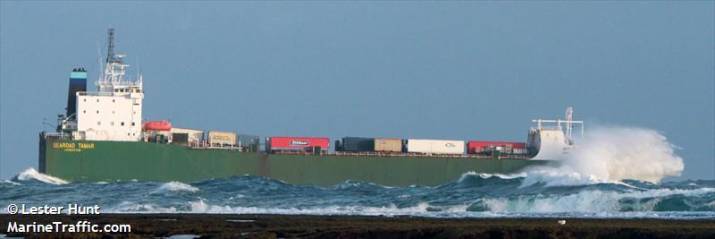

*Pic: Photo credit: Les Blair, www.marinetraffic.com
Before you start preparing your lamb chops or Sunday lamb roast, spare a thought for the lambs from whom the meat came.
Because key processor JBS in Tasmania has indefinitely shut down its ‘small animal processing line’ at Longford, at a minimum cost of 130 direct Tasmanian jobs, the chances are that the lambs – usually 3-4 months old, so not much more than babies – have been shipped to Victoria or even further, slaughtered there, and the meat is being shipped back to Tasmania for local butchers and supermarkets to sell back to you:
http://www.abc.net.au/news/2017-02-24/jbs-abattoir-workers-to-be-stood-down-again/8299656
Stop Tasmanian Animal Cruelty does not want to enter into to debate about meat quality, other than to note that the welfare compromises for these baby animals are enormous and indefensible.
Basic research has informed us that typically, these lambs would be ‘yarded’ on their properties of origin typically at about 2pm, say, on a Monday. This means that from this point they will be denied feed and water – effectively until they are dead. A transporter might arrive at 7am the next morning, and the truck would deliver the animals to the wharf at Devonport at some stage late the same afternoon.
The prime mover leaves the trailers on the wharf regardless of the weather conditions until the ship (usually the Searoad Mersey or the Searoad Tamar) sails some time that evening, possibly at around 8pm.
Stop Tasmanian Animal Cruelty’s Suzanne Cass has seen these cicrumstances on numerous trips to Devonport.
“I’ve often passed through Devonport in the late morning or early afternoon, and seen trailers packed with animals sitting on the wharf for hours on end in the heat of the day, and in driving wind and rain as well’, she said.
‘The trailers are loaded onto the top of these ships, where the animals are exposed to wind, rain, sea spray and rolling and pitching for the duration of the voyage to Melbourne, which, even on a ‘standard’ voyage in reasonable weather conditions, will be at least 12 hours. Bass Strait is a notoriously rough and treacherous stretch of water’.
In all this time, the lambs will still not have been given feed or water.
Once the trailers are unloaded from the ship in Melbourne, which can take hours, the lambs will then be trucked to a processing facility, which could be another 8 hours away or more, They may arrive at some stage on Wednesday afternoon, and they will not be given feed or water there either. They will most likely be processed at some stage on the Thursday. At a conservative estimate, that is an outrageous 72 hours or thereabouts.
Stop Tasmanian Animal Cruelty obviously does not support the slaughter of animals, but if we were to visit the most fundamental principles of animal welfare, the Humane Slaughter Association tells us that:
‘Many millions of animals are transported every day around the world. Most animals farmed for human consumption are transported at least once, if not many more times, during their lifetime. It is important that these journeys are kept as stress- and injury-free as possible.
The HSA maintains that:
Animals should be slaughtered as close to the point of production as possible;
Transport should be minimised by travelling from the farm direct to a slaughterhouse’.
‘We believe that the State Government needs to step in and put an end to what is essentially nothing more than torture for animals’, said Ms Cass. ‘This is going on week in and week out from Tasmania.
‘All this came to a head in the case of the cattle shipped from Stanley to Port Welshpool in Victoria in January last year, when 59 cattle out of 208 died on a little landing barge called the Statesman. Ten were dead on arrival, and another 49 had to be shot, yet it took Victorian vets all day to even get there to end the suffering of the animals. Extraordinarily, neither the Tasmanian nor the Victorian government put a stop to this shipper’s activities …’.

Photo credit: The ‘Statesman’ – George Brzezina, www.marinetraffic.com

‘The cattle were ‘spent’ dairy cows, and processor Greenham’s, who owned the cattle at the time, refuses, I believe, to process them in Tasmania. This means that they face an horrendous journey from their properties of origin to northern Victoria, up near the NSW border. Observers at Tongala have reported to us that the cows are still ‘leaking’ milk, and that they are desperately hungry and thirsty while they wait to be processed into hamburger mince for the US market. These poor cows face a much longer and more arduous journey even than the lambs.’
There was yet another ‘incident’ as recently as January 2017, when ten out of 38 cattle died when a trailer tipped on the Searoad Mersey as it travelled from King Island to Devonport.
See story here:
http://www.abc.net.au/news/2017-01-26/livestock-shipping-deaths-on-bass-strait-prompt-law-requests/8214684
‘We aren’t economists, but there is clearly some benefit passing to processors from these shipments as Tasmanian jobs are being lost’, Ms Cass continued. ‘But regardless of the economics, the suffering of these animals is cumulative and extreme, and we ask Tasmanian consumers to please think about all this when they are buying meat. We believe that Tasmanians genuinely care about animal wefare, and they will want to know about this’.
Ms Cass is urging people to write to the Minister for Primary Industries, Water and the Environment, Jeremy Rockliff, and demand that what she sees as the greed of these processors is dealt with. If nothing else, she says, between this and the live export trade, Tasmanian and Australian jobs are being lost while the animals are the victims.
Suzanne Cass has a Grad. Cert. Professional Legal Studies, an M-PET (Master of Professional Education and Training), a Grad. Cert. Educational Studies, and a Dip. Management and Leadership
• Guardian: Dairy is scary. The public are waking up to the darkest part of farming
• Playground: “Vegans and vegetarians think they don’t kill animals but they do”
• Return to Now: Agriculture: “The Worst Mistake in the History of the Human Race”
• Return to Now: Civilization is Inherently Unsustainable
AND EVEN EARLIER … Jared Diamond, May 1999 …