Economy
Travel: Winds of Change …

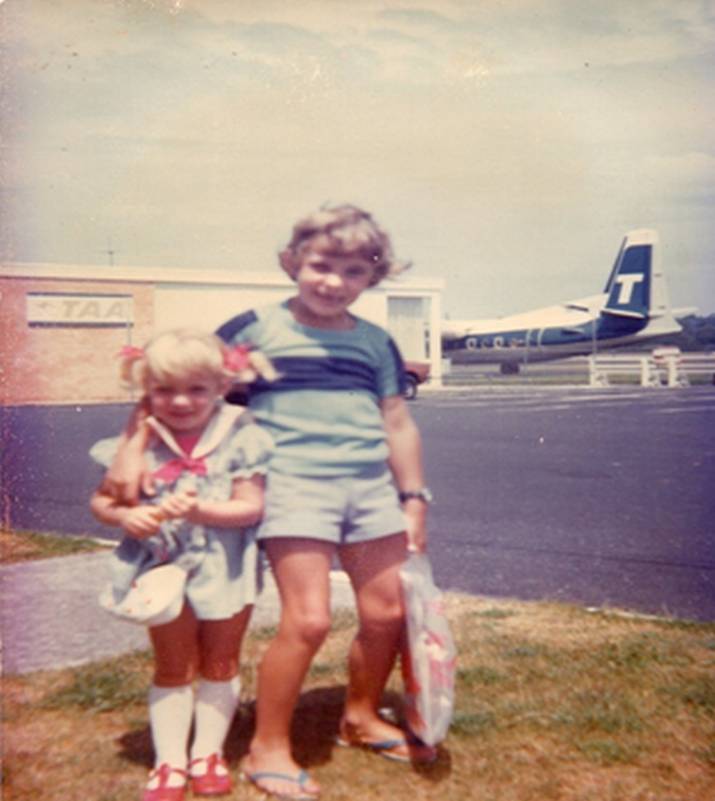

Simpler times: My son and daughter at Wynyard airport circa 1974
Flat pack domestic airline travel
FJJ is very learned and nationally well-regarded business consultant, whom my former organization often used. I remember some years ago we bumped into each other at Melbourne airport, both awaiting a delayed Tasmanian flight. He surprised me, when I complained about airline service, telling me that the major task of Australian domestic airline operators was to confront and downplay the unrealistic service standard expectations that had built up in the public’s mind over the years. This was not long after the Ansett collapse. He was well placed to know this as his brother had been a senior executive at Ansett Airlines.
I grew up in that sleepy world where airline travel for the ordinary person was a luxury and under what was termed the two airlines policy. This consisted of the privately owned Ansett Airlines and the government-owned TAA and effectively restricted capital city to capital city flights to these two operators.
One player who sought to circumvent this from 1982 was East West Airlines who inserted a third leg between capital cities so that one flew Melbourne – Albury- Sydney or Sydney – Coolangatta – Brisbane at a considerably lesser price than the majors. The story of domestic airline travel is littered with government either intervening with policy levers, overt favoritism or simple inaction in not supporting some players. In my view the Hawke government was not terribly supportive of East West and its independent orbit was forced back into the gravitational pull of Ansett then controlled by two favorites of Hawke, namely Peter Abeles and Rupert Murdoch. Perhaps government action could have saved Compass a genuine low cost carrier and there is a clear argument that perhaps John Howard could have intervened more strongly to save Ansett, although as my business consultant friend would have counter argued, excessive fleet variety was at the core of Ansett’s problems.
Other winds of change were blowing worldwide that was the increasing deregulation of the aircraft industry which had as its core promise cheaper fares. Another worldwide trend was the growing attraction to neo-liberalism and the short-term budget boost that privatization offered which led to the Qantas sell off in 1993. Another core tenant of neo liberalism was only economic activity in the private sector could be truly efficient. Key also to neoliberalism and its dogma is the view organized labor was a bulwark to progress and this was crudely on display during the bitter pilots’ strike of 1989.


The friendly way
All of this seemed so far away when in the mid-fifties I joined the TAA junior Flyers Club and received my badge. It would be too fanciful to say I placed it alongside my Commonwealth Bank money box – two venerable safe government owned businesses later to be forever changed by a tide of neo liberalism! I dreamed of the day I would take a flight from Wynyard aerodrome to Melbourne. Mum and Dad used that quaint term aerodrome and I can’t help thinking it had more mystique to it than airport. When I did get my first flight it was in the 1960s and it was from Hobart. The airlines had offices in the city and offered a free airline coach to the airport. If I remember correctly Ansett was located on the corner of Harrington and Liverpool Streets. The airlines had state managers at the time who were both visible and accountable. Here you could buy an airline ticket which was in fact a small booklet, so much classier than a boarding pass. Tickets seemed expensive but there were few circumstances in which you could not get a refund. Airports were relaxed places but food was expensive and there were limited venues for food and drink. A major reason for this was every flight and every passenger got a hot meal and tea or coffee as part of the fare. Liquor was plentiful and inexpensive as taxes and excises were not applied in what was federal airspace. Another quaint feature of Hobart Melbourne flights was they often stopped in at Launceston to collect a few passengers so sparse was the use of aircraft as a travel medium in those days!
On board tasks were allocated along sexist lines – pilots were male and air hostesses, to use the nomenclature of the times, were all female. Nonetheless, these to use the modern accepted and gender neutral term, flight attendants seemed to me to be quite glamorous in their cocked hats.
The protocol for delays was it was always the airlines fault and they never shirked at giving delayed passengers meal vouchers or reasonable hotel accommodation, if the delay was overnight. This is in stark contrast to today’s carriers, although the delays emanating from the Chilean volcanic ash cloud in 2011, where I was stuck in Melbourne for several days, did see a reluctant Qantas provide passengers with accommodation and some meals. Other out of pocket expenses were subject to much haggling. At best this accommodation and those meals were at the middle range of the scale.
In addition, airlines at the time provided coaches into the arrival city, I can remember the Melbourne one for TAA being at Franklin Street. In addition, parking at airports was free and unlimited. Discount flights were available through a peculiar practice known as standby, whereby one went to the airport ready to fly and if there was a last minute no show you got a seat at a heavily discounted price. Nowadays I suspect airlines never take off unless flights are packed to the gunnels, such is the magic of centralized computer bookings. I can well remember driving to Launceston to get a cheap East West flight to Sydney and parking there for almost two weeks returning and simply getting into the car and heading home to Hobart. Today such a sojourn in an airport car park would cost me the equivalent of a deposit on a house. I wonder as I was parking in Launceston for free all those years ago was there a potential IPA member lurking around surveying those car spots and salivating about the future revenue they could engender in private hands!


Travelling in a bubble
From 1989 to 2005 I was a frequent airline traveller across Australia. This was because the work I was engaged in required frequent airline travel. Until the collapse of Ansett I was a frequent user of its services as my organisation had a contract to use Ansett, thereafter I almost exclusively used Qantas. As a frequent traveller, I often received upgrades, particularly to the then business class. I could linger in airport lounges sipping chardonnay and quaffing biscuits and cheese. Taxis would collect me at the airport, my luggage got priority and as large parcel of this time was pre 9/11/2001 the overlay of intensive airport security was not present. Overall flying was a doddle. Of course, when secreted in a bubble it’s hard to see out unless that bubble bursts. Around 2007 I commenced living on a fixed income and relied on a few consultancies to augment my income. Only then was I subjected to flight travel for the ordinary person. Those words of FJJ suddenly rang loudly again in my bubble free world of flight. I now know why politicians who fly in the bubble and have perks, either as a condition of their office or just the largesse of airline companies, eager to curry their favour, are not responsive to the ordinary flying public. They don’t have to fly in their shoes. This disdain is so complete we don’t have a specific Minister for Civil Aviation anymore, so strong is the faith in deregulation and the ability of an unfettered private sector to deliver an airline travellers paradise. Service quality still exists but perhaps now only from the point of boarding to the point of aircraft departure. Booking and prefight activity was down to you; it was you that needed to do the fetching and carrying not airline staff. I learned that cheap airline tickets had their price, such is the nature of flat pack airline travel. The little things had also disappeared – no wink and a nod for a suitcase a couple of kilos over the limit, no upgrades unless you bid in dollars on line, no free meals, even water needed to be purchased.
In addition, what almost amounted to confidence tricks became de rigueur. Take an advertisement for $99 flights to Broome: sounds good but the fine print reveals its one way only, so unless you live in Broome, the cheapest fare back is in the hundreds of dollars. Another reason for the particularly like the flimflam of the say $100 fare which unless you stand up during the flight or travel in the cargo hold is not a $100 fare because you must pay for your seat. I understand airlines are examining standing up flights for short hauls. The airlines websites are a work of art. The gouging of people using credit cards to pay is just part of the sting that is airline internet booking. Rigorous attention and fierce concentration are required of the purchaser, carefully opting out all the way the internet booking routine through lest you want to add tens of dollars to your final price. Make a mistake on the date and its curtains unless you want to spend a couple hours trying to get through to the airline call centre and get your changes made, usually with the addition of quite a few dollars on your original price. Flights to and from Tasmania are routinely delayed and it’s not just that this didn’t happen before deregulation, it’s just that in days of yore there were apologies and recompense, today it’s just one part of the lottery we call domestic airline travel. Modern developments also have seen Hobart ‘s importance decline as an airport – it’s a point to point and not a hub airport, which restricts its ability to recover quickly from delayed or cancelled flights
The point needs to be made by way of balance, it’s not that airline staff have grown ruder or disdainful of the traveling public. Now they must dissemble more to a public whose expectations of air travel are of the ancien regime and they are called on to unyieldingly police the rules because competition had nailed costs down so rigidly that every activity is costed down to every gram of luggage, to every second of labour to every centimetre of seat space.
Hub airports & the aerotropolis – not all for the traveller
Prior to 1990 a terminal’s primary purpose was a comfortable and passenger friendly place where travellers waited for or transited to trains, ferries, buses or planes. They seemed to be all for the traveller.
Parallel with the privatization of Australian airports starting in 1997 and fully consistent with neo- liberal philosophies was the growth of ‘non-aeronautical’ development on airport sites.
Today we witness the phenomenon of large international airports competing for international passengers who transfer to or from long-haul services. Airline hubs developed focussing air travel from spoke airports to the central hub, thereby given airline companies efficiencies of scale hitherto unseen. Cheap fares and the explosion of international travel accelerated this hub arrangement. Passengers now had dollar signs around their necks as they could generate revenue for these airports through a variety of services such as shops, bars & restaurants, parking, car hire, hotels and limousines to name just a few. The increasing use of airlines for freight using hub airports made terminal sizes even bigger. With bigger airports came bigger distances for passengers to traverse within airports as they sought to make onward connections, necessitating sophisticated internal transfer systems such as light rail or mini buses
The amount of dead time in airports increased but capitalism was there at the ready with a plethora of duty free shops and other services for the bored traveller. At Munich airport, so intertwined is the commerce with the airport it was hard to find a departure board to locate my flight. A giant Bayern Munich Football Club outlet dominates the entrance and it takes you a while to discern you are even in an airport. Even with travelators distances to walk became even greater in most airports. An emerging phenomenon adding to passenger dead time (and annoyance) is the use of buses to transport you from a point in the terminal to the actual tarmac spot where the plane is parked. In the ultra-commercial money making entities that airports have become even gates are valuable; they often make commercial agreement with airlines for sole use of gate space. An equally annoying commercial feature associated with Melbourne airport is the surcharges placed on taxis to use the airport that are passed onto suprized customers at the end of a trip, usually ex- meter.
I have travelled a lot in east and south east Asia since 2007 and have had considerable exposure to the huge airport hubs in Kuala Lumpur, Singapore Changi, Bangkok Suvarnabhumi, Hong Kong, Shanghai Pudong and Guangzhou Baiyun. Immense airports all in competition with each other and all security conscious almost to the point of paranoia. Security checks at Changi are performed on transit passengers, both on the way in and on the way out, despite in my case having come off a flight from Australia where I just underwent a rigorous security check. More dead time the world passenger must program into his or her travelling time. Recently in China, as a response I suspect, to the terrorist attack, of 28 June 2016 at Atatürk Airport in Istanbul, rudimentary security checks were being carried out at the terminal entrances, perhaps a necessary but none the less frustrating imposition on the time and patience of travellers.
The newest development is the ‘airport city’ or the aerotropolis with significant non-aeronautical functions such as offices and retail complexes at the centre of road and rail corridors with groups of aviation-linked businesses stretching many kilometres away from them. Many city offices are relocating to cheaper land around airports. The land is rendered cheap because aircraft noise is a major deterrent to more expensive residential developments. A major example is parcel freight trucking businesses where so many synergies exist. Many economists argue that airports are a key major generator of economic activity with significant downstream benefits.
Case study 1: Bangkok International Airport (Suvarnabhumi)
An earthly space station
Like most international hub airports, the layout resembles a space station with a central core or main terminal emitting arms where planes dock called concourses. This airport has six labelled A to G. This airport is in the world’s top ten for actual physical space the airport at large takes up and in the top twenty for numbers of annual passengers that use the airport. It’s quite a way from the city, as are most major international airports, with the exception possibly of Sydney’s Mascot airport. There are two features of the airport that annoy me. It’s not what they dub the ‘happy toilet’ – Asian airports compete rigorously for spotless toilets- in most you could hold a picnic on the floor, but rather the huge distances between concourses especially when you have two artificial knees. A mistake you make here if you are a first-time user of the airport is to get straight to your gate lounge. Now the word lounge is a misnomer. An austere row of seats awaits you in a narrow corridor. This is where you must wait until you are summoned below to the gate hold rooms, which are slightly less austere and this where you enter plane from or if you are unlucky enough to the bus that’s takes you onto the tarmac. Regrettably once you enter the concourse it’s a long walk and there are zero facilities for the most basic things such as availability of water or toilets. My advice make sure you use the ‘happy toilet’ at the head of the concourse before you embark on the long journey to your departure gate. Halfway along you may, if you are in the right concourse, see an immense golden statue of the late king.
King power is king
The shadowy King Power Group is the sole duty free retailer. How it became the sole concession holder for all airports in the country has been the subject of much international conjecture and generated some legal action within Thailand. Its principal owner Vichai Srivaddhanaprabha is the effective owner of Leicester City Football Club. The presence of King Power is evident from the moment you enter the airport and I find it almost overpowering. In conclusion, the visa on arrival feature of the airport is one of its more positive features, its efficient and there are few delays. Another positive thing about the airport is the availability of booths that will sell you reasonably priced SIM card, complete with a Thai phone number, and wi-fi package for periods as short as ten days. They even install the SIM for you and neatly package up your old SIM and this feature creates savings on the outrageous roaming fees charged by some Australian Telcos.
Case study 2: Terminal 4 Melbourne (Tullamarine)
Completing the self-service loop
The downgrading of customer service to virtual self-service is almost complete if one takes the new terminal 4 at Tullamarine airport as a reference point. Never has a complex been built that so meets the needs of all stakeholders with the standout exception of the passengers! Predominately used by Jetstar it also services REX and Tiger passengers and has been operating for less than a year. Another way to describe it would be that it caters for the lowest level of budget flyer. It is short on bells and whistles and long on passenger “do it yourself”. There are no air bridges and there is an extensive walk from the arrival gate to the baggage collection area and the exit doors. There are no travellators. It is not overendowed with toilets nor drinking fountains. I have been through the terminal over a dozen times at various times of the day and night and an airline service desk located near the elbow bend corner which marks the start of the long walkway to the gates, I have never seen staffed. All embarkations involve a walk down the aircraft steps and across the tarmac for a distance. There is little protection from the elements and the stench of aviation fuel is unpleasant but not overwhelming.
First experiences
My first use of this terminal saw me arrive by taxi. I have back and shoulder problems so I decided against using the Sky bus, as this sometimes involves extra lifting of suitcases, whereas a taxi will usually drop you at the door reducing the need to lift suitcases if you get a good cabbie. Not at T4, the taxi arrives upstairs at a point someway from the terminal. Entering the terminal, I noted it was different from other terminals in that seating was reduced to a minimum and there did not appear to be service counters. One is forced to generate a boarding pass at a kiosk and use it to load your suitcase via an optical reader onto a conveyor belt, provided you meet the weight requirements for your ticket. Jetstar have staff patrolling to assist flyers who somehow can’t load their baggage of which there were many. I could see all around me people frustrated, feeling useless, some almost in tears as they were forced to completely service themselves. It is important to note Jetstar did provide aid by way of roving staff members, but it seemed to me to be shambolic from a traveller’s perspective. You can only generate a boarding pass when your flight was opened which lit up on the board, shrewdly when the flight was opened, no gate departure lounge number was forthcoming. The large board tells you not to worry a departure gate would be provided soon and you make your way up some escalators to the first floor where you go through security. Then you arrive into an area that has little resemblance to a traditional airport. It is effectively a shopping centre, admittedly with many places to eat and drink for passengers. Finally, you find the departure board amongst the pizazz of the shopping centre which tells you to relax your gate lounge will be provided shortly. This is code for shop, shop, shop! To me it was no more than a cunning subterfuge to entice one into shopping. I surmised from long experience the gate lounges with the highest numbers and the furthest away would be the embarking points for Tasmania and made my way down the long corridor to the last gate. I was not wrong by the time I had gotten there a small sign revealed this was for the Hobart flight. The critical first moment of truth in marketing, is as its initial proponent A.G Lafley postulated, the impression gained on that first exposure to a product and how it shapes future thinking. It will take a lot to sway me away from my initial negative reaction to T4.
A horrible hindrance
My first departure and a couple of subsequent arrivals did not endear myself to T4 so for a time I flew Qantas or Virgin despite the extra expense just to circumvent using the terminal. My next “T4” flight was early afternoon and I decided to take the Sky Bus as my luggage on this journey was relatively light. In the Sky Bus terminal at Southern Cross a sizable wall advertisement caught my eye. It was for T4 shopping promoting its virtues purely from a shopping perspective, further evidence that the axis tilting away from airports as places to wait for or to embark or disembark aircraft. The ad as a further incentive no doubt emphasized a 2800 capacity car park, with of course no mention of the usurious and uncompetitive parking rates that are the hallmark of modern Australian airports.
I arrived at T4 and quickly looked for a seat. I have two artificial knees and some back and shoulder problems and can’t stand for long periods and my wait was on actual departure times was just under 100 minutes. There are few seats in T4 in the ground floor waiting area but there is one reasonably substantial café with seats and I got some coffee and invaded the table of two Chinese girls who had a spare seat. Soon the flight board started to show the sad news of a delay to my Hobart flight. As a solo traveller, of course I ran into the perennial problem of solo travellers- what to do with your bags when you need to purchase food or use the toilet or indeed even more important how to maintain your seat. Leaving your bags creates two problems: the first is it is in fact illegal in these days of heightened terror alerts to leave unattended bags and of secondly it leaves your possessions open to theft or pilfering. I tried to induce the Chinese girls into taking temporary custody of my bags by trying to show off my Mandarin, but that fell flat as they were Cantonese speakers! In near faultless English, they advised me they would happily look after my bags.
I had to eat, despite the fact I had paid for lunch with my online booking and the generous helping of humble pie the Chinese girls fed me, the delay run into lunch time. So, I ate and still the delay sign was up on the board. No further information was forthcoming. I tried to make a dash to the next floor where there is a myriad of shops to get a newspaper or some reading material, but unless you go through a full security check you can’t enter the shopping area. Somehow the brains trust behind T4 have missed a trick there not allowing delayed passengers access to their shopping heaven on the next floor up. This embittered me even more and the lack of information on the delay from Jetstar was starting to irk. Finally, the delay came out on the board as plus I hour but continued to blow out until we got a firm 5 PM departure time.
I had been trapped in Melbourne for three days in June 2011 when all aircraft were grounded due to the Chilean eruption ash cloud and the major source of frustration for travellers was the lack of information from the airlines; generic information or no information is not soothing or reassuring for passengers and I can’t understand why they don’t give out near worst case scenarios. Passengers are made to feel like a commodity. As it turned out T4 passengers were directed to a gate lounge where we were forced to stand in a cramped bollard roped zone that snaked around a very small area for another 30 minutes before embarkation. Jetstar, in a PR coup, then decided to send officials to measure up and police the carry-on baggage for travellers who were into their fifth hour of delay. A clear case where you can be right but wrong in the same action.
Elderly passengers and those with minor impairments
The one size fits all approach of domestic carriers has many adverse and unintended consequences for travellers. I have some back and shoulder problems and two artificial knees. At a standard airport with air bridges and reasonable distances between check in and departure gates I can manage quite well. Hobart airport present additional difficulties as one must walk some distance across the tarmac in often atrocious weather conditions and climb, for me, quite steep stairs. In addition, as the airport is in a constant state of refurbishment more walking is usually added onto your trip to the check in point. Generally using budget airlines, a similar disembarkation scenario is presented. My situation is not so extreme as to warrant a wheelchair or a lift into the aircraft and pride also dictates I put up with it but it has soured me against airline travel. Also with artificial limbs I must undergo extra screening going through security. Once needs to remove belts and shoes and putting shoes back on is difficult as security don’t provide shoe horns. I long for international flights where I can use the full body scan it’s much easier. I understand and appreciate the need for security scanning but surely we can devise more streamlined and passenger friendly security checks. The convoluted current process has not altered since immediately post 9/11.
Deregulation and air travel for all
In 1995 with airline deregulation in full swing the then Bureau of Transport and Transport Economics published a paper outlining the benefits of deregulation. These included
• Lower average air fares
• More people travelling by air
• Increased Competition
• More efficient carriers
• Improved quality of service
• Continuing aviation reform
It is fair to say whilst we complain about an increasing self-service foisted on the travelling public airfares are cheap and a whole new cohort of citizens are enjoying air travel than ever before. Swathes of domestic and international tourists have bolstered internal air travel and the expansion of other hitherto localised pursuits such as national sporting competitions, school trips/schoolies and family reunions and the like have seen air travel grow at a massive rate. As for the claim of increased competition, if we count Qantas and Jetstar as one entity, then we effectively have a two-airline policy still. Yes, there is Tiger and Rex and a few minor players but essentially two major groups dominate air travel in Australia. My suspicion is that exclusive deals on terminal space have frozen out potential new players, but its only a suspicion and I may be indulging in oversimplification. In addition, whilst fares are cheap the all up costs for travellers may not be: airport parking is uncompetitive and expensive, cab fares are certainly not cheap and food and drink are generally not included in fares anymore and represent another out of pocket expense. Point to point airports like Darwin and Hobart relative to the Melbourne- Sydney- Brisbane access have less late flights, necessitating additional expenses for overnight hotel stays. Certainly, efficiency drives airline service, my whole article acknowledges this, but as the Bureau of Transport and Transport Economics stated
‘Continuing increases in patronage are also evidence that the incumbent airlines are market responsive.’
This statement neglects the fact that Jetstar and Virgin artificially cut prices in an unsustainable way to attract travellers, just ask Compass airlines. In addition, with no national fast train services capital city to capital city of note, airlines in Australia don’t have the competition from trains that China or Europe enjoy. With no real universal service obligations in airline travel some routes are poorly served or very expensive. Airfares to Canberra are notoriously expensive for the tourist, as fares are loaded because most travellers to Canberra have their fares paid by the government or by the private sector.
They also found there had been improvements to the quality of service noting
‘A key, measurable indication of higher quality service can be found in flight frequency improvements.’
This is in my view an erroneous measure and seems to me to be a measure of frequency not quality. Surely some polling of end users might provide a better guide.
As for deregulation being a driver for continuing aviation reform one must treat the modern-day usage of reform with suspicion. The term reform is heavily tainted and often means the opposite; one person’s reform is another’s regression. Politicians promote media reform but it seems to me to be code for greater concessions to major media barons. For neo liberals the airport is a blank canvass ready to daub with the dollars of profit.
In addition, scant investigation has been done on the effect of deregulation on aircraft safety, maintenance and pilot skills despite the urgings of prominent Australian Dick Smith.
Multiple Ministers for Civil Aviation
I have previously talked about MPs who travel in a bubble. Awarded top tier complimentary airline lounge membership, such as the captains lounge travelling by air for them is a breeze. There is no one or no organization to stand up for the rights of the lay airline traveller; certainly, not politicians. We all must become our own Ministers for Civil Aviation. All MPs should be forced to once a year book a fare to Canberra themselves, on line, using their own funds (to be later reimbursed) on the cheapest fare of the day using public terminals and public transport, thus at least once a year getting into our shoes. Of course, this will never happen and conditions for budget travellers will continue to get even more one sided. A very good guide to airports worldwide, identifying the best and worst, is available at the blog site:

Simpler times: My son and daughter at Wynyard airport circa 1974
Up, Up and Away
This wonderful song, written by master song writer Jimmy Webb was popularized by the US pop group the 5th Dimension and was altered slightly by TAA and used as an advertising jingle in 1972. It is one of those advertisements that forever lingers in the recesses of your brain, not unpleasant, not nagging. It conjures up a sense of the freedom associated with airline travel and a sense of almost out of body experience. It is a sort of marker of the high point of the two-airline policy. I recall a great airline experience around fourteen years ago where I was up, up and way. I was flying from Darwin to Melbourne. As I checked in the service desk staff member told me I was to be upgraded to first class. It was a clear bright day as we flew over the Australian desert stretched out below me and I was alone in first class. As I sipped a very smooth cab sav and sampled rare roast beef I looked down and saw Lake Eyre full of water, the flight attendant was calling me sir and refilling my wine and the lyric began to pierce my mind gently and reassuringly…up, up and away.
Suddenly its 2016 and I’m in Terminal 4 and no up, up and way in my head today rather the lo -fi music of Pigeonhed exhorting me to ‘get down on your muthaf…kin’ knees.’
Relax FJJ the loop is now complete.
*Greg Cure was educated in the Classics at the University of Tasmania. He was a senior strategic manager for many years in the Australian government. He was awarded an Australia Day Award (Australian Government division). He is an author, social critic, poet and freelance management consultant. He has spent a good portion of the past decade working as a teacher of both English and Business in China. He is the author of “Where did all the good times go” an examination of the 1960’s R&B musical revolution in the UK and this work has also been translated into Chinese. He has contributed articles to magazines in China. In his early years, he worked in the mining industry on the West Coast of Tasmania as well as spending several years as a builder’s laborer. His hometown is Strahan and his maternal grandfather was a Huon Piner.