Economy
Perhaps the erudite readership of Tasmanian Times could cast an investigative light …

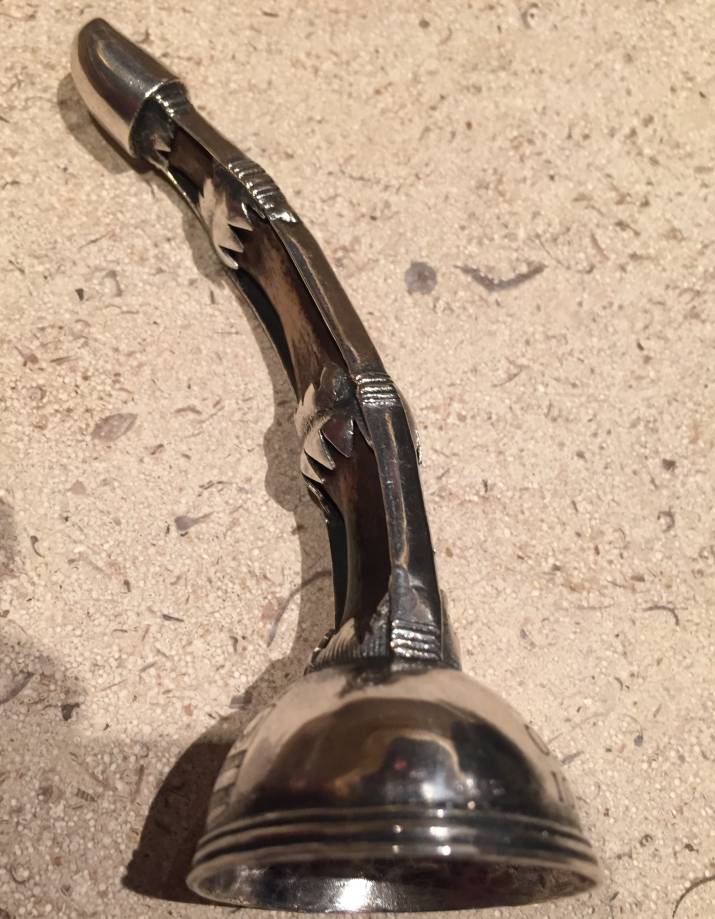


I have recently acquired a most interesting relic – a silver-mounted human finger-bone with an apparently unknown history.
It has the base inscription S Wernere/Ora Pro Nobis/1621 23 Marty and has a fine contemporary coat of arms as yet unidentified.
I will be exhibiting this treasure at the Runnymede Fair in Hobart which is open Friday 14 th to Sunday 16 th October between 10 am and 5 pm.
Perhaps the erudite readership of Tasmanian Times would care to cast an investigative light on this most interesting historical object which is now nearly four hundred years old.
*John Hawkins is a Sandhurst-trained former British army officer, now an Australian resident of almost 50 years. For the past 14 years he has been enhancing the Bentley landscape in the Chudleigh Valley, Tasmania. He is well known for his two-volume standard reference on Australian Silver, and for his knowledge of the Life and Times of Erich Abetz.

Comment 5 by Shan Wee: “Readers may be interested in the magnificent painting: The Incredulity of Saint Thomas, 1603 by Caravaggio depicting Saint Thomas investigating the spear wound on the body of Christ, one of the most magnificent images to be found in religious art. The Finger of the doubting St Thomas is preserved in the Basilica di Santa Croce, Florence. The motif of the hands is an old one, the device of Saint Thomas’s finger perhaps inspired by a Diirer print. Surprisingly, only Malvasia, the propagandist for Bolognese painting, faulted the picture as indecorous. It was much copied, even while Caravaggio was still alive. Cardinal del Monte, Ciriaco Mattel, Prince Ludovisi, and the duke of Savoy all owned versions of it, so its lack of obvious mysticism and its psychological penetration must have struck a contemporary response. Perhaps Mr Hawkins’ finger is from the other hand. I have attached with this email the image of the Incredulity of Saint Thomas, courtesy of www.caravaggio.org”
• Leo Schofield in Comments: I make no claim to erudition (except, perhaps, in matters baroque) but my good friend Mr. Richard d’Apice, AM FSHA, is not only a fine lawyer but also a veritable fount of erudition in matters heraldic. He is Vice-President of the Australian Heraldry Society ( website: http://www.heraldryaustralia.org ) and has come up with the goods. His view is that Mr. Hawkins’ curious object is a devotional reliquary containing the long missing finger of St Werner of Oberwesel whose cult was supressed in 1963. He writes … and … Mention of matters baroque in an earlier post prompts me to mention that the glorious young Russian soprano Julia Lezhneva is back in Australia. Few of those who were present in the Federation Concert Hall for her first-ever Australian concert, a highlight of the 2014 Hobart Baroque, will forget the joy of hearing a voice of such beauty. Nor will they fail to recall the five standing ovations she received that evening. As Richard Flanagan wrote, the miracle was not only the voice and the music and the singularity of the event but “the fact that it was happening in Hobart …”


• John Hawkins, Comment 18: The Cloisters Collection in the Metropolitan Museum of Art in New York also has a reliquary in the shape of a finger. Accession No: 47.101.44. Provenance : Henri Daguerre, Paris (sold 1929) Brummer Gallery, Paris and New York (1929–sold 1947) sold to the Metropolitan Museum in1947. It is referred to in A Treasury at the Cloisters and it is supposedly the finger bone of St. Amicus, 12 October, died 733; in Northern Italy is patron of Mortara near Milan. I like to think that my finger is the nicer of the two, it will be displayed as a delectation for the residents of Hobart and for purposes of sale, from tomorrow 14 October until Sunday 16 October.