Economy
How well do you know the new Senate Candidates … ?

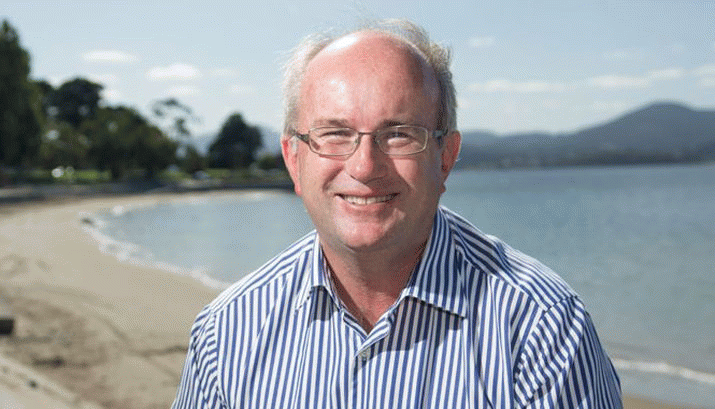

How well do you know the new Senate Candidates at the election on Saturday? How well do you know the incumbents? Can you even name the incumbents? As we approach the home straight I will provide some insights into my background that may guide you to either vote for me, or place me at number 58 on the Senate ticket (or should I say at 57, as I think most TT readers have already selected their number 58th favourite).
Whilst contesting this years election as a Senate candidate for all of Tasmania, the North West Coast is where I grew up during my most formative years. I don’t mind being called a “blast from the past” because it was a past when the North West coast was a centre for Tasmanian industrialisation and the HEC’s Mersey Forth hydroelectric power scheme was the biggest construction show in town.
A few years after emigrating from Holland in 1962, our family settled in Tasmania where I was raised in the HEC’s construction village of Gowrie Park, attending Gowrie Park Primary and then Latrobe High school, which was led by the firm, fair, but formidable Principal, Jack Curtis. Despite holding traditional values, Latrobe High School was also progressive in many ways, teaching independence through supporting adventurous activities like caving and bush walking. As 14 year old teenagers we would think nothing nothing of climbing Mt Roland (without adult supervision) or spending the day underground, abseiling down 100 foot drops in the dark and exploring exotic sounding and world beating cave complexes like “Kublai Khan”. Only much later did I fully appreciate how lucky we were.
The hierarchy of Hydro was based on technical ability and qualifications. At the top of the tree were the civil engineers, led by Sir Allan Knight. Under his leadership (1946–1977), renewable power generation grew tenfold from 172 to 1515 megawatts and the HEC’s workforce grew from 1000 to over 5000. Many of the new employees were post war European migrants like us, boat people. We lived in a very egalitarian, ethnically diverse society, with everyone housed in near-identical “hydro houses”. We were all proud of our parents’ achievements and they instilled in us the value of hard work and technical excellence. The hardest subjects at school were Maths and Science but that was what we wanted to be good at. Luckily we had maths teachers like Brian Cadle, who really knew their stuff (as well as fly fishing). Classes were streamed. It was tough, but reflected the real world.
The hydro schemes were not only large, they were innovative, winning international recognition for advances in the technology of dam and power station design and construction. Engineers from around the world came to Tasmania to learn the latest techniques.
It was hardly surprising then, that the four Willink kids got the “technology bug”. We have all studied at UTAS. My oldest brother Alex went on to be a civil engineer like his father, managing billion dollar construction projects in places as far flung as Chile, Nigeria and the North Sea. My brother Rob, a geologist, went on to complete his PhD and become the General Manager – Exploration for Origin Energy. Origin developed the Yolla Gas Field gas field, which is closer to Tasmania than Victoria. Their plan was to pipe it back to Devonport and build a large gas fired power plant employing thousands during the construction and ongoing operating phases. Sadly the Tasmanian Government rejected the Origin offer and Yolla gas was piped north to Victoria. Had Origin succeeded, there would have been no recent energy crisis and unemployment on the North West Coast would be much lower. Last but not least, my sister Marijke, also a UTAS science graduate, worked as a palaeontologist for Woodside, Australia’s largest independent oil and gas company.
My first two jobs were on the HEC’s Pieman River Scheme. Firstly, as a kitchen hand in Tullah, working 16 hour split shifts and then as a labourer on the MacKintosh dam face, where it was our job to break big rocks into little rocks using jack hammers. Real “convict stuff”. In the early 70’s my father moved on to the Gordon River Dam and I left home to join the Army, eventually serving for 20 years in a variety of technical management positions, including 5 years as a bomb disposal officer.
Upon leaving the Army I was fortunate to join Tasmania Police at the start of a 10 year innovation program called “Project Baton”. Then Inspector (now Commissioner) Darren Hine managed their business projects unit and I managed their computer and communications branch. Together, we introduced many advances, including new DNA and fingerprinting systems, improvements to the Police radio network and a changed focus from reactive to intelligence led policing, which was enabled through the integration of dozens of previously separate and “stand alone” databases. By 2008, Tasmanian crime rates in many categories had halved. From being average amongst Australian states, Tasmania went to having the lowest crime rates in the nation.
It was inevitable then, that after being bought up in a construction village and pursuing a 30 year, “hard core” technical career, that I would be attracted to politics and the Science Party. The Australian Parliament of today is comprised mainly of former lawyers, union officials and professional politicians. Where are the people that know about technology, the key to Australia’s future? Where are the people that make decisions based on evidence and data rather than those who have the loudest voice or greatest power?
The Science Party (formerly the Future Party) has about 1500 members on the mainland, comprising mostly of scientists, technologists, engineers and mathematicians; with many involved in research and development. These are the people that actually make innovation happen.
The Science Party is dedicated to doubling research in Australia. They believe that whilst the major Australian political parties are all talking about innovation, much of it is “smoke and mirrors”. Behind the scenes in Tasmania the number of CSIRO scientists has been cut and recent promises to “increase their number” will only result in a partial recovery.
The Science Party also supports a renewed focus on the teaching of science and maths in schools. One of Australia’s most successful technical entrepreneurs, Matt Barrie (developer of Freelancer, the world’s biggest outsourcing website capitalised at over a billion dollars when it listed on the stock exchange in 2013) said in April this year “The number of young Australians involved in the tech industry has dramatically fallen and is an absolute crisis”.
Mr Barrie also said “If there’s one thing we need to do to fix this industry, it’s to get more people into it. The number of students studying IT has fallen by somewhere between 40 per cent and 60 per cent in the last decade, with the number of women enrolling in technology degrees also dropping dramatically. This is all in the middle of this historic boom in technology” he said. The solution, Mr Barrie and I believe, lies with education from kindergarten to year 12 system in a system like Estonia, where 100 per cent of publicly educated students will learn how to code starting at the age of seven or eight, first grade and continue to the age of 16 in high school.
In Health, the Science Party has recognised that science has been the key contributor to increasing the average lifespan, of everyone in the world, by 5 years since the year 2000. That’s incredible but the future may be even more so with advances in medical science in areas such as genetics and stem cell research. I see a world in which each of us knows (if we want to) what diseases we are likely to get, when they are likely to occur, what we can do to prevent them (or allows us to plan our lives around them, if we can’t); and an integrated medical system that monitors our condition and intervenes with preventative measures when needed. National sharing of health records will be critical.
I believe in making Tasmania great again. We are ideally suited to be a part of a real innovation boom. As a geographically isolated and therefore measurable state we should be Australia’s guinea pig for new ideas and the introduction of new technology. With increased research, a greater focus on science and maths at school and people with technical skills in parliament, the Science Party can help make this happen.