Coroner & Legal
Unsustainable Tasmanian waste management

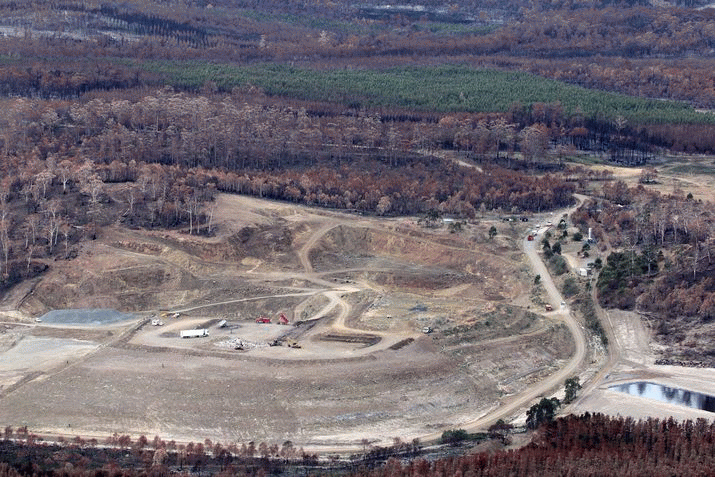

*Pic: The SWS waste dump site …
More waste is going to Tasmanian landfill than ever before. The current form of waste management is not sustainable. Tasmania lags behind the country in terms of waste management, especially diversion from landfill. Consultants “Blue Environment,” commissioned in 2013 by the state government’s Waste Advisory Council (WAC), to investigate current Tasmanian waste management practices, find that:
• Tasmania’s kerbside (municipal) recycling rate of 33%is poor compared to mainland states;
• Our industrial recovery rates are woeful between a half to a third of other states; and
• Construction and demolition (one component of industrial waste) recovery rates are negligible (meaning close to zero).
Blue Environment also finds that mainland landfill operators have much higher diversion rates and also have statewide targets, including 90% for SA, 80% for NSW and Vic. Many overseas countries are up to 90 per cent diversion from landfill into reuse and recovery. Unless Tasmania really comes to grips with managing waste – our throw-away mentality will become a costly burden on the Tasmanian ratepayer.
Hobart City Council has introduced green bins to further minimise waste to landfill in the Hobart municipality and to lengthen the amount of time McRobies Gully can viably operate. This is not entirely to promote a cleaner – greener image but also to allow more time to collect funds to be able to remediate the landfill site when it is finally closed.
Never the less, Hobart’s intervention is laudable as a step in the right direction. HCC is starting to accurately cost landfill and this will potentially make diversion more attractive.
However, leaving waste management to local government entities is a piecemeal approach to managing waste in Tasmania. Entrenched landfill operators, duplication of operations and limited size of population makes negotiation with national waste management industries, on a municipal basis, unviable. Without intervention by state government, landfill, operated by local government entities, will continue to be the unsustainable norm.
Why is state government dragging its heels, when other states are embracing the creation of many new jobs through waste diversion from landfill by imposing waste levies as incentives to promote waste reduction?
As Blue Environment finds, ‘in effect, it is more expensive in Tasmania to recycle material than it is to dispose of waste to landfill. In other Australian states, the development of a robust recycling industry has been led by the introduction of a waste levy. This (waste levy), applies a charge payable by waste generators when disposing of waste to landfill; the levy is not charged (or rebates apply) when the waste material is recovered or recycled. The waste levy provides a financial incentive to recycle, which in other states has been used to fund activities such as the development of recycling infrastructure, establishing markets for recovered materials, resource efficiency assistance to industry, and various strategic waste avoidance and minimisation initiatives. In fact Australian Bureau of Statistics data shows that, in Tasmania around 4 times the number of jobs were created by recycling than by landfill disposal; it also found recycling businesses had annual turnover 700% higher per tonne than landfill organisations.’
This is a missed opportunity for the creation of up to 900 direct and indirect jobs. This information is also backed up by a waste levy benefit study undertaken on behalf of the Southern Tasmanian Waste Strategy Authority by MRA (2015), in support of the Tasmanian Waste and Resource Management Strategy 2009.
The MRA report supports the levy to reduce waste to landfill by supporting businesses to increase resource recovery, recycling and composting. Levies have proven in other jurisdictions to effectively promote preferred alternative waste treatment and does not promote dumping?
Why is the Tasmanian state government determined to promote landfill above all other forms of waste management even though, in the draft Sustainable Infrastructure Australia, Report, 2008 (SIA), into Tasmanian Controlled Waste Practices, names five methods for dealing hazardous waste, other than landfill, that are considered advisable?
With all these reports advising on a state based waste levy, backed by positive data from interstate, why is the state government reluctant to take the lead, although approached on many occasions by proponents of waste diversion from landfill?
Perhaps the state government’s refusal to engage is guided by a few entrenched advisors who have an interest in promoting the status quo – old landfill technology.
Tasmanian landfill operators are owned and controlled by councils or organisations controlled by councils. In the south of the state Southern Waste Solutions (SWS), an Authority owned by four Councils, is an example. This leads councils to support the status quo as they gain financially through tip fees, business gets cheap waste disposal and councils (perhaps with the exception of Hobart) seem to ignore the on-going risks and true long term cost burden to ratepayers, of landfill.
On Friday 6 May a seminar, “Emerging Technologies in Waste Management” attracted speakers from interstate and overseas.
This vibrant seminar, hosted by the Tasmanian branch of Wast Management Association of Australia (WMAA), engaged the audience in potential redirections in waste management already introduced and proven in mainland states and overseas, promoting large scale composting and intense recycling, gasification and waste to energy.
State and local government representatives were there, and could not have missed the strong message made by national and international speakers that without government intervention and state based waste levies, directed to industrial waste producers, changes will always be unviable, piecemeal activities with the cost ultimately falling on ratepayers.
But instead the state government has granted $2 million to the Copping C cell without gaining evidence that there is a need, other than the proponents opinion, recently stated – “because it (Tasmania) hasn’t got one?” We don’t have an incinerator for PCBs either – is this a reason to have one? This statement also assumes we have waste that can only be disposed of to a C cell, which is not the case. It also assumes that all legacy waste is poorly stored or contained. We understand that Nystar’s jarosite – legacy waste, although not ideally stored, is capped and secure.
As examples of how diversion from landfill operates. Two major entities, Nyrstar and Macquarie Point, have not availed themselves of the many offers made by SWS, to subscribe to the C cell.
International company Nyrstar has a policy of recycling its products and prides itself on over 90 per cent recovery and currently sends “waste” produced to its upgraded plant at Port Pirrie SA for further processing leaving an inert residual that can be used for bricks.
Macquarie Point – likewise, has stated that there are more sustainable methods of dealing with site contamination. Unless – of course – they are regaled with such a low cost offer by SWS that economically they cannot refuse!
The need for a C cell becomes all the more questionable following the WMAA seminar. Why and how has SWS received this recent Government funding of $2m to commence building the C cell (total cost $11m), when, there are no customers and no substantial source ongoing hazardous waste and therefore, no viable business case, to warrant this 300,000 tonne landfill facility?
It must also be acknowledged that should the $11m C cell go ahead, this will mean that landfill will be the preferred form of hazardous waste management in Tasmania for the next 20 years at least.
Why has state government refused to impose a waste levy, against the advice of many state based waste management providers, the SIA Report and more recently the MRA 2015 Report, “Tasmanian Waste Levy Benefit Study.”.
Against all evidence to the contrary, should the state government fund a municipal landfill C cell that will take high level industrial, hazardous waste that creates very few jobs and has a high environmental risk? Or should government intervene by introducing a levy to lift the cost of landfill to make reuse and recycling more cost competitive?
Why is state government reluctant to take the reigns as directed in the Tasmanian Waste and Resource Management Strategy, 2009?
But it is not too late for the state government. It has committed to the revision of the 2009 Strategy: this is an opportunity to revisit its waste management priorities.
Peter Derkley,
President,
Southern Beaches Conservation Society Inc. (SBCS)
With acknowledgement to Peter McGlone and Angela Marsh.