Article
The good, the bad and the ugly, even crazy (2) …

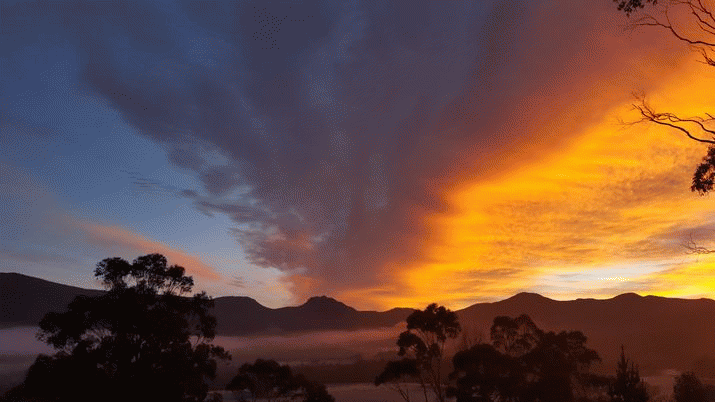

*Pic: ‘Sleeping Beauty breathing out vapour …” Cathy Temby’s picture, taken ‘on a very cold morning’ is from HERE
The below list of parties registered for the next Senate election completes those listed in http://www.abc.net.au/news/federal-election-2016/guide/stas/
As in Part 1 of this article of the same name, the policies and details highlighted herein are a result of my own personal interest and priorities, with effective action on climate change and a sustainable environment being foremost. A few other notable points of interest or policies that caught my eye have been included.
Renewable Energy Party:
The Renewable Energy Party does not appear on the abovementioned list but TT has an article by Jack Gilding, the party’s campaign manager here: http://oldtt.pixelkey.biz/index.php?/pr-article/new-party-puts-the-election-focus-on-renewables/
The party is tightly focussed and policies all work towards 100% electricity from renewable resources by 2030; 40% transport needs met by renewable energy by 2035; and the urgency to move to net zero emissions by 2050 to limit global warming by 1.5 degrees C.
Arts Party:
“A CREATIVE VISION FOR THE FUTURE”. The Arts Party was founded to encourage the creative, cultural and educated life of every Australian.
Policies focused solely on arts & culture, the industry incl. film, TV, radio & music etc.
Mature Australia Party:
“ MAP stands for all mature-age Aussies who believe they are entitled to more effective and equitable representation by those we elect, and more say in the decisions of our parliaments and governments. MAP believes that we have been bogged down, for too long, in short-term policy and decision making in our political and governmental systems and processes – instead of offering positive actions and initiatives to secure long-term goals. “
Policies mostly relate to superannuation, pensions, taxation etc, but also looks at sustainable economic development & investment. Water and energy security are addressed, but not in the context of climate change mitigation or protection of the environment.
“MAP wants to see an integrated national energy program drawing on Australia’s ample reserves of high quality coal and natural gas, and our acknowledged potential in areas of solar, wind and water power generation. It should not be – and MUST not be allowed to become – a question of “either –or”. We are rich in ALL of these natural resources – and we must use them all.
Recurring droughts and water shortages which are holding back (even crippling) our primary and secondary production, sapping the life out of our rural communities..even impacting on our mining industries and our urban lifestyles…. are among the most serious issues facing Australia today.
MAP wants to see a long-overdue national infrastructure scheme implemented to harness, conserve and use our abundant national water resources across the nation, as a major commitment to rival – even exceed – the Snowy Mountains Scheme of the 40s and 50s.”
Nick Xenophon Team:
“ Climate change & energy– Action is required to reduce carbon emissions and our reliance on fossil fuels and inefficient forms of energy generation. Australia is uniquely placed to embrace renewable energy resources. Government at all levels must play an integral role in leading a best-practice approach. It is about being smart and efficient for the benefit of the planet.
Environment – Clean air, clean water and preserving our iconic natural resources are fundamental to guiding what we do for our environment – not just for us, but for Australia’s future generations.
Live animal exports – It is important that strict controls are placed on live animal exports to ensure animals are treated in accordance with Australian animal welfare standards. However, our preference is to have Australian processing and the exporting of chilled meat.
Utilities – ideally all essential utilities (electricity, water, gas and NBN) should be owned by the public. Current rules need to change to have a greater focus on the rights of consumers and small businesses.
Food security – Australia needs a comprehensive strategic approach to protect, invest and grow our own food production resources. It is an integral part of our national security.
Predatory gambling – targeted gambling reform is required. We have the world’s highest per capita gambling losses and level of problem gambling. Our governments are totally out-of-touch with the overwhelming community desire to rein in the damage caused. “
Science Party:
“ The Science Party was founded with the primary goal of implementing good policy. Policies cover a range of areas where the Science Party sees the need for advancement and reform, and it is continually being expanded.
Renewable energy is pivotal to reducing pollution from energy production. Our energy policies include: an ETS and modernising the grid.
Environment – includes protection of native forests and action on climate change.
Science & research – The Science Party will plan for the future through targeted government investment in areas that encourage economic and technological development. This includes: doubling the investment in research to $18.4 Billion; and encouraging research into safer sources of nuclear energy, including fusion and thorium reactors.
Freedom & rights – includes the legal right to voluntary euthanasia.
Immigration – The Science Party has a plan for migration, the 20/20 vision, that will increase migration to keep our economy strong and counteract the ageing of our population. This plan aims to increase Australia’s population by 20 million people over the next 20 years.
Animal welfare – includes the creation of an independent office for animal welfare; research into ‘in vitro meat production’ (?); opposes battery cages, sow stalls and jumps racing; and has restrictions for live animal exports. “
Pauline Hanson’s One Nation:
“ Affordable energy – climate science: Climate change has and will continue to be used as a political agenda by politicians and self interest groups or individuals for their own gain. We cannot allow scare mongering by people such as Tim Flannery, who make outlandish statements and are not held accountable. Climate change should not be about making money for a lot of people and giving scientists money. Lets know the facts and scientific evidence to make a well informed decision as to how best to look after our environment.
Paying a carbon tax or an Emissions Trading Scheme (ETS) is not going to wave a magic wand and stop nature changing the climate change. It will only make it harder for Australian families and businesses to make ends meet. We can address real environmental issues with legislation. Hitting struggling families and businesses with another tax has been designed to make some people a lot of money. Don’t allow yourself to be misled.
Instead of so-called ‘Alternative Energies’ that are really ‘alternatives to energy’, we will work to reduce energy prices, and bring back dependability and reliability through environmentally responsible, energies. Low cost energy enables efficiency and productivity that generate wealth to protect the environment.
Our primary producers produce plant by-products which are currently wasted. Where conditions and economics allow, let’s enable them to make biofuels.
Australians are at our best in sporting conquests and recovering from Natural disasters. Mateship shines. The greater the challenge the better Australians perform. “
There are fourteen listed solutions, too much to reproduce here.
Euthanasia – supports this with strict conditions & processes.
Sustainable development/Agenda 21 – In 1992, Paul Keating signed Agenda 21 on behalf of Australia. 178 Nations around the world signed Agenda 21. What is Agenda 21 you may ask? In short, it’s about global land use, global education, and global population control and reduction.
Agenda 21 leaves no stone unturned and no person outside of its reach. In order to accomplish its goals of sustainable development and to make you into a so-called “steward of the environment,” Agenda 21 seeks to control you and your life.
Another arm of Agenda 21, is to privatise water. A farmer can only capture 10 % of the water in his dam, the rest must flow to the rivers and creeks, or be taxed.
Agenda 21 also calls for the fencing of rivers and creeks, at the expense of the land owner, to stop live stock from accessing the water, supposedly for environmental purposes. Water is our life’s blood, without it we will die.
No government or individual has the right to own or control another person’s use of water. In a drought stricken country such as Australia, we should be assisting farmers to put more dams on their properties, not shut them down with fines, taxes and meters, or limiting the size of a dam if it does not impact on other properties and their water supplies.
It’s the man on the land that is being targeted today, tomorrow it will be the cities that will be taxed for the rain water they capture in their tanks.
In September 2015, the United Nations held a ‘Sustainable Development Summit; where they officially released ‘Agenda 2030,’ following Agenda 21.
These Agendas are designed to control people’s rights, water, population, health, education, sovereignty, ownership of land and how we choose to live our lives.
One Nation will further research, inform Australians and repeal these Agendas if not in Australian’s best interest. Some states in America are repealing Agenda 21 due to the desolation it has caused.
Water – We propose the establishment of a Federal funded, no catches, no blackmail, water management plan Australia wide, to ensure adequate storage and supply of water and prevent its degradation. We do not believe in the commercialisation of a God given resource resulting in the exploitation of Australians for the profit of a few.
One Nation believes water is so important that it should have its own portfolio. As one of the world’s driest continents, Australia must use its water resources wisely. The main problem is more one of unequal distribution and storage rather than shortage. We propose water management practices to provide adequate storage. Re-use of suitably treated recycled water and the piping of it inland for use by councils and rural land for irrigation. We do not believe in the privatisation of water. Environmental fundamentalism is driving policies that are eroding our property rights through greatly increasing the regulatory burden (Water charges and COAG) and by denying us our constitutional rights.
Primary industries – One Nation will protect our primary industries from deregulation and withdraw from international treaties which put us at any disadvantage.
Home ownership for young Australians – One Nation proposes to allow Australians up to the age of 38, to access their accumulated superannuation funds, to use as a deposit to buy their first home.“
Family First:
Most well known representative is Senator Bob Day, SA.
“ Climate change – Family First’s position is (selection only here):
– Climate change has been occurring since time immemorial
– Claims that ‘there is a scientific consensus’ and ‘the science is settled’ are not true.
– Carbon dioxide is not a pollutant, it is plant food.
– Carbon dioxide has had no discernible influence on the world’s climate in the past and there is no reason to believe it should in the future.
– Where someone wishes to ‘do something’ about climate change, they must do so at their own cost. – Low income people could not afford the capital cost of participating in photovoltaic (PV) solar panels or similar schemes, so ended up subsidizing the middle and upper classes with the capital cost of acquiring them. This is unconscionable, and can not be resolved through a tax and compensation scheme. This only churns money and continues to pick winners. The only way that people should address their own concerns on such matters is to spend their own money, or form private companies to invest in that area without government subsidies.
– Family First opposes the introduction of any emissions trading scheme or so-called ‘carbon tax’ and believes it would be grossly irresponsible to proceed with such a policy that will involve major changes to the Australian economy without first having a proper, independent inquiry e.g. a Royal Commission, which was prepared to listen to the many distinguished scientists who disagree with the current ‘climate change doctrine’.
Life – Family First supports the right to life. It opposes abortion and euthanasia. “
Australian Sex Party:
“ Biodiversity – Our survival depends on clean water, healthy food and fresh air and these must not be sacrificed for short term economic gains. The Australian Sex Party supports the protection of biodiversity, old-growth forests and marine parks and fisheries.
Fracking – Australia needs to end its reliance on fossil fuels. The Australian Sex Party accepts that this can’t happen immediately, and that interim energy supplies are needed. If unconventional gas continues to be used, it should be seen as a short-term solution only, using industry best-practice, following environmental reports and should not include hydraulic fracturing (fracking). Hydraulic fracturing poses an unacceptable risk to Australian farming.
– Prohibit the future use of hydraulic fracturing and ensure that environmental damage associated with future unconventional gas projects is minimised.
Great Barrier Reef – The Australian Sex Party will protect the Great Barrier Reef by:
– Committing $250 million of Federal Funding over 5 years to address Sediments, fertiliser and pesticides from farming flowing into the Reef’s water.
– Banning all offshore dumping of dredge spoil in the Great Barrier Reef and its surrounding area. On-shore dredging to be allowed only after thorough environmental impact studies conducted.
– The Australian Sex Party’s commitment to stop burning coal in an effort to reduce climate change and local environmental impacts will assist the protection of the Great Barrier Reef.
Renewable energy – Anthropogenic climate change poses an immediate existential threat to humanity. We must accelerate our development of renewable energy sources. The Australian Sex Party will:
– Subsidise the development of renewable energy industries, including established industries such as wind and solar.
– Push for alternatives to burning coal for base load power. A base-load cannot be economically achieved in the short term through renewable sources such as solar panels and wind turbines. Given Australia’s stable geographic profile and the resources available, nuclear power may be the best source of base-load power during the transition to a more robust renewable energy system. The Australian Sex Party will consider all options for replacing coal burning as Australia’s main source of power and advocate for further nuclear investment.
Science funding – The Australian Sex Party will work with Parliament to develop a strategic, long-term vision for science, and commit to long-term research funding. “
In conclusion, this exercise in familiarising myself with the policy detail of senate parties on offer has been very enlightening. I’ve learned that the name of the party or even the presentation of their leaders can often be misleading. In some cases, I have actually been shocked by the content of some of the policies; and I’ve also been made aware of the ‘true agenda’ and poor quality of some parties by the way their arguments are put (tone, treatment & credibility) within their own websites.
Before casting your vote on July 2 2016, I encourage all concerned voters to delve into each of the parties – the party’s goals, arguments for policies and whether their priorities on balance fit yours. Please, don’t vote ‘blindly’. Don’t be (mis)led by the name or the image presented by the leader. Look into the detail first, please, to make sure you give a fully informed vote to someone you really agree with!
• Hans Willink in Comments: … I concede that my anti-Malthusian, pro-immigration view has perhaps been influenced by my Dutch origins. Holland, a country about two thirds the size of Tasmania, is the world’s second largest exporter of agricultural products, after the USA. Together with the USA and Spain, the Netherlands is one of the world’s three leading producers of vegetables and fruit. It supplies a quarter of the vegetables that are exported from Europe and with exports earning €80.7 billion. As an analogy, take Tassie, lop off the west coast, then put ALL of Australia’s population into it and then feed most of Asia as well as ourselves. How do they do it? (and do it sustainably)? Through technology, research and science! …