Economy
End of an empire

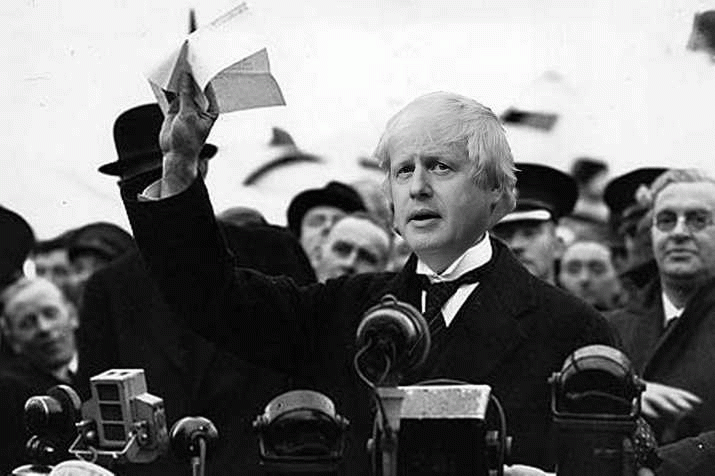

*Pic: Boris Johnson as Neville Chamberlain … Pic by cogito ergo imago, Flickr
The world’s geo-political axis has been turned topsy-turvy as a result of a major tectonic shift that no-one really saw coming.
On 24 June 2016 thanks to Brexit, Great Britain lost its greatness.
Empires go with a whimper, never a bang.
And they always whither from within.
Look at the Roman empire, which broke into two around 476AD, with the Western part crumbling quickly while the Byzantine wing took another millennium to disappear.
More recently, the arguably greater USSR empire collapsed without a shot fired in anger on 25 December 1991.
Why is Great Britain no longer great?
Because its constituent parts that supported the remain campaign, notably Scotland and Northern Ireland will most probably seek greater autonomy, if not outright independence from the now dis-United Kingdom in order to remain with the European Union, as will the rock of Gibraltar, where an overwhelming 95.9 per cent voted against Brexit.
Even within England, there is a yawning geographic divide between the pro-Brexit rural areas and the pro-remain major urban areas, most notably the City of London, where its major international financial status is now at risk as is the British currency.
It will be interesting to see whether London secedes from the rest of England or seeks greater autonomy, like Hong Kong has within the PRC’s ‘one country two systems’.
Also just as significant, is the demographic story that pits the higher-educated, younger and richer constituents against the older, less qualified, lower socio-economic predominantly white constituents.
The baby boomers and X-generation have conspired to block the aspirations of the Y and Z generations through the Brexit result.
By a fell swoop, the latter group can no longer live and work in the 27 nations that make up the European Union.
In some ways the end of the British empire will have greater repercussions for the world economy than the dissolution of the USSR, including any domino effect that this could bring to the European Union itself.
No-one really knows what the full ramifications are of Brexit.
We live in interesting times.
Source: The Guardian, ‘EU referendum: full results and analysis’ (www.theguardian.com/politics/ng-interactive/2016/2016/jun/23/eu-referendum-live-results-and-analysis)


*Phil na Champassak co-owns The Madsen Boutique Hotel in Penguin and is a founding board member of the Cradle Coast Innovation Inc whose purpose is switching on innovation in a regional context and enterprise.
FOR and AGAINST leaving …
• John Pilger: Why the British said NO to Europe
• Laurie Penny, New Statesman: I want my country back This was never a referendum on the EU. It was a referendum on the modern world … It says something about this campaign that I’m no longer at all worried about risking hyperbole or unoriginality when referencing all that Nazi history they made us study in school. I’m just frightened. I’m frightened that those who wanted “their” country back will get their wish, and it will turn out to be a hostile, inhospitable place for immigrants, ethnic minorities, queer people – everyone and anyone who wasn’t included when Farage proclaimed victory for “ordinary, decent people” this morning in front of a posse formed entirely of angry-looking, whey-faced blokes in suits …
• Nick Cohen, Guardian: There are liars and then there’s Boris Johnson and Michael Gove … Yet they gazed at the press with coffin-lid faces and wept over the prime minister they had destroyed. David Cameron was “brave and principled”, intoned Johnson. “A great prime minister”, muttered Gove. Like Goneril and Regan competing to offer false compliments to Lear, they covered the leader they had doomed with hypocritical praise. No one whoops at a funeral, especially not mourners who are glad to see the back of the deceased. But I saw something beyond hypocrisy in those frozen faces: the fear of journalists who have been found out. The media do not damn themselves, so I am speaking out of turn when I say that if you think rule by professional politicians is bad wait until journalist politicians take over. Johnson and Gove are the worst journalist politicians you can imagine: pundits who have prospered by treating public life as a game. Here is how they play it. They grab media attention by blaring out a big, dramatic thought. An institution is failing? Close it. A public figure blunders? Sack him. They move from journalism to politics, but carry on as before. When presented with a bureaucratic EU that sends us too many immigrants, they say the answer is simple, as media answers must be. Leave. Now. Then all will be well.…
• Guardian (Observer): View from Wales: town showered with EU cash votes to leave EU In Ebbw Vale, with little immigration and perhaps more EU investment than any other UK small town, the sense of injustice is greater than the sum of the facts
• OffGuardian: Guardian Watch: Insults fly in post-Brexit hysteria
AND … James Dryburgh …
• James Dryburgh, Right Now: AUSTRALIA: BECOMING THE “OTHER” Polish journalist Ryszard Kapuściński spent his life immersed in human conflicts all over the world. Reflecting upon decades of observation, he concluded that the Self is not a solitary individual – its composition includes the Other. In simple terms we use the concept of “Other” to distinguish between ourselves and those of different traits – such as nationality, religion, gender, or ethnicity. Since the Howard era, collective Australia, “public Australia”, has been obsessed with negative perceptions of the Other and in doing so has damaged the Australian Self. Heading toward the 2001 federal election and fearing defeat, Prime Minister John Howard embedded a strong concept of the Other into our public language with the now infamous words: “We will decide who comes to this country and the circumstances in which they come.” We heard the clear implication that “boat people” (they) are not like us. The Other was demonised with parroted lies about children being tossed overboard by “the kind of people we don’t want in Australia.” At least since the time of Plato, it has been understood that for politicians it is easier to pander to our inherent vices than to harness our virtues. It is also well known that when fear increases, society becomes more conservative. …