Economy
Tasmanian devil cancer research down a blind alley?

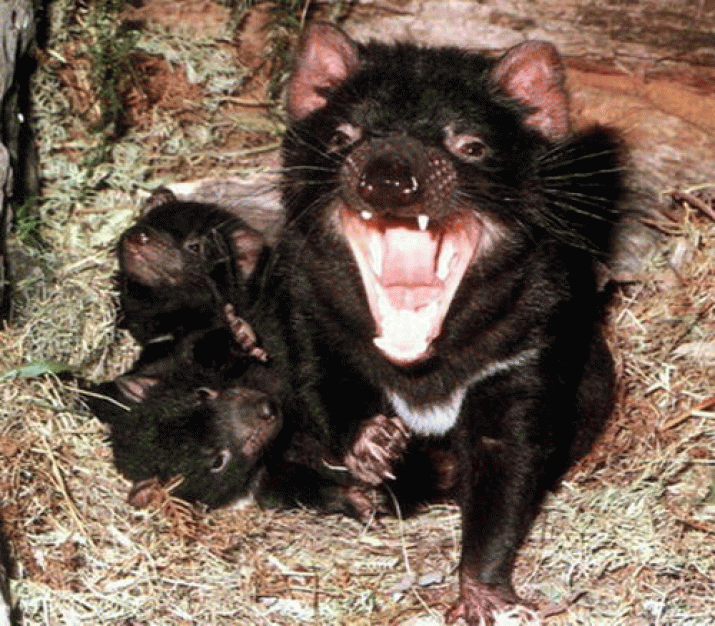

Scientists have been investigating a deadly disease afflicting the Tasmanian devil, a carnivorous marsupial on the verge of extinction due to what is called devil facial tumour disease or DFTD.
They have followed a single research pathway, assuming the cancer is an allograft, namely a transmissible tumour.
For a decade, investigations into possible alternative explanations for DFTD have been neglected, despite calls for transmission studies.
Cui et al in a paper published in Biochemical and Biophysical Research Communications on 20 May 2016 provide evidence that DFTD is actually not a transmissible tumour.
They say that Tasmanian-government-sponsored research into the devil cancer ‘could only have proved that DFTD tumours were clonal’, namely in a cell line, but not transmissible.
Cui et al proved that DFTD tumours in male devils ‘were induced in their own hosts’, so they were not induced from cells from another devil’s tumour.
This is evidence that the claim that a single ‘rogue’ cancer originating in a female devil ‘was incorrect’.
Cui et al are undertaking further research to investigate the possible role of viral induction of DFTD.
Studies into the possible role of pesticides and poisons that have polluted the devils’ environment are still urgently needed.
Download, read for yourself …
*Dr Jody Warren is Honorary Post-Doctoral Research Associate, School of Humanities and Social Inquiry, University of Wollongong