Economy
The Pain You Feel is Capitalism Dying

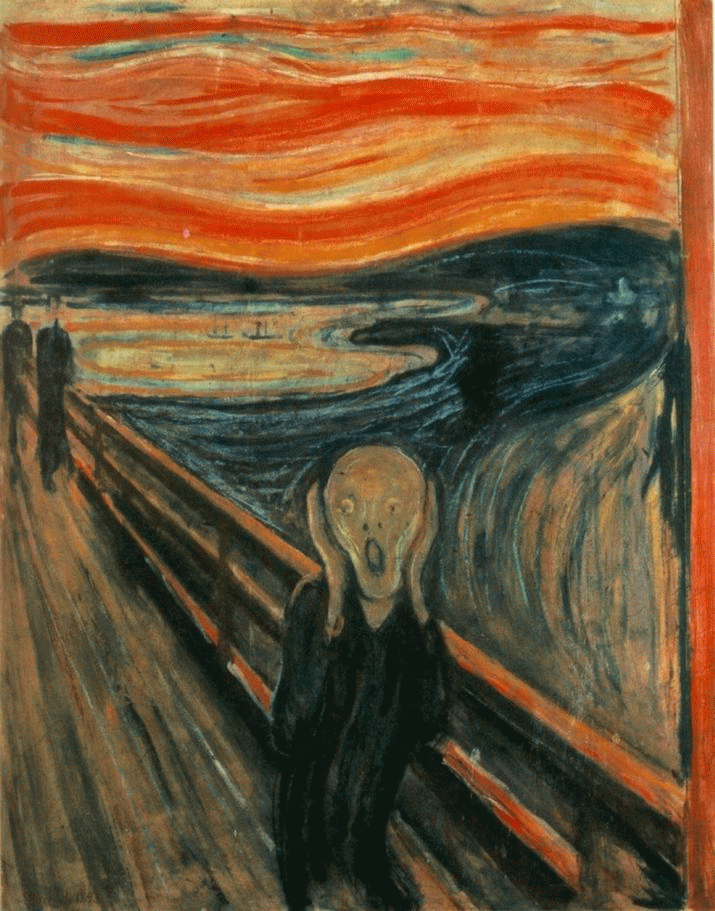

*Pic: All about Edvard Munch’s The Scream, HERE
It can be very confusing to know that you won’t find a decent job, pay off student loans or put in a down payment on a house in the next few years — even though you may have graduated from a top-tier university or secured glowing references from all those unpaid internships that got you to where you are today.
Even if you are lucky enough to have all of this going for you, you’ll still be one among hundreds of applicants for every job you apply for. And you’ll still watch as the world becomes more unequal, with fewer paid opportunities to do what you feel called to do in your work or for your life path.
What’s more, you won’t find much help from your friends because most (if not all) of them are going through the same thing. This is a painful and difficult time that is impacting all of us at once.
There will be people who tell you it’s your fault. That you aren’t trying hard enough. But those people are culprits in perpetuating a great lie of this period in history. The standard assumptions for how to be successful in life a few decades ago simply do not apply anymore. The guilt and shame you feel is the mental disease of late-stage capitalism. Embrace this truth and set yourself free.
To see how broken things have become you’ll have to think systemically. Take note of the systems built up to create this situation and understand how it came to be — so you’ll see why it cannot possibly continue on its current path.
First, a diagnosis of the problem …
A Global Architecture of Wealth Extraction has been systematically built has been systematically built up to rig the economic game against you. This is why a tiny number of people (current count is 62) have more wealth amongst them than half the human population.
Decades of those using tax havens to hide their wealth, unfair trade agreements designed to extract wealth from poor countries, banking regulations and austerity measures meant to destabilize entire economies so massive transfers of wealth can go from everyone else to a tiny financial elite, and election rules that all-but-guarantee only those who become whores to these financial pimps will ever sit in high office.
So yeah, it’s okay to feel restless as capitalism winds itself down from these system-level harms to society.
Why do I say that capitalism (in its corporatist, wealth-extracting form) is dying? There’s a long, detailed story that could be told about this. For the sake of brevity, I will answer with two essential pieces that show how business-as-usual is finished. It is physically impossible for it to continue much longer.
Reason 1: There Are No More Profits to Extract.
As eloquently described in the writings of Jeremy Rifkin and Paul Mason, the primary motivator for capitalists — to extract wealth from consumer exchange in the form of monetary gain — is crippled by the fact that the science of wealth extraction has become so advanced that every new wave brings diminishing returns. What is called “marginal cost” by economists, the difference between how much it costs to produce something and what people are willing or able to pay for it, is nearly zero now for everything we manufacture or provide as a service. This zero marginal cost trend is breaking capitalism down by the unexpected outcome of its own spectacular success.
Add to this that most of the growth in the global economy in the last 40 years has been in speculative finance. The money system grows faster than the productive “real” economy — with the predictable outcome of market crashes, financial collapse, and structural adjustments (wealth extraction) when the mismatch grows too large. What we end up with is bloated debt too large for everyone to pay back. Combined with the end game of wealth hoarding mentioned above, this is a death knell for capitalism as we’ve known it in the last 100 years.
Reason 2: Damage Built Up in the Natural World
There is no such thing as an economy that exists without the physical world. The delusional idea that markets are separate from nature has guided mainstream economic policy for a long time — and now we are seeing the consequences in mass extinctions, loss of topsoils, climate change, collapse of fish stocks in the world ocean, rising levels of pollution, and more …
*Joe Brewer a change strategist working on behalf of humanity, and also a complexity researcher, cognitive scientist, and evangelist for the field of culture design.