Travel
Struth!

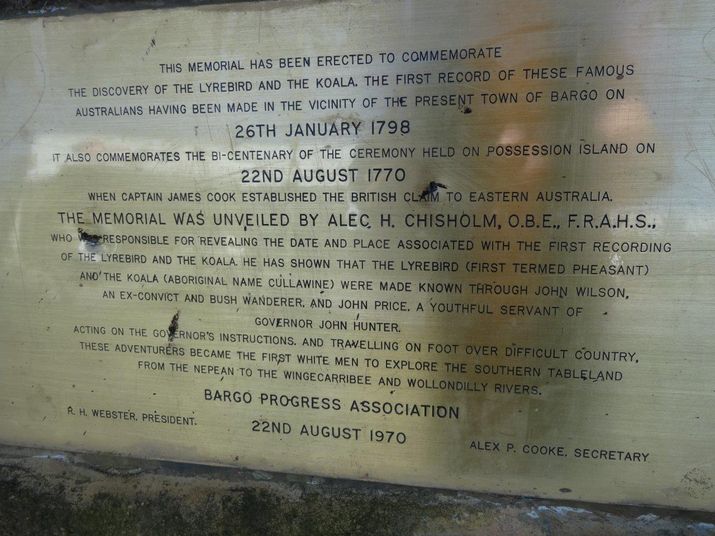
PLAQUES commemorating the first sighting by white man of a koala and a lyrebird at what is now Bargo in NSW on January 26 1798. (Pics: David Ellis)

IN his continuing search for the more weird, wacky and wondrous in this world, David Ellis ponders just how coincidental was it that the first sighting of a koala and a lyrebird in Australia by white men in 1798, should have occurred on January 26 of that year – the date that was to ultimately become our Australia Day.
Convict John Wilson who had been transported for stealing ten pence worth of cloth from a shop in Lancashire, arrived here on the ship Alexander with the First Fleet in 1788, and when freed after seven year’s penal servitude, largely shunned white society and chose to live with Aboriginal people who taught him much about survival in the bush.
Ten years later, when Governor John Hunter decided to investigate what lay in the distant highlands to the south-west of Sydney Town, he put together an exploration team of four Irish convicts, their guards, one of his servants named John Price, another free man, and as their guide, John Wilson whom he recruited for his bush knowledge.
The Irish convicts and their guards soon tired of the harsh trek and returned to Sydney Town, but Wilson, Price and the other man continued on foot, Price who was just 19 at the time keeping a journal in which he detailed the harsh conditions they endured.
And on January 26 1798 while camped at what is now the township of Bargo, he recorded the trio’s first-ever sightings by white men both of a koala and a lyrebird – Price describing the latter as a pheasant, leading to a-now village nearby being named Pheasants Nest.
Plaques of a koala and a lyrebird, and a third commemorating the trio’s historic sighting, are mounted on three boulders in a small park at the spot in Bargo.
David Ellis, ellispr@bigpond.net.au
