Economy
STATE: Is the UTG to be Tasmania’s moral compass?

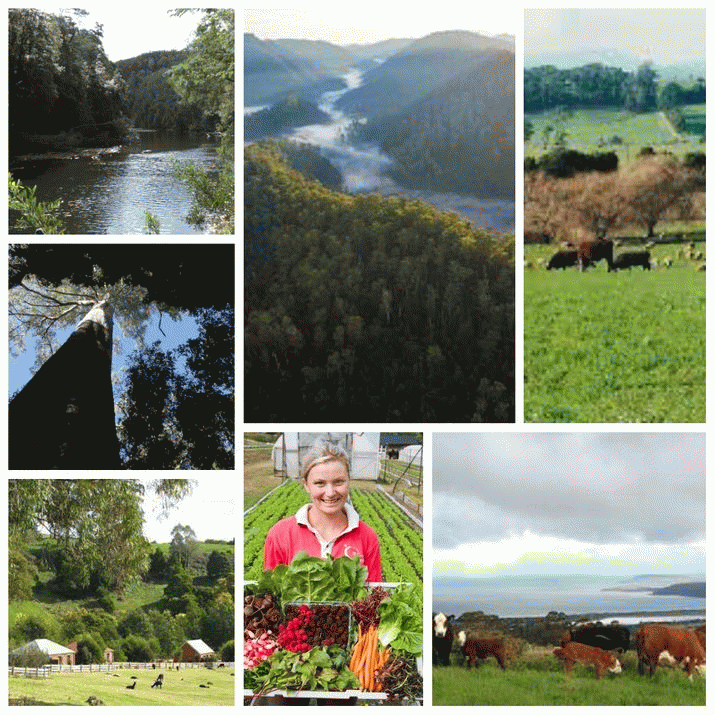

From a social ecology perspective, there is no surprise at a loss of direction by the Tasmanian Greens. We saw this when the Democrats lost their way and failed to reflect internally. Without serious internal reflection and learning, loss of moral compass is almost inevitable for political parties. The re-emergence of the United Tasmania Group in the voice of Geoff Holloway, represents just such a dissatisfaction with the ability of the Tasmanian Greens to reflect on their own moral compass and performance.
The chardonnay policy focus and corporate language of brands etc, by Cassy O’Connor and Co suggest a loss of connection with the green charter. Not that commercial literacy in a greenie is not to be valued, but it’s the suggestion that practical considerations are as a matter of course put before moral questions; something that never has been taken lightly in the green movement.
The reason the debate about wilderness policy has not been had internally, is because of lack of understanding and respect by some green parliamentarians for party policy conversations, just one of many issues that still need serious review following the last state election caning. Anecdotally, the reason O’Connor and Co co have not heard, is that there is no confidence that she can hear or respond to critique appropriately. None deaf as will not hear.
Geoff makes the point privately that social history literature suggests that all aspirational democratic movements are fated to become trapped by the exigencies of power; ref Michels ” iron law of oligarchy” .
It would only be fair to make the point that all the major Tasmanian parties appear trapped by the same phenomena. The UTG would equally be vulnerable too if it became a party, but its role is far more valuable as a moral bulwark for all progressive Tasmanians and their respective political parties.
However the green movement in Tasmania is much bigger and broader than any single political party; its members are active in all parties. Many will be attracted back to the Tasmanian Greens if a respect for difference can be recreated.
As dysfunctional as existing political parties may be, their role is a fact within current constitutional arrangements, they but are sorely in need of structural evolution on several grounds:
A) The need for a clearly articulated moral platform. Here the Tasmanian Greens are blessed by having both their own charter and their progenitor, the UTG’s “new ethic” to reflect on. Questions like, are we walking the talk? need to be systematically and openly discussed.
There are too many in the party that have not taken the time to reflect on how well they have walked the talk at a personal level, at the organisational level or at the parliamentary level. If they wish to be the party of moral leadership, internal practice must live it. It has lost too many outstanding people recently.
B) All parties need a clearly defined boundary between the parliamentary wing, party proper, and of course donors. The Tasmanian Greens currently have a problem with parliamentary interference with party process; Liberal and Labor yet to sort the issue of donor overreach which gave us the Gunns/Forestry fiasco.
C) The internet has changed everything. Transparency in all things is the order of the day. Sooner or later all the necessary facts for citizens to make judgments will come to light, Ref Panama papers”, “Wikileaks” etc. Staffers who feel betrayed can so easily leak electronic records. Openness, transparency and public accountability are the only secure option for politicians now. There is no longer a barrier to more direct dialogue with citizens about issues of the day. The richness and diversity of citizen stakeholders is the resource needed to understand complex situations. Getup is an example of how citizen views can be represented now. Narrow self-serving oligarchies have no where to hide now.
It is clear for the Tasmanian Greens, there has been a bit of a vacuum of moral leadership since the retirement of deeply-trusted Kim Booth and Bob Brown. A predictable succession-challenge to which their successors must rise, now they realise they have a leadership role that is different from representation. Success will depend very much on them growing personally into the jobs.
Tasmania sorely needs fresh energetic leadership; all parties seem to be floundering in the area of strategic thinking and risk management. It is clear the complexity of our ecological economic environment is beyond the grasp of current elected parliamentarians, and also their own charter.
Tasmania sorely needs fresh energetic leadership. All parties seem to be floundering in the area of strategic thinking and risk management. It is clear the complexity of our ecological economic environment is beyond the grasp of current elected parliamentarians. They should remember they are only ordinary citizens with a limited skill set. Their role is not to solve our problems but to facilitate good process of governance. They need to bring back the career public servants who are able to challenge self-indulgence, group inertia and group think and be protected from retribution. Public servants need to be educated in the art of developing community conversations on complex strategic issues, like inter-generational equity, social justice and environmental responsibility, in order to guide policy development.
Because of its clearly-articulated moral foundations, Tasmania needs the Tasmanian Greens to lead us out of this mess, providing they get their housekeeping done. The beauty of being a small state is that we can respond quickly when we have to, as we did when the UTG and collaborators put an end to the post WW2 Hydro hegemony.
Maybe parliament does need a party of absolute principle as intimated by the UTG?
*Duncan Mills is a social ecologist living near Cygnet with experience in party politics, large organization and agriculture, concerned with issues of human awareness, consciousness and wellbeing.
• Mark Horstman, Catalyst, ABC: Tassie Fires We like to think Tasmania is a refuge from climate change – a cool green island at the bottom of a warming world. But this summer may have seen a tipping point. The unprecedented number and size of fires ignited by dry lightning in Tasmania are no longer ‘natural’ events. Conditions are so dry that the soil itself is burning. Ecosystems normally too wet to burn are going up in smoke. 1000 year old World Heritage forests face irreversible loss. Is this what climate change looks like?