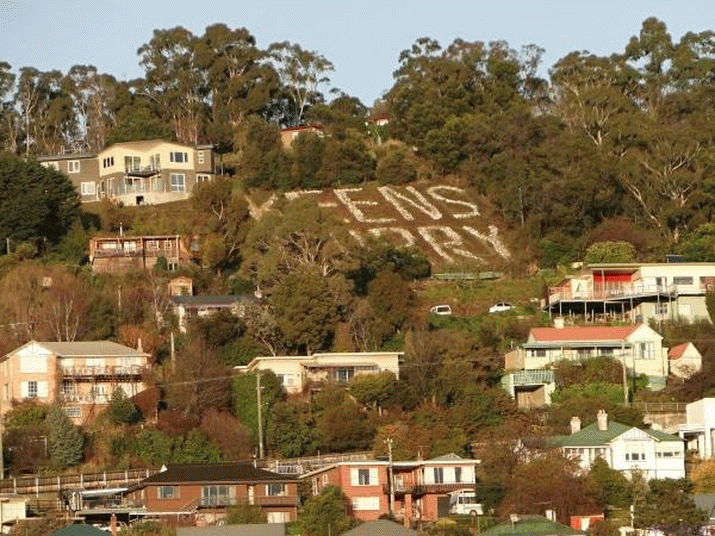
I’ve only just seen my old friend Charles Wooley’s piece “Deceptions and such pranks are fun”, which appeared in the Tasmanian Times last April ( HERE ). Charles is an amusing and at times eloquent writer and he was on form with this piece.
The events he describes did happen: close on 50 years ago, a group of us re-arranged the white-painted stones of the KEEN’S CURRY sign in South Hobart to read NORM CURRY. It stuck out like dog’s bollocks on that hillside and a Mercury scribbler wondered if it referred to Arnold Curry, an ex-Communist union official who was known as Norm to his mates.
However, as Charles relates, we had in fact “outed” an ASIO agent of that name for spying on students and staff at the university. Sadly, Charles and I today can only agree on the mechanics of what he regards as a “prank”. Otherwise we are two old blokes at political loggerheads.
Old men often regret what they see as the “excesses” of their youth, sometimes with good reason, but more often because they have abandoned the principles they held so passionately in their youth. Sipping their Grange Hermitage and shuffling their share certificates, such old fogeys have made their peace with the bourgeoisie they once loved to shock — and even dreamed of overthrowing.
Alas, by his own admission Charles didn’t even make it to old age before morphing into a “good conservative” and today he disowns his youthful ways. He laments that “young and thoughtless we took this [the exposure of the agent] to be a giant hoot”. “How terrible it must have been,” he moans, “when all over town he [the agent] heard people asking ‘Who is Norm Curry?’”
It’s touching that Charles frets over a spook’s career blighted by the naughty students but I doubt that Norm was enrolled at the university under the name on his birth certificate and he was probably quietly transferred when his cover was blown.
But there are more serious objections to Charles’s belated and misplaced concern. Norm Curry was not some inoffensive pencil pusher; he was an agent spying on behalf of the government. As Charles himself reminds us, the Vietnam War was raging at the time and we young men were forced to register for what the Liberal government euphemistically termed “National Service” and the public called “the Nasho”.
We weren’t allowed to vote, but if your marble rolled out in the Tattslotto of death that was the farcical selection ballot, you’d be whisked off to basic training and a decent short back and sides at Puckapunyal. There, along with rifle drill and other military skills, you were filled with bunkum about the Domino Theory and how Australia was supporting the allegedly “democratic” leaders Diem, Thieu and Ky in Saigon.
Many of the 19-year-old “nashoes” found themselves shipped off to Vietnam. There in the jungles and paddies, they fought farm boys and girls who had never done anything to us and who were fighting to unite their country and drive out the latest foreigners in a line that had had variously occupied it since 1858.
Quite a few of my boyhood friends were “nashoed”. Old men said it “made men of ’em” but conscription destroyed the lives of countless young men. One kid I grew up with lost a leg and another came back with shrapnel wounds all up his back. Over 500 Australians died there and thousands came back with what the Yanks called the “thousand-yard stare”. Many still bear the physical and psychological scars of a war that was none of our business. Some of them had been bathed in Agent Orange and they had to fight the government, the bureaucracy and the R.S.L. for an admission of what it had done to them.
Menzies and the other old men responsible told the public that we had to be in Vietnam to stop the dominoes falling all the way to Australia. I’ve never worked out whether they actually believed it, or whether they knew it was bullshit but justified it to themselves as a necessary fib to maintain the US alliance. Whatever the case, it sucked people in. When a friend applied for recognition as a conscientious objector in Hobart, a fool of a magistrate demanded, “What would you do if a Chinese Communist soldier was raping your mother on the front lawn?”
And if the war was traumatic for the American, Australian and New Zealand boys drafted to fight it (and their families, subsequently), let’s not forget what it meant for the Vietnamese and the other peoples of Indochina. Somewhere around three and a half million Vietnamese died during the Second Indochina, or American, War and this came on top of those who died fighting the French and the Japanese.
The sheer scale of the onslaught by the most powerful country in history on a Third World people is mind-boggling. One author wrote of “the opulence of America at war”. Vietnam’s ecology was shattered by a superpower that tried to “bomb it back into the Stone Age”. In total, the US exploded 11.3 million tons of munitions in Vietnam, dwarfing the amounts fired in all theatres of World War II. Over 72 million litres of herbicides were sprayed, affecting 43% of the cultivated area of South Vietnam and vast swathes of forest and mangrove. On top of this, whole areas were defoliated by napalm, Rome ploughs* and high explosives dropped in massive amounts from B-52s. The effects of the war continue to this day and are summed up thus by a Vietnamese writer: “not since the Romans salted the land after destroying Carthage has a nation taken such pains to visit the war on future generations”.
Norm Curry was not playing some kind of harmless game when he sat in lectures listening what his lecturers said — particularly the leftist ones. ASIO’s brief was to spy on and disrupt those who actively opposed the war and conscription. The Liberal government was perplexed and outraged that young people dared to speak out, march in the streets, occupy the conscription offices, and refuse to register for National Service. We also incurred their ire for opposing apartheid and supporting the Gurindji people’s struggle for land rights. We also distributed leaflets in the Hobart streets giving the exact location of the city’s ASIO offices, with an explanation of the spooks’ activities and we revealed Curry’s identity in another leaflet circulated on campus.
You can read the ASIO reports about those events online today. The spooks didn’t stop when the putative Mr Curry was outed. The files are heavily redacted, but enough remains to show that they sat in on meetings, befriended unsuspecting participants, filmed them, tapped phones, staked out people’s houses, bugged premises, and followed activists about. In some cases, they intervened to prevent people from gaining employment. If things here were as they were in the UK, undercover operatives even slept with unsuspecting peace activists.
By 1973, the spooks had become so arrogant that they refused to provide information to their theoretical boss, Lionel Murphy, the Attorney-General in the Whitlam Government. In response, Murphy led a raid by Commonwealth Police on their Melbourne HQ. It’s the closest they have ever come to getting their come-uppence.
Today, their power is greater than ever. They can arrest people on suspicion of offences, hold them incommunicado, force them to answer questions, and even have them gaoled if they divulge what happened. They can carry weapons. And yes, Charles, as you say, they can have people arrested for revealing their identities.
I for one don’t regret splashing that spook’s name over that South Hobart hillside all those years ago. We weren’t thoughtless and it wasn’t a prank. We were fighting to stop an undeclared and criminal war and in the Keen’s Curry incident retaliating against government spies. Charles, old friend and neighbour, I must say that even as an almost-septuagenarian, I’d do the same again. If there was any thoughtlessness, it lay with those who sent conscripts to fight and die in that awful war—and whose direct political descendants do the same over and over again.
*Rome ploughs were bulldozers with sharpened blades that would operate line abreast with heavy chains slung between them, smashing down the forest.