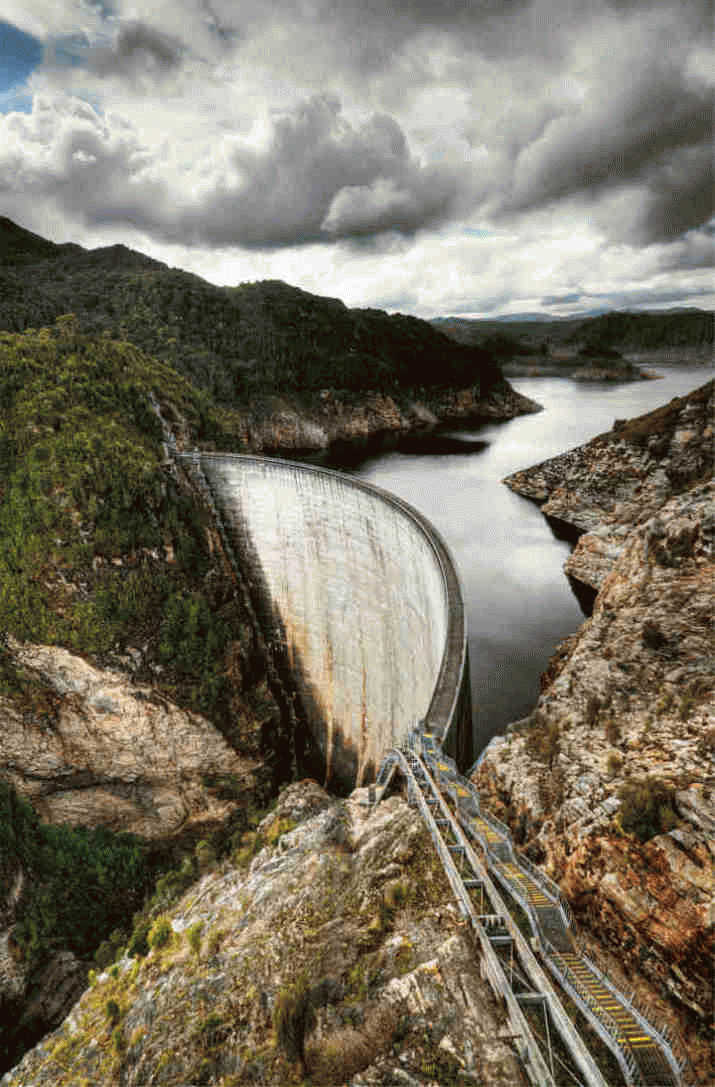
*Pic: ABC pic of the Gordon dam …
We have been told by our Government that all will be well with the Power system in Tasmania, and that the Hydro Power will be able to cope until Basslink comes back online.
Is this really true?
Last week we used 1.1% of the water in the dams, that has taken the dam levels down to only 18.9% capacity.
Given that it is never possible for many reasons to completely empty a dam by drawing water from it, we should assume that for environmental reasons and physical reasons the storages will not be able to go below 10% capacity.
That means that we have at the most 8 weeks of water left to run the Hydro schemes.
So the scenario is this, supposedly by the end of March Basslink will be repaired. That will bring back online an import capacity of around 500 megawatts.
The Tamar Valley Power station is capable of supplying 387 Megawatts and the Wind Farms a maximum of 310 Megawatts.
Total capacity without Hydro Power is then 1197 Megawatts.
Of course we cannot rely on maximum power from the wind turbines but still a maximum is just that.
Tasmania uses around 1300 Megawatts of Generator Capacity in Summer, and 1900 Megawatts of Generator Capacity in Winter.
So there is the rub.
Hydro will not feasibly be up to much generating capacity until the winter rains come, that is late June to July usually, but then the dams will only just begin to fill then and the water will not really be able to be used straight away as we need to allow the storages to refill.
My question is where is the power going to come from. Sure 60 % of our power is used by major industrial users and if we shut them down for 6 months we would be able to get by with Basslink and the Tamar Valley power station as our consumption would be only around 520 Megawatts in Summer and 760 Megawatts in Winter.
Will the major industrial users take kindly to such radical power cutbacks or will they take their business and run overseas as some have been reportedly considering.
Time will tell, maybe someone else will know of a way to generate baseload power that can be brought online very very fast.
Over to you …
I am sure that if I have missed something obvious TT readers will fill me in on it. – Pete Godfrey
Tasmania’s Power Generating Capacity
Wind
Huxley Hill 2.5 Mw
Bluff Point 65 Mw
Musselroe 168 Mw
Studland Bay 75 Mw
Total Wind: 310 Mw
Gas
Tamar Valley 387 Mw
Hydro
2286.7 Mw
Total Generating capacity: 2983.7 Mw
Tasmania’s average power usage is:
Summer: 1300 Megawatts
Winter:1900 Megawatts
Basslink Rating: 500 Mw
With Hydro Power out of action due to low water levels Tasmania’s generating capacity including maximum import capacity of Basslink is 1197 Megawatts.
That is implying that all the wind generators are developing full power 24 hours a day. Which they will not be.
We are still between 100 and 700 megawatts down on generating capacity.
Anyone got a spare 500 to 1000 Megawatt generator laying around in their back shed?
• John Lawrence in Comments: Pete, those figures look pretty right. Except, part of AETV, a Rolls Royce 60 Mw machine, is overseas being repaired. Some say wind in Tassie operates at 40%. Shenhua supposedly did their figures on Woolnorth and Musselwroe at 38% but output hasn’t been quite to expectations? HT only has a minority (25%) interest in the joint venture, so it doesn’t disclose too many details in its Annual Report. Solar operates at around 15%.
• Chris in Comments: How prudent was it to reduce the feed in tariffs to 5 cents per KWH thus turning people off installing household solar? Just imagine if 10,000 homes were to install say 5 KW units with some incentives, (like headwork gifts to developers) then there is a potential for a further 50MW to be added to the system …


See Comment 6 by Ced …
• Steve in Comments: #19; Mr Harriss; if you have been following this debate on TT, you would be aware that John Lawrence has done a detailed economic assessment which indicates that it’s very improbable that the logging of Lapoinya is going to turn a profit: HERE .You are obviously across the economics of the situation, as indicated by your costings of protest action. Please could you supply a rebuttal of John Lawrence’s analysis, indicating which of John’s assumptions are unreasonable, and why. As a tax payer, I’m concerned that fellow taxpayers, such as the residents of Lapoinya, are forced to suffer the destruction of an area that’s special to them, and all at a net cost to the State. It would be of great value to have the economics of the situation explained in detail.
• Derbytas in Comments: … Tasmania has more than a Billion Dollars of Debt, from the building of these dams, still unpaid. The punters of Tasmania have been paying the interest on this debt and subsidising these bulk users for decades. But that seems to be how things are done in Tasmania.
• Clive Stott in Comments: I am not sure why the Basslink fault cannot be accurately pinpointed, the type of fault known and communicated to the public? Someone is not telling us the full story, unless I have missed it. I cannot believe we have to physically dig up a cable to see where and what the fault is …