
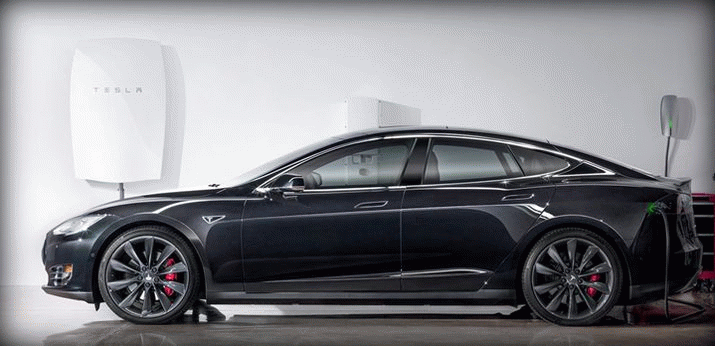
Tesla’s 10,000kw wall mounted electric storage unit – US $3500
It’s finally here, it’s long overdue, and it will be causing shock waves of panic through the mighty coal and oil magnate’s psyche.
The American innovative energy company Tesla have finally released their power storage system that can revolutionise the world with new age technology that could potentially supply most residential, community and commercial operations with off-grid power storage.
This Lithium-ion energy product has the ability to supply mains voltage electric-power storage to every terrestrial corner of the globe. Gone are the days of fuel-guzzling, noisy power generators, or cumbersome acid-filled battery storage.
With present advancements in electric vehicles, the entire world could be fossil-fuel free in decades if there is the political will.
Whilst the basic Lithium-ion battery technology has been on the market for many years, it previously lacked a driving corporation to set such ideology on a world stage until Tesla’s vision was released.
Tesla has essentially aimed its immediate mark on Australia because of the extensive potential of attracting customers due to Australia’s high network charges, and the fact that there is already 1.4 million homes in the country with roof-top photovoltaics that produce 4400 megawatts.
With little economic return on passing excess power supply back the grid, it makes sense to store your own energy for night-time use. This will enable many people to go off-grid and avoid network charges altogether.
Australia’s network operators and electricity retailers know that battery storage is inevitable, and so to protect their business they will most likely enter a turf war between themselves, whilst in the meantime they will raise tariff structures and probably attempt to ban storage units from the grid.
Ultimately if battery storage becomes widely adopted in Australia whereby many consumers supply and manage their own power then the death spiral begins as the networks will have little ability to retain or recoup their revenue. The solution of course is for the networks to get onboard and operate as an alternative energy supplier/retailer to keep both tariff and maintenance costs lower.
In Australia it is still a few years away from a full market implementation, though in New Zealand there is a company called Vector who are in the forefront of installing solar power storage in homes. They also intend to use the Tesla products.
Australia’s energy markets are destined to be revolutionised by Tesla products over the next decade, leaving the current energy networks and retailers in notable uncertainty unless they adopt the new wave of energy consumerism.
The future looks promising for energy consumers who can afford to upgrade to this 21st century technology.