Economy
Kiwi ‘Hunter-Conservationists’ Slam DOC Poison Plan

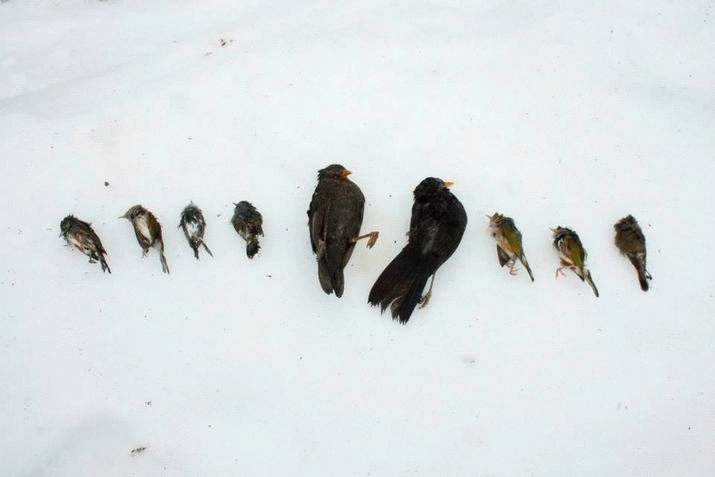

*Pic: Poisoned by 1080 …
A New Zealand national hunter’s organisation has rejected a call by the Department of Conservation (DOC) for more 1080 aerial drops.
The New Zealand 1080 poison controversy just gets more intense as the government dogmatically continues to drop 1080 and wants to drop more of the ”ecosystem poison.”
The Sporting Hunters Outdoor Trust (SHOT) spokesman Bud Jones said DOC’s call for the continued use of 1080 for rats was ignorant of basic biology and causing heavy ecological damage to the forests.
The SHOT reaction was sparked by a public report in which a DOC scientist claimed New Zealand’s biggest pest poisoning programme last summer killed 95 per cent of the rats it went after and more evidence shows forests are better off after 1080 drops. He said the benefits of 1080 outweighed the losses of birds.
“The bird species we monitored all benefited from the 1080 drop. A few birds were killed by 1080 but many more would have been killed by the rats and stoats the 1080 killed,” he said.
Bud Jones said after 1080 was dropped, fast breeders such as rats with a female capable of bearing 40 young a year surged back from those inevitably surviving 1080. He said Landcare Research studies research such as Nugent and Sweetapple (2007) and Ruscoe (2008) verified the induced population explosions. Within three years populations can be three times original numbers, creating a mega-rat problem. Incredibly, DOC’s solution to the problem it had created with 1080 was more 1080.
But Bud Jones, of the Wairarapa, said beech seeding had occurred for millions of years while rats (kiore) were introduced by Maori 800 years ago and ship rats at least 200 years ago. Over centuries, nature had adjusted food chains and predator-prey relationships.
“Bird life with dawn choruses were prolific until the last two decades. DOC with carpet bombing 1080 ended that. Any bird declines have happened in the last 20 or so years. Why? Does that not indicate the predator/prey relationship was in equilibrium until DOC disrupted the eco system?”
It is ecosystem detruction
Bud Jones described 1080 as an ecosystem poison. Many including DOC, did not seem to understand the slow-to-kill poison first developed as an insecticide, was lethal to all life from insects and other invertebrates, to birds and animals.
“It is not target specific. It is ecosystem destruction.”
Bud Jones rejected the credibility of DOC scientists.
“DOC’s scientists are in effect, scientists paid to promote department policy. In effect it’s a vested interest in a poison cycle of industrial proportions. No prizes for guessing who pays. It is high time the public switch on to this theft of their tax money and destruction of the wilderness.”
Bud Jones rejected the argument that hunters were selfishly only concerned about deer being poisoned.
“I’m a conservationist first and foremost,” said Bud Jones who had received a Queens Service Medal award for his conservation work in creating wetlands. “And yes I’m a selective hunter, a trout fisherman and nature admirer.”
He said he had annually trout-fished the South Island’s Maruia River for 40 years but recent 1080 drops had been devastating on bird life.
“Bird life was abundant until 1080 made it a forested morgue. 1080 is an eco-tragedy,” he said.
*Tony Orman (MNZIS) is a former town planner, conservationist (‘wise use of resources’), journalist and author of 24 books.


• Richard Prosser: Challenge To Prove Safety Of 1080 In Waterways
Government agencies claiming 1080 found in waterways and creeks poses ‘no risk’ should prove it by eating the whitebait people have been forced to throw away, says New Zealand First Spokesperson for Outdoor Recreation Richard Prosser, above.
The challenge comes after KiwiRail workers discovered more than one hundred 1080 poison baits in Kapitea creek at Kumara following an aerial 1080 drop last week. Others are too afraid to eat whitebait from the creek.
“Resource consent for OSPRI’s poison drop was approved by Westland Regional Council, the Department of Conservation and the Ministry of Health. Surely then, they should be willing to prove the safety of 1080-contaminated water by eating the whitebait and fish from the creek and nearby streams.
“Dumping 1080 poison from the sky has left some household water supplies contaminated. The rules to avoid waterways are not being taken seriously. The rule makers must explain to the public why they’re not worried about baits ending up in creeks that supply drinking water.
“The manufacturers of 1080 have specific instructions stating it should not be used in or near waterways,” says Mr Prosser.