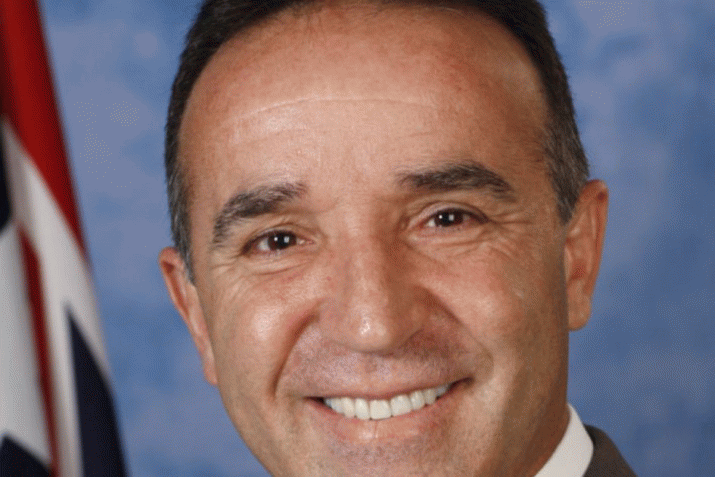
Andrew Nikolic, one of Tony Abbott’s favourite whips, is a person who deserves more time in the national spotlight. He’s done a terrific job whipping party members into voting for things they were going to vote for anyway.
There he was on the television on Monday night scurrying down a parliamentary corridor towards the party room meeting with a surprisingly small wooden ballot box in hand. Last week we reported Nikolic’s concern that some of his colleagues were trying to “out-compassion” each other when it came to dealing with fleeing refugees.
His previous gig as an army brigadier peaked as head of the 200-strong media liaison office at the Department of Defence – that is, chief flack for our triumphs in Iraq and Afghanistan.
Fortunately, information has come to hand about the brigadier’s effective methods of dealing with the problem of too much compassion.
In 2007, special forces captain Andrew Paljakka, 27, took his own life in a Kings Cross hotel after being told the army was going to confiscate his commission.
He had been the youngest person to graduate from Duntroon and clearly he was struggling with PTSD after his experiences in Afghanistan, where he is said to have killed a man and witnessed a child being raped.
His father, Arvi Paljakka, said the Department of Defence’s claim that the family wanted a closed inquiry into Andrew’s death was false and that the army wanted to cover up how his son had been treated.
Military spin doctor Andrew Nikolic swung into action and insisted that the family had requested the media and the public not be admitted to the inquiry, adding, “We are respecting this request in an effort to avoid unnecessary stress and grief.”
He skilfully managed a situation where, again, there was a danger of an outburst of compassion.
Nikolic is a member of Young Otto Abetz’s tender-hearted team Tasmania.
• via Peter …
ABC: Australian Defence Force chief called on to supply suicide figures to Senate inquiry
“Defence often quote a study that was done in 2010 that shows these mental health problems are no different amongst Defence Force personnel and vets than they are in the wider community, but we’ve heard very, very different evidence from a number of experts,” he said.
“We’re definitely getting mixed messages between what the Government is providing in terms of their data on the extent and significance of mental ill health and post-traumatic stress disorder amongst returned service personnel.”
The Senator said he established the inquiry after hearing from veterans’ groups about growing mental health problems in their community.
“Groups, especially younger veterans’ groups, were telling us that the Government wasn’t doing enough,” he said.
“A number of veterans were living rough on the street, there was a much higher rate of suicide amongst veterans and, of course, there were issues around substance abuse.”
The inquiry is focussing on post-traumatic stress disorder, mental health policies, counselling and housing services as well as record-keeping for mental ill-health hospitalisations and deaths.
Also appearing on Monday will be the Vice Chief of the Defence Force, the Chief of the the Air Force, the Chief of the Army and the Head of the Department of Veterans’ Affairs.
The Senate is due to report back in February 2016.
http://www.abc.net.au/news/2015-09-20/inquiry-calls-for-defence-force-to-present-suicide-figures/6790134