Coroner & Legal
Abbott’s war on governance


It should come as no surprise to anyone who follows politics that Tony Abbott’s natural territory is as a fighter and brawler. The question on many minds is whether he would rather fight than govern. We might also wonder about his capacity to govern without the cover of one “war” or another.
The militaristic theme has come to the fore again recently with the so-called “lawfare” changes to the Environment Protection and Biodiversity Conservation (EPBC) Act in relation to third party appeals to environmental law. It’s there again in the prospect of military involvement in Syria and the recent developments with the Australian Border Force.
Many are questioning the logic and motives of the prime minister on these and other issues. Some would suggest that along with the war on union thugs, the war on “illegal” boat people, even the war on ice, Abbott is using these battles as distractions from the main game of governance of the nation. He is in a continual search for a wedge against the Labor Party that will resonate at the polls. And to what end?
We see the PM’s style in recent attempts to remove the so-called third party “legal standing” provisions of the EPBC Act, put in place by John Howard, which granted rights to community groups and individuals to have their say in the courts in relation to environmental approvals. By focusing on this issue, Abbott has also shone a light on the incompetency of environment minister Greg Hunt regarding the Adani and Shenhua coalmines in Queensland and New South Wales.
While the senate is unlikely to pass the proposed amendments – something of which the PM would have been well aware – the obvious message to the community is that Labor is apparently anti-mining and anti-jobs. Better still, he hopes to rekindle the image of the Labor–Green alliance with which he has previously scared voters. There is no real policy outcome here, no economic benefit; it is purely about politics.
Questions are also being raised about the prime minister’s ambition to send troops to Syria. Is it about caring for those who are trying to flee persecution or about the instinct of a brawler who believes fear can be used as a political tool to win an election a long way from the persecution?
In the short term that election is the Canning byelection, and his survival as leader; in the longer-term, his ambition to win the next general election.
Abbott argues that the destruction of antiquities by Daesh is justification for going to war, and has instanced the historical significance of Palmyra in Syria in the development of humanity as evidence. No mention here in Australia of the significance of the massive Aboriginal grinding stones that will be destroyed by the Chinese-owned Shenhua mine on the Liverpool Plains in the Namoi Valley. In fact, the changes to EPBC could remove the rights of the oldest civilisation on Earth to prevent desecration of our antiquities.
Australia’s “all the way with LBJ” attitude towards partnering with the United States in war is not good. The Vietnam War had enormous impacts on those who participated, apparently to stop the yellow hordes from taking over Australia. Fast forward to today and the contorted posture our nation has towards China – our need to accommodate the country in an economic sense, while still maintaining a military alliance against it with the US – is precarious indeed and does not look to be getting significant thought from our government.
The extraordinary positioning of our Middle East relations over the decades is almost unfathomable, but can be simplified thanks to Abbott’s “goodies and baddies” analogy.
In 1979 Saddam Hussein was a goody in the Iranian conflict. He was a baddie in the first Gulf War against oil-rich Kuwait in 1990. The Americans left him to rule Iraq from a minority Sunni position and watched as he carried out atrocities against other minorities such as the Kurdish people in the north and the majority Shiite Muslims. In 2003 he was a baddie again and was subsequently removed and executed. In his stead, a Shiite goody came to power and persecuted the previous Sunni baddies who prior to being baddies were goodies.
Some of the extremist Sunnis decided democracy wasn’t for them and sided with Daesh, partly because of a lack of faith in democratic processes and distrust of the previous US alliance commitments.
So the context of today’s decision to declare war on the state of Syria – which has been engaged in a civil war where all the participants are or have been baddies – raises the question of how we determine who we are fighting against and whether diplomacy would work better than engaging in an illegal war with all the possible domestic ramifications that may flow from such a decision.
Read the rest of this brilliant article, The Saturday Paper here
This article was first published in the print edition of The Saturday Paper on Sep 5, 2015 as “War on governance”. Subscribe here: https://www.thesaturdaypaper.com.au/subscribe
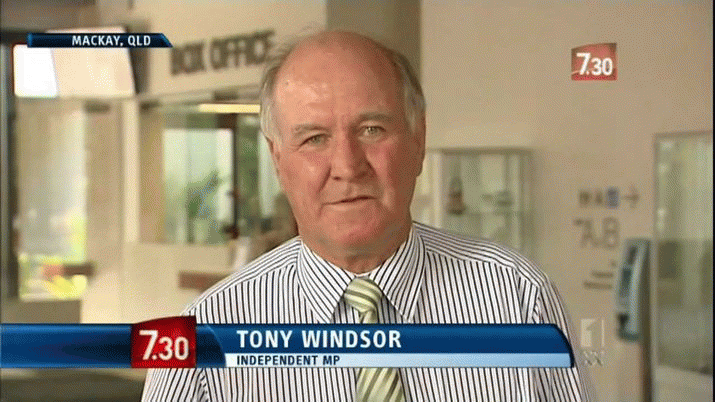
Tony Windsor is the former independent member for the federal seat of New England
• Jamie Ward in Comments: Please go to the guardian website and have a look at the latest cartoon from “1st dog on the moon”. It is so unbelievably spot on that I got a shiver up my brain box!!! !st Dog for PM: Here