Economy
Salmon Senate Inquiry part of ongoing of scrutiny, not the end

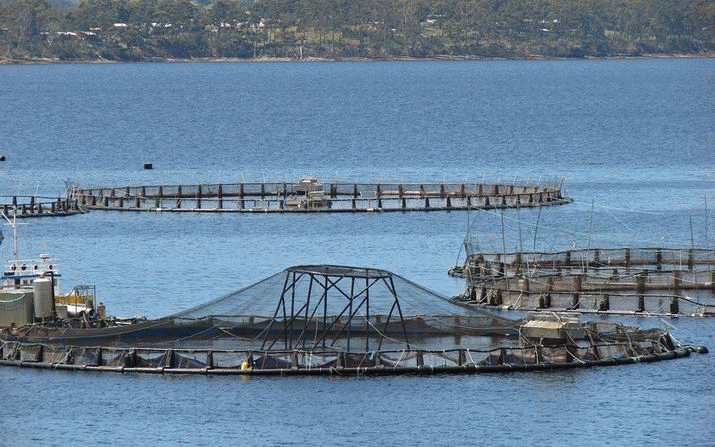

The Greens Senator for Tasmania, Senator Peter Whish-Wilson, said, “Today’s release of the Senate report into salmon farming in Tasmania is part of ongoing scrutiny by the Greens and other stakeholders.
This scrutiny will continue until the Tasmanian Government properly regulates the salmon industry, the environmental monitoring is transparent and the science, especially in relation to Macquarie Harbour, is better understood.
Genesis of Inquiry
“I initiated this inquiry because whistle-blower(s) provided to the Greens emails and reports indicating that serious environmental impacts were occurring as a result of the salmon farming industry. These claims were made by industry CEOs in their own words and backed up clearly in departmental reports.
“This inquiry was initiated for the benefit of all stakeholders, including the salmon industry.
“While the Tasmanian Liberal Government wanted to hide their mismanagement through vacuous green-bashing it was clear to all that there were serious issues in the sector that needed investigating.
Inquiry Process
“When I instigated this inquiry I said I wanted it to ‘shine some light on some of the murky information that has recently surfaced regarding the sustainability of salmon farms in Tasmania’ and I believe we have achieved that.
“The Inquiry has provided the opportunity for submissions to be made from a range of industries as well as agencies, scientists, community groups and environmentalists.
“I am deeply disappointed that the three salmon company CEO’s were not available to appear at the Inquiry to discuss the concerns they had raised in emails to the Tasmanian Premier.
“I am also disappointed that the head of DPIPWE, the regulator of the salmon industry in Tasmania, was not available to be questioned in hearings.
“These absences have limited the amount of scrutiny that could be applied as part of this Inquiry.
Inquiry successes
“The pressure brought to bear upon industry and government has already achieved a number of clear successes:
“The decision by the Tasmanian Government to retain the Marine Farm Planning Review Panel, the independent body that approves new fish farms, despite the government having previously said it would be abolished.
“Research programs have been funded and brought forward in relation to environmental impacts on Macquarie Harbour and the impacts of salmon farming on the abalone industry.
“The public is now aware that the state government had secretly lifted a cap on salmon biomass in Macquarie Harbour.
“Additionally, sections of industry themselves have admitted that stocking levels in Macquarie Harbour are likely to be revised down as a result of issues over dissolved oxygen levels.
Inquiry Report
“The report published by the Senate Committee is a relatively comprehensive summary of the issues associated with salmon farming in Tasmania. It will be a useful resource for stakeholders and policy-makers for years to come.
“However, The Greens believe that the recommendations provided by the committee do not substantively address the seriousness of the problems in transparency and regulation that are so apparent.
“The Greens have provided a substantive dissenting report with 24 clear, constructive and non-controversial recommendations that would adequately address the issues raised in the body of the report.
“It is clear that there is a conflict of interest in DPIPWE’s roles as and we strongly believe that the EPA should be made regulator for the sector.
“The monitoring of environmental impacts needs to be made much more transparent, especially around dissolved oxygen levels. The state government’s implied reason for keeping this data from the public, because it is too hard for the public to understand, is indefensible.
“The situation in Macquarie Harbour is unique and a special Task Force needs to be set up to guide the ongoing science, monitoring and community engagement.
“Additionally, an independent investigation needs to be carried out to examine if breaches are occurring in Macquarie Harbour and what the EPBC licensing implications of this are.
“Finally, the planning practices for salmon farming need to be brought into line with other developments and the Tasmanian Planning Commission needs to be empowered to provide guidance for marine aquaculture activities,” he concluded.
The Greens dissenting report can be found HERE on page 129 of the report.
• Bryan Green: Labor welcomes findings of salmon inquiry
• Jeremy Rockliff: Salmon Inquiry
• The Mercury Editorial: Facing up to reality
THE essentially clean bill of health that’s been handed to salmon farming in Tasmania is good news, but perhaps the more significant message in this scenario is that our state must come to terms with the realities of the 21st century.
Industrial enterprises in this day and age cannot afford to take the attitude that some less-reputable businesses, here and off our shores, have in the past.
Businesses that do not live up to increasing community and consumer expectations are on the road to failure. Any business that tries to cover up or talk its way out of trouble when consumers and the community raise concerns is headed for trouble. And any business operation that requires government to regulate, legislate and spin the truth to protect it from the scrutiny of the public faces inevitable disaster.
We have seen it all before.
The modern world is highly interconnected by the internet and social media. Reputations can come and go in the blink of an eye. Our state depends as much, if not more, than any other on its brand for clean, green, premium goods and services. Governments at all levels, and independent regulators, must work together to ensure that reputation is maintained and that the best economic, social and environmental practices are in place.
The salmon industry is a flagship for Tasmanian enterprise. It carries our brand out into the world. Poised for expansion, it promises to bring much-needed investment and jobs to our island.
It is vital the industry acts openly and transparently, and leads the world in its practices so as to maintain its commendable standing in the global market place. The best chefs in the world seek out salmon grown in the cold waters off Tasmania. It is served in the best restaurants in the land and overseas. It has graced the tables of the British royalty and of some of the world’s most discerning palates.
It is unhelpful and unproductive to dismiss the recent inquiry into salmon farms as a witch-hunt or to ignore demands from the public for proper scrutiny.
The residents who live near the operations of these farms have a right to know what is going on and deserve to be reassured that there is no detrimental effect on them personally or on the environment.
Those who run shellfish farms and dive for crayfish and abalone have a right to know their livelihoods are not being threatened.
It is well past time that we accept that transparency and scrutiny is increasingly being demanded by the public. We cannot turn back the clock, and any attempt to continue the bad habits of the past will jeopardise the very thing that is being protected — economic growth and prosperity.
Tasmania is not alone in being forced to face up to these realities. It is happening around the world, and those economies and producers who come to grips with it first — and incorporate public and consumer concerns into their business models — will gain an economic advantage.
There appears to be a level of cynicism in the community at this time. It is beholden on the sector and its authorities to take the public with them. The innovative and entrepreneurial minds at the helm of the salmon industry are entirely capable of doing this.
• Rosalie Woodruff: Senate Committee on Fish Missed the Boat