Coroner & Legal
Dyson Heydon … and the Sir Garfield Barwick Address

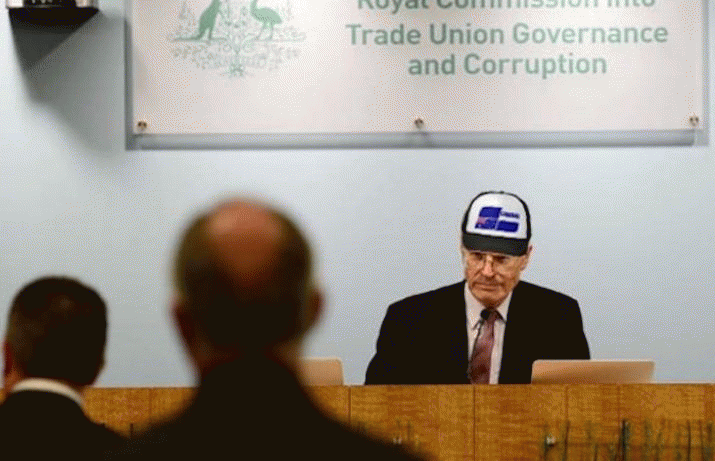

*Pic: The Shovel: Eyebrows Raised As Dyson Heydon Accidently Wears Liberal Party Cap To Royal Commission Hearing Royal Commissioner Dyson Heydon has apologised for wearing a Liberal Party cap to the Royal Commission into Union corruption this morning, saying he ‘didn’t realise’ the cap had the Liberal Party logo emblazoned on its front. “I overlooked the connection between the logo on the cap and the Liberal Party of Australia,” Mr Heydon said in a statement today. Liberal Party MPs, including Attorney General George Brandis, have come out in support of Mr Heydon, saying there is no suggestion of bias. “It is just a hat. He took it off as soon as he was made aware of it; that should be the end of it,” Mr Brandis said Former Speaker Bronwyn Bishop said it was a trivial matter and nothing more than a witch-hunt. “I would often arrive at the Speaker’s chair and accidently start handing out Liberal Party brochures. We’ve all done it! Move on.” While there is mounting pressure on the Commissioner to resign, Prime Minister Tony Abbott has advised Mr Heydon to let the shitstorm grow for another two or three weeks before finally standing down.

Sir Garfield Barwick

Evan Whitton notes: Sydney notoriously has no memory. Sydney lawyers in the Liberal Party and former High Court judge Dyson Heydon presumably have no memory of Garfield Barwick’s crimes. If they did, the lawyers would surely not put on an annual Sir Garfield Barwick Address, and Heydon would surely not consent to give the address. At a minimum, Barwick (Chief Justice 1964-81) should have been dismissed for misconduct. But organised crime is systematic criminal activity for money or power. Readers can decide whether or not Barwick was an organised criminal. Three pointers: • He concealed his interest in companies in cases before him. Maximum penalty: two years in prison. • Tax evasion (Mundroola) can result in eight years in prison. • In a series of tax cases, his lies, e.g. a profit of $2782 is a loss of $186,046 (Curran, 1974), effectively stole millions from pay-as-you-earn taxpayers.
‘The judgment of the Lionel Murphy Case is the worst miscarriage of justice since the great Danton was bodily placed under a guillotine by a conspiracy of his colleagues. It is impossible to have a fair trial after two years of strongly anti-Murphy stories by the Charlotte Cordays* of the Sydney press. This, to us men in the street, has been an obvious political setup from the start – with racist overtones in the sense of a pack of WASPS suddenly discovering an unashamed, unconquered Celt approaching a powerful social position – the Chief Justiceship of Australia.’ – Lawrence Beck, sculptor, of Leura.
[* There is a minor problem here. Mlle Corday stabbed M Jean-Paul Marat on the basis that he was too bloodthirsty: M Georges Danton went to the guillotine on the ground that he was not bloodthirsty enough. It is thus unclear whether Mr Beck wishes us to equate Murphy with Danton or Marat, or both. However, we catch his general drift.]
‘…the media dropped the (Mundroola) matter the moment (Barwick) declared himself not guilty. Why? Because the Chief justice, like the Queen, can do no wrong, though a minor justice may? Or because Barwick and Murphy belonged, in their salad days, to different political parties?’ – Professor Russell Ward, Emeritus Professor of History, University of New England.
The proposition thus is: Chief Justice Sir Garfield Barwick, hero of the Right, was saved by the Right and the press; Justice Lionel Murphy, hero of the Left, was brought down by the same alliance. The Mundroola affair, and the role of the press in it, thus requires some examination.
Both Barwick and Murphy were failed politicians who found soft landings on the High Court; they owe their heroic status to their periods on the Bench. Malcolm Turnbull, in The Bulletin in June 1980, judged three of Barwick’s actions to represent a ‘misuse of power:’
Sitting alone in 1974 on a constitutional case involving Senator James Webster, a member of his former coalition (‘wrong in law… also wrong in principle’;)
Giving advice to the Governor-General in 1975 (‘unforgivable’;)
Inviting, in 1976, when the membership of the court changed, the re-litigation of a matter (the constitutionality of Senators from the territories) on which he had been on the short end of a 4-3 decision the year before (‘Gibbs and Stephen … included some dark words about the motives for the re-litigation.’)
Elements of the Right may be assumed to have derived a deal of satisfaction from such misuse, as well as from the agility of Barwick’s mind on the matter of ‘tax avoidance.’ In 1980 Senator John Button quoted him as saying to a barrister who had used the term: ‘Look, you cannot call this ‘tax avoidance’. If there is not tax to be paid, it has not been avoided, has it?’
Barwick has said he started Mundroola Pty Ltd in 1946 for the benefit of his two children. He stated that it was a ‘family’ company. The most substantial shareholder, with 4000 of the 4800 deferred shares, until 1974, was his close friend and business associate, Mr Leslie J. Thompson, a director of Ampol, Brambles, and CSR Chemicals. Barwick had no shares, but was managing and governing director. He said his wife had ‘a small shareholding’. In fact, she held 850 of the 852 ordinary shares. From 1964 to 1974, Mundroola bought land for $162 161, and sold land for $595 740. At June 30, 1973 it held shares which cost $167 548 and which had a market value of $357 880. While Barwick was Chief Justice, cases involving Ampol, Brambles, and CSR, in which Mundroola held shares, came before him. He did not declare an interest in those cases.
A number of questions remain unanswered about the Mundroola affair. Among them, raised by Senator Gareth Evans in the Senate on 29 April, 1980, were:
1. Was Barwick one of the unnamed directors to whom Mundroola made loans at low, or possibly, non-existent, rates of interest?
2. Was Barwick one of the unnamed directors to whom directors’ fees were regularly paid?
3. Did Barwick receive the use of his Careel Bay house, which was owned by Mundroola, rent-free, or at an abnormally low rent?
Section 34 (b) of the Crimes Act 1914 provides that ‘any person who… being a judge or magistrate, wilfully and perversely exercises Federal jurisdiction in any matter in which he has a personal interest, shall be guilty of an offence.’ The penalty for a breach is imprisonment for two years. If, therefore, the answers to any of the above questions is yes, Barwick might be judged to have a pecuniary interest in Mundroola, and might thus have been at risk of being charged under the Crimes Act.
The Barwick (or Mundroola) affair ran for barely more than three weeks in April and May 1980. The sequence of events is significant.
Late in 1979, the Labor Party got a tip about Mundroola, and began an inquiry. The Barwick connection, however, was first publicly revealed on 18 April, 1980. It was then reported by Paul Malone in The Australian Financial Review, that the NSW Corporate Affairs Commission had approved plans to strike Mundroola off the register for not lodging annual returns since 1973. Mundroola filed the missing returns six days later. These stated that Barwick had resigned as a director on 31 December, 1974. On Saturday 26 April, The Age ran an article which stated that Barwick, without declaring an interest, had sat in judgment on cases involving corporations in which Mundroola had shares. Senator Gareth Evans gave notice in the Senate on Monday, 28 April that he would next day move that a joint parliamentary committee be appointed to inquire into the Mundroola matter.
The then Prime Minister, Malcolm Fraser, got in first. At 4.15 pm on the Tuesday, he produced a letter (dated the previous day) from Barwick absolving himself of all blame. Barwick’s letter said he had no proprietary interest, which was not an issue, in Mundroola. Barwick did not address himself to the question of possible pecuniary interest. He said he could not believe that any fair-minded person would have entertained any doubts about his impartiality in appeal cases. Fraser said no inquiry was needed, or would be granted. He said: ‘The decision as to whether a conflict of interest situation arises is one for the individual to make.’ Bob Ellicott, Barwick’s cousin, and then thought to be a front-runner to succeed him, produced a brief (294 words) opinion, by Solicitor-General Morrie (later Sir Maurice) Byers. Parts of this opinion supported Barwick’s position, but the opinion appears to have some internal contradictions.
Evans began detailing his evidence, the product of some months of research, in the Senate at 5.11 pm, four minutes before the Barwick proceedings concluded in the House of Representatives. The Senate debate did not end until just before 10.30 pm.
Two things followed from this timetable:
The Barwick-Fraser-Byers assertions could not, and did not, respond to the questions, noted above, or other matters raised in Evans’ speech.
Because of media deadlines, the Barwick-Fraser-Byers assertions would necessarily command the bulk of the media coverage that night and next morning.
Evans’ speech was grave and restrained. At the end, he said: ‘I make no suggestion that I have mounted other than a prima facie case … only (a parliamentary) inquiry would give full opportunity to the Chief Justice to put on record … all the matters about which this Parliament and the Australian community must be satisfied before this matter can ultimately be put to rest.’
Senator Don Chipp, who then commanded a party of two Australian Democrats in the Senate, said ‘that the Chief Justice has been indiscreet, that he has been arrogant, that he has been foolish … Surely in the Senate tonight an unanswerable case has been made that the Chief Justice should have disclosed at least his interest in Mundroola and its transactions . . .’ Chipp said that, ‘reluctantly,’ the Australian Democrats would vote against Evans’s motion, nor, to avoid impertinence to Evans, would they move an amendment. But, he said, if there had been a motion ‘to censure the Chief justice or express concern about his lack of conduct, we would have voted for it.’ However, Chipp concluded, ‘to have a parliamentary committee investigate the conduct of the Chief Justice of the country does not make sense to me, and, therefore, we cannot support it.’
Did the press (and, come to that, the Labor Party) drop the Barwick / Mundroola matter ‘the moment (Barwick) declared himself not guilty’?
In The Australian Financial Review the next day, 30 April, Mungo MacCallum wrote: ‘As a number of people on both sides put it one way or another after the event, their moods varying through anger, frustration, uneasiness, and sheer puzzlement: What were they trying to hide?’ In a leading article next day, the Review said the issues were unresolved.
The Australian on 1 May reported Mr Roderick Meagher, president of the NSW Bar Council, as saying that the facts disclosed in Barwick’s letter completely answered ‘the scurrilous and politically-motivated allegations … made against him. It is regrettable that such allegations (of conflict of interest) should have been made at all.’ The Australian, in a leading article on 2 May headed ‘When the smearing has to stop,’ said: 1… Sir Garfield’s letter, tabled quite properly by the Prime Minister on Tuesday, gave a full, reasonable and persuasive answer to the charges being bandied about in Parliament and in some sections of the press … This is intended as our last word on the matter. Let us urge the same on everybody.’
On the same day, a long comment piece by Russell Barton in The Sydney Morning Herald traversed Evans’s speech and the holes in the Barwick-Fraser-Byers assertions. The outstanding questions were again reviewed in The National Times on 4 May by Stuart Simson and Marian Wilkinson. They reported Evans as saying that several important questions still appeared unresolved. A week later Simson reported that on 2 May in the ACT Supreme Court Justice Francis Xavier Connor had, by implication, torpedoed Fraser’s theory that it was up to the judge to decide whether or not he was in a position of conflict of interest.
This was virtually the last reference in the press to the matter. Nor was it revived when in May 1982 a Senate Estimates Committee discovered that a Cabinet meeting on 10 February, 1981, the day before Barwick retired, made a special ‘arrangement’ whereby he was given amenities worth about $60 000 a year, including a full-time car and driver worth $32 000.
The Mundroola affair touched the integrity of one of our most important institutions, the High Court, yet it now appears that many got it wrong. For Barwick, assuming he had nothing to hide, and in the interests of the institution, it may have seemed proper to have welcomed Evans’s request for a parliamentary inquiry, and to have made a full disclosure on the outstanding questions. Fraser likewise. Sections of the press, notably in the Fairfax group, appear to have been inclined to pursue the matter. But, in the face of Barwick’s silence, the Government’s determination to stonewall the issue, and the absence of new material, they may have found it difficult to get a fresh toehold on the affair.
Nor did the Labor Party seek to clear up the outstanding questions when it got into office. A spokesman for Senator Evans told me, in June 1985: ‘Senator Evans did not institute any inquiries when he became Attorney-General because the facts relating to impropriety and conflict of interest had been established clearly, as set out in Senator Evans’ speech to Parliament. There had never been any suggestion of illegality or criminality.’
It may be that the main reason the Barwick matter was handled badly was that the time was out of joint. 1980 was not 1984. As exemplified by Senator Chipp’s remark in the Senate, in 1980, few people, one suspects, were ready to face the possibility that a Chief Justice could be involved in dubious practice. The watershed came in 1983, when the ABC’s Chris Masters found some Sydney magistrates prepared to state publicly that a magistrate had sought to fix a case. The Wran Royal Commission, and the imprisonment of a magistrate for four years, followed. Nothing, in terms of questions about the administration of justice, has been the same since.
One guesses that after that, if Barwick were still Chief Justice, if Fraser were still Prime Minister, and if Senator Chipp had the balance of power in the Senate, it would be unlikely that the matter could be disposed of peremptorily with a parliamentary manoeuvre.
As far as is known, Barwick’s brother judges then on the court, Sir Ninian Stephen, Murphy, Sir Harry Gibbs, Sir Ronald Wilson, Sir Anthony Mason and Sir Keith Aickin, did not decline to sit with him, or invite him to demonstrate that he in fact had no pecuniary interest in Mundroola. Evans did not pursue inquiries into it when he became Attorney-General in 1983. The matter is thus still unresolved.
However, in a Senate debate on fringe benefit taxes on 4 June 1986, the Labor Finance Minister, Senator Peter Walsh, said he could remember a case concerning someone who had been a director of a company called Mundroola and had lived in a house, also called Mundroola, which was owned by the company. Walsh went on: ‘He had been living in that house and had been a director, according to what the Corporate Affairs Commission records showed, from 1974 to 1981 (sic). Under those circumstances, either that director was obliged to include in his personal tax return – as imputed income for a company-occupied house – some notional rent, or, alternatively, the company was required to include in its company taxation return the rent received from the director-tenant of the company-owned house.
The tenant concerned at the time was the Chief Justice of the High Court of Australia. Very conveniently in 1981 (sic), a letter of resignation became public which was dated 1974. The ink was still wet. In other words, the Chief Justice of Australia at that time was in a situation, by any prima facie grounds of evidence, in which he was a tax evader. To get himself round this problem, he became a forger’.
Opposition Finance spokesman, Senator Anthony Messner, said Walsh’s remarks were irrelevant. Walsh replied: ‘The case to which I referred is highly relevant because the prima facie evidence shows that the Chief Justice of Australia between 1974 and 1981 (sic) was a tax evader.’
• mr t in Comments: Thanks Evan. Last week I tried to post a comment several times on the suitability of Barwick for any legal or political address. Michelle Grattan had noted his advice to Kerr in the Whitlam dismissal but there was no mention of his position during the growth of tax evasion. My comments (unpublished by the ABC and Fairfax) were brief but mentioned the Bottom of the Harbour schemes. Below is an extract from 2012 in the AFR:
• phill Parsons in Comments: What more is to be said. Partisan to the last and in the climate Abbott has created, not unlike Howard’s climate when he freed people from politically correct speech on racism only to find he had unleashed Ein Reich [One Nation] under Hanson, Abbott has allowed by his failure to lead, all sorts of divisive elements on the social body. National Security has raised up the spectre of religious intolerance and racism in the guise of Reclaiming something that never was and by running out the IPA far right agenda he has given imprimatur to the warriors against fairness and justice for the many. Heydon has nailed his flag to the mast and must go. Even if he stays his good ship Terror of the Unions is so battle scarred by the Captain, the pick of the Captain, that all its goods will be tainted and change no opinions when they are unloaded.