History
The Son With No Name … Island and Julian Burnside

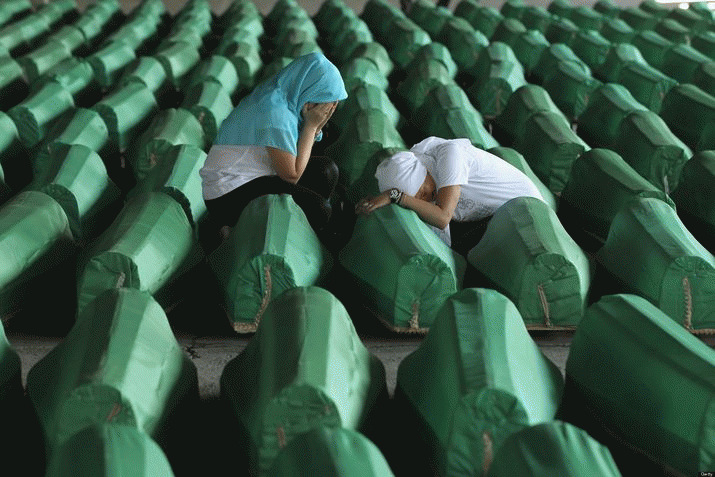

*Pic: Image from Huffington Post here
Alija was wearing a plain white t-shirt several sizes too large. His wife wore the same shirt with a different shape of misfit. We thought we’d had everything ready: apartment, threadbare but solid furniture, washing machine that appeared to work, pasta and tinned food in the cupboard and the power on. What we weren’t ready for was people who reportedly had only a suitcase of worldly possessions arriving without that suitcase.
They had emerged from Immigration clearance clutching courtesy toilet bags, edgily, as if a shirt and a toothbrush kit might not ward off evil or salve the prickly fortune of a new country. Our welcome party of three people and a soccer ball felt inadequate.
Back at the apartment they had taken off their shoes and changed, and we had showed them how to switch on the fans that now chopped late September night into pieces and whirled the glug around. Alija kept patting the head of Salim.
“My son,” he said, “my son.” Salim rolled his ball across the floor. Between them they spoke little more than these words and hello-goodbye pleasantries. I had about the same in Bosnian. My two assistants, themselves refugees of a few years earlier, did all the heavy lifting of the conversation. They were also my cultural guides and had insisted, for example, on spending the last of the grant money on the array of tiny cups into which Melvina now poured the coffee.
“Wouldn’t you rather sleep?” I asked quietly.
Melvina and Alija stared vacantly as if time itself was just yet another thing scorched by war.
…
By the time the suitcases arrived a few days later our sponsored refugee support group had already covered considerable ground with our charges in tow: Immigration office, bank, Medicare, the only primary school that had an Intensive English Unit, bus terminal, Interpreter Service, post office, local shopping centres, library. We had accumulated a large pile of translated brochures in languages they might conceivably understand such as Tropical Health Issues in Croatian and Cyclone Evacuation Procedures in Serbian. There was also the lease to their apartment and the utilities contract that had just been transferred to their names.
Melvina straightened the pile of documents and put them on a table beside the telephone. From one of the suitcases she produced a doily and placed it on top of the printed documents. And on top of that, a photograph of their three children.
The girl we knew about. She was somewhere in the system and likely to arrive in the next few months with her husband as our next family to be supported under the resettlement program.
I asked my assistants in an off-stage whisper about the other boy in the photo. He looked like the eldest with the cut of his father’s chin jutting protectively across the other two. We can’t ask, they said. Some things can’t be asked yet.
…
Alija and Melvina were both enrolled at the Migrant English Course with an entitlement of five hundred hours of study. They made passing friends there but always seemed tired when I saw them on my weekly visits.
“Hot,” said Alija simply. “Hot. I no like.” I wasn’t in a position to do anything about Darwin’s climate, not even apologise for it.
Melvina made thick coffee in a long-handled pot and Bosnian baklava and was always busy dusting. It was a fruitless battle in her louvred box but she struggled on. There was not a single item more frequently dusted than that photograph of the children.
Three children, not two.
Not asked, and not told.
…
After some months they moved to a housing commission house out in the no-nonsense belt of post-Tracy bungalows that spoke of brick that would not be huffed and puffed away, nor promised anything other than solid walls and a ceiling upon which geckos might scurry and pause and scurry some more.
They dropped out of their English classes. Alija said he had chronic headaches and there was an exhaustive round of counsellors and frowning doctors before we had papers ready for a disability pension.
I filled them all out, one bleating space after another. Name, address, date of birth, telephone number, dependants.
Melvina lit another cigarette and another. Alija coughed and wore a grimace that was beginning to fit too well. His wife emerged from the cloud of smoke with a tear that dripped into a bowl of salted nuts.
“Sorry, I no English,” she said. “No school. No any more school. Think, think, very hard for me. I sad for my son.”
…
I remembered the news reports from Srebrenica. Men behind fences, skeletal beings with desperation where eyes had once been. A letter arrived from the Red Cross offering compensation for the son who was among the disappeared. We had it translated and presented it solemnly to Alija and Melvina one morning.
She held the paper firmly and decided uncertainly which way was up.
Without reading it she put it on top of the pile and then replaced the doily and the photograph. It was some time later I realised that even though she might have chosen not to read the letter, it appeared that she simply couldn’t.
My assistants fidgeted. The dots were joining for them and they had enough anguish in their own journey not to want to know all the details. Even this felt like a betrayal for all of us. We started with earnestness and sixteen hundred bucks with which to give a family a new life, but we can’t raise the dead from the barking muzzle of war crime. We didn’t even have a name. A boy or a man or a soldier, missing presumed dead in a mass grave. Fish in a barrel.
Missing. Wrong time, place and ethnicity. Presumed ‘cleansed’, ethnically.
The missing is lessened if you spray the photograph with Mr Sheen once a day and wipe clean.
…
My sun, my sun beats down with the merciless razor heat of unfortunate longitude. Alija delivers junk mail for pennies a shot to people who, like him, couldn’t give a flying digital videodisc for the latest bestest. Melvina is out contract cleaning houses and hoping she won’t get reported to social security for the extra cash.
Cash money.
The Transitional Government of the Republic of Bosnia and Herzegovina hereby states its offer to you of a sum of three thousand convertible marks as compensation for the loss of your son in the vicinity of Srebrenica in 1996.
Blood money.
Time plants its head in its hands and weeps.
…
I see her mouthing the words on the catalogue headlines.
Bread rolls $1.99, pack of six ready-to-bake-at-home.
8 megapixels with zoom lens!
Half-celery, product of Australia.
30+ sunscreen (Cancer Council approved).
Harry Potter print Snugglers.
The words are born like children, helpless and in need of nurture until fully grown. I try spelling the words for her letter by letter. Every sound is hard won. Melvina pouts the consonants through cartons of cigarettes and swallows the vowels in alternating gulps of hard homeland snow and adopted sweat.
She has a grandchild now and he looks too much like someone else. His knees bruise on cheap tricycles and she applies plaster free from sniper fire. I have never seen her smile beyond a curl of courtesy, and I have never heard the name of that other son.
…
There are labels affixed to everyday objects; Melvina has given her whole house the see-and-say treatment with sticky notes. Alija grumbles mildly about them but he also appears proud in her growing ability.
When a yellow leaf falls from the cupboard, c-u-p-b-o-a-r-d, he dutifully picks it up and tries to reattach it.
“No worry, Alija, no worry,” she says. “I again write.” She peels another and writes. I borrow her pad and write my name and stick it on my shirt and she almost laughs.
I still fill out papers for them but as we do citizenship forms one day I notice that she has a duplicate.
“Please you write. After, I write. Same you write. Thank you help me. I again write.”
Alija blushes on her behalf. “Always write. And read. Our language too.”
A grand-daughter arrives and there are new photos. Alija takes some video – the children playing at the water park, the Bayram party for the end of Ramadan, the chickens in the yard, the family gathered and Alija looking like a Doobie Brother in the Hawaiian shirt he got for his birthday – and asks me how to transfer it to a VHS cassette. They have Australian passports now and are going back to Bosnia for a holiday.
While they are away their daughter and son-in-law tell me of another reason for the trip. A mass grave has been excavated and relatives of missing persons are being invited to submit DNA samples for matching.
…
My own path takes me to Europe and in a side-trip from Italy I end up in Sarajevo. I pass on gauche souvenirs such as umbrella stands made from shell casings. In Mostar I take pictures of ruined buildings, doors and windows that are empty constellations adrift in a galaxy of bullet holes. On the bus back to Split we stop at a roadhouse. I am wandering around the back to take a picture of frowning mountains when the driver stops me with a hand on my shoulder.
“Ne, ne,” he admonishes. He mimes stepping on a land mine and leaping to eternity.
…
The son still has no name. He grows not older while his younger brother turns into a man and leaves soccer and classrooms behind for a factory job and a girlfriend in Melbourne. Melvina and Alija have their grandchildren and school runs. They can’t stand the heat any better than they could at the abrupt beginning and spend most days cradled in a womb of air-conditioning. In the afternoons Alija still delivers catalogues. Melvina can read them to me now. She buys the Bosna Times and reads about trials of war criminals punctuated by advertisements for Minas coffee and hokey mix-tapes of narodna crooners.
The DNA sample provided by Melvina Hasanovic does not match any existing sample in our database of persons recovered, including those from the recent excavations at Sandići.
…
Things change in the world of refugee support. Volunteers are still there but they are coordinated by a team of professional staff at the Melaleuca Centre. I had long since faded into the background even before the intake panned to Somalia, Nepal, Liberia, other countries I can barely name but that are vaguely familiar from news reports twitching with switchblades and child soldiers. Melvina and Alija, indeed also the other five families we settled from Bosnia, still introduce me as their sponsor although formally that arrangement ended ten years earlier.
Alija has found a few friends from the old country, men who once a week or so limp around with legs of shrapnel to play cards or chess. They say little; words in any language are just another exhaustion.
Melvina is different and somehow antisocial in her shapelessness. Coffee and cigarettes are still the propulsion from her twilight zone of sleep on anti-depressants to cleaning and household chores. Pendulous memory sends her back. A speck of dust on the framed photo might suggest she has managed to pass a day without thinking of him but there are none. She has no fashion, girls’ nights, neighbourhood associations, parties, hobbies, holidays, no existence beyond the entrapment of uncertainty.
She says she is writing about her experiences during the war. Long pause.
The sun drops its fiery coin to pay for fifteen minutes of sunset. As dark comes to us so does her story. “My husband say we go, I say no, my home, I no go. Why? My home. Then very bang bang, bad people, everybody run. My neighbour gone, everybody gone.”
Melvina screws her face up with resignation rather than anger. “No help.
Nobody help nothing. Ni na nebu ni na zemlji. We say my language. No in, up…sky, no in ground. Nobody help.”
Alija is quiet. “If I listen my husband, my son no die.”
I ask her if one day I might read a translation of her writing and she sighs too softly to hear as she pours more peanuts into a bowl, each one making a tiny thud as it falls and then lies still.
…
For a few years she grew capsicums, tomatoes and cucumbers. Now the vegetable patch is being reclaimed by weeds.
“I tired,” says Melvina.
She buys her cucumbers waxed and wrapped to sterility by an anonymous company somewhere. She says they taste of nothing and she dips them in vinegar and salt and says they still taste of nothing because she didn’t grow them. They taste of anonymous.
She had to get rid of the rooster because the neighbours complained. The last five hens scratch at the dry ground for answers.
…
“Please you come, we have form.”
I fill out Australian Immigration departure cards once again. The flights are booked, the trip planned. Melvina creakily copies my print on to a second pair of cards. The amount of space left for writing is a challenge for an elderly migrant unfamiliar with forms.
Are you carrying more than AUD$10,000 in cash? No.
Yes.
A DNA match has been found.
A hoped-for miracle melts.
A burial is being organised.
A mass burial; there are many victims, all broken and tangled, all decomposed until eyesockets are set in permanent accusation, all kept dinner-warm in memory as they have been hidden cold in ground, all flesh made history and that the kind we barely speak about.
A wooden box will hold the remains, and for decency’s sake it will appear like a coffin until the bundle within is lifted out and returned to earth.
A plain green cloth shall cover the box.
A woman and a man shall weep. They are not alone.
A prayer will be held.
An imam will invoke God and justice and heavenly realm of peace.
A talon of sadness will scratch a truism in my back: it is the living who require the prayers of the dead.
A mass gathering will unite mothers of the disappeared.
A woman will return her own bones to Australia and I will ask her to write for me in brave and true letters the name of her lost son, now at rest and forever dusted.
And her son will have a name.
• SMH: You’ve been misled on boat people: Here are the facts • NB: The latest Island has a wonderful interview (as well as other great reads) with Julian Burnside by TT’s James Dryburgh. Island is only hardcover these days ( there is a website where you can subscribe: http://islandmag.com/ ).