Coroner & Legal
Geelong Star now completely off the leash …

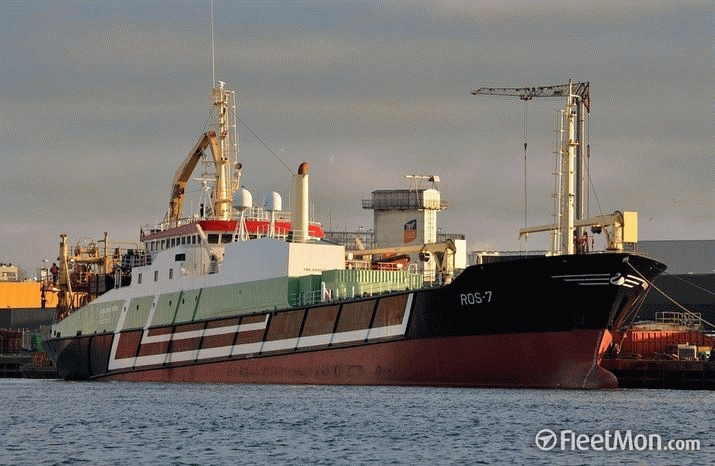

Government axes super trawler scientific advisory committee
The Federal Government’s Australian Fisheries Management Authority (AFMA) has disbanded the Small Pelagic Resource Assessment Group (SPFRAG), the only Government committee that specifically provided scientific advice on the management of Australia’s Small Pelagic Fishery (SPF) and the Geelong Star super trawler.
The abolition of the committee has occurred at a time when it is most needed to protect ecologically vital fish stocks from depletion by the foreign-owned super trawler. The Geelong Star is currently operating in secret and has been killing protected dolphins and seals.
Members of the committee have previously been prevented by the terms of their membership agreement from speaking publicly about AFMA management problems in the Commonwealth’s Small Pelagic Fishery which stretches in a 200-mile wide band right around Tasmania and the southern half of Australia.
AFMA’s decision to disband the committee allows them to speak freely for the first time.
“Until now we have been very constrained in what we can say about AFMA processes and the way it manages the small pelagic fishery”, says Jon Bryan from the Tasmanian Conservation Trust. “We have even been prevented from consulting with colleagues and outside scientific experts”.
“The management issues associated with the small pelagic fishery and the Geelong Star have remained hidden for too long”, said Graham Pike, a recreational fishing advocate and consultant who represented the recreational fishing sector on the now defunct committee. “I think that the committee was disbanded on 30 June 2015 to remove dissenters from the AFMA management process and reduce public scrutiny of this fishery.”
Jon Bryan and Graham Pike have been members of the SPFRAG committee for the 10 years since it was formed. “We believe that this is a critical time for this fishery and the worst time for a scientific advisory committee to be abolished”, Jon Bryan said.
“There are a whole series of serious problems associated with the management of this fishery and the operation of the Geelong Star. For example, there is no scientifically justified mechanism to prevent localised depletion of fish stocks having unacceptable impacts on recreational fishing and the welfare of seals and dolphins is not being properly protected.”
“We were independent voices. We pointed out conflicts of interest and other governance issues to AFMA and have basically been ignored”, Graham Pike said. “AFMA has learnt nothing from the Borthwick inquiry two years ago and has failed to implement the recommendation that AFMA introduce enhanced transparency arrangements into their processes of governance and decision making.”
“Our concerns about the failure of AFMA to adequately deal with conflicts of interest in its management processes have been justified by documents released under Freedom of Information”, Graham Pike said. “These show that the AFMA-appointed Chair of the SPFRAG resigned on 8 January 2015 because of her own concerns about conflicts of interest. That Chair pointed out that one industry committee member was ‘in a perpetual state of pecuniary conflict’ and ‘it is not in AFMA’s nor the fishery’s best interests for him to continue to be involved in the RAG’s advisory role and processes’.”
The Australian stocks of small pelagic fish are among the last healthy stocks left anywhere in the world. Once huge populations of these species in other parts of world have been drastically overfished. These fish are vitally important to the marine environment and for recreational fisheries around the southern Australian coastline.
“Much of the overfishing in small pelagic fisheries around the world has been caused by super trawlers such as the Geelong Star”, Jon Bryan said. “Another super trawler, the Margiris, a sister ship of the Geelong Star, was banned from fishing in Australia by the Labor Government in 2012. The Federal Court of Australia found that the Environment Minister at the time was justified in imposing the ban on environmental grounds”.
The Geelong Star is currently operating secretly in Australian waters. Basic information about where it is operating and what it is catching is hidden from public scrutiny”, Graham Pike said.
“How can the public have confidence in the management of this fishery or the Geelong Star if basic information is not available? We don’t even know exactly where or when the seals and dolphins were killed”, Jon Bryan said.
• Karl Stevens in Comments: Meanwhile starving sharks are attacking surfers in Winter along the East Coast of Australia. Its time to boycott all Dutch products. The ‘Moccona’ coffee I’m having right now will have to go. I will switch brands today. I urge all Tasmanians especially fishermen and surfers to join a boycott of Dutch consumer products.
• Andrew Wilkie: Super trawler now completely off the leash … “The situation has reached a point so bizarrely at odds with the public interest that the community is questioning the probity of some politicians and bureaucrats, and indeed fisheries management in Australia,’’ Mr Wilkie said. “This is an absolute outrage. The Federal Government has axed the only group providing scientific advice on this fishery and allowed the Geelong Star to turn off its tracking device to plunder in secret. And all the while it ignores public opinion and other commercial fishing interests, just to line the pockets of a foreign company that employs a couple of dozen Australians. “AFMA would only have taken this step with political top-cover.’’ In April Mr Wilkie asked the Commonwealth Ombudsman to investigate concerns – shared by members of the now axed SPFRAG – that Seafish Tasmania, the operator of the Geelong Star, helped advise its catch quota. …
• Richard Colbeck: Stakeholder advice remains important for Small Pelagic Fishery science
• Andrea Dawkins: AFMA stacking the trawler deck
• Carol Rea in Comments: … So it seems Senator Colbeck has been stretching the facts to fit the story. This is not fish protein bound for Aussie shops. It’s about export dollars, a few jobs on the vessel and flow on effects for Geelong to the tune of $20 million – well that’s what he said back in March 2015. Now I don’t begrudge feeding West Africans whose fish stocks have been smashed – but not at the risk of the same thing happening here in Tasmania. The science is in question, the Advisory Body is disbanded – yet the vessel continues to work – in secrecy from the public. …
• Stop The Trawler Alliance: Government Shoots Super Trawler Messenger