Coroner & Legal
Chinatown …

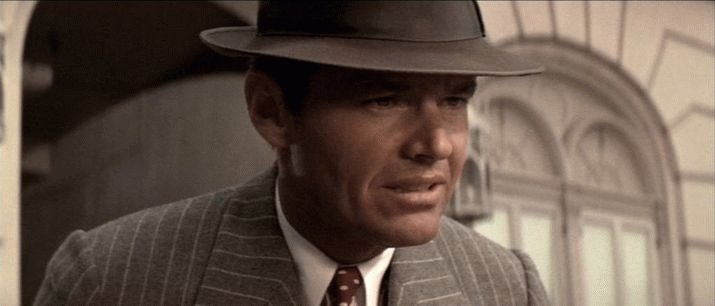

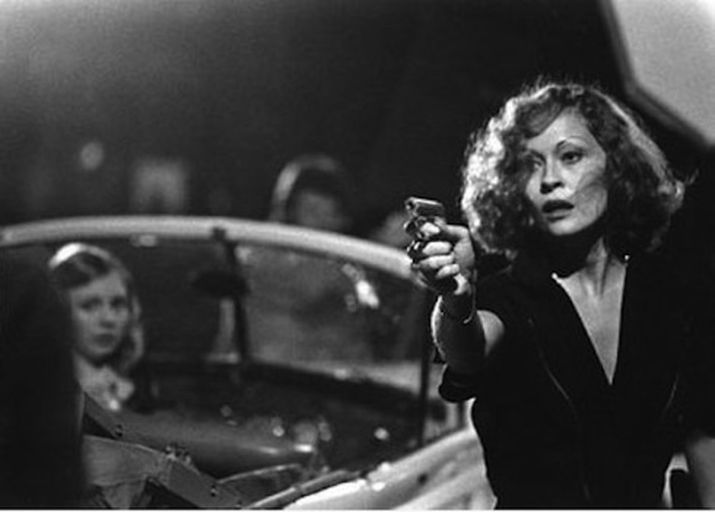

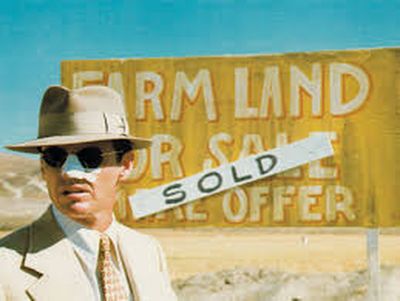
Stills from Chinatown …

It was a movie I’d seen long ago. Chinatown starred Jack Nicholson and Faye Dunaway. They were probably then at their best. It was directed by Roman Polanski, beautifully scripted and beautifully shot. A few weeks ago we had the chance to see it again. Once more, I was almost spell bound by how a detective thriller can be, in the hands of a master, a work of sheer artistry. Where years ago, the story line seemed far fetched, at this viewing, it became more sharply focused as an essay in deception and malfeasance.
Stripped bare, the story is of the owner of a water utility who is using his control of the water resource to create a supply crisis. By this, he was ultimately forcing orchardists from their land. The “supply crisis” was engineered by, every night, having some of his retainers dump to the sea, all the water that has built up in the reservoirs during the past day. This way, there is never enough water to irrigate crops and so orchards are failing and land values falling. He then buys up the land on the cheap using unwitting proxies. When he has finally captured all the land, he can then, hiding behind his proxies, carve the whole lot up into new sub-divisions for a growing California. It was a story that had the ring of an underlying truth.
It was really the large US energy utility, Enron, whose management opened the world’s eyes as just what a scale this sort of thing can be played at. One of their ruses was to know when a consumption peak was approaching, and quietly start reducing generating capacity, and so create a supply crisis. The crisis can then be used as leverage on regulators and local suppliers to crank up prices and gain other regulatory advantages. When they were finally caught out, the collapse was spectacular. A lot of money was lost, and thousands lost their jobs. Enron has since been regarded as a bench mark in corporate malfeasance.
In both these cases, a false crisis was engineered for gain. An interesting variant is stealing someone else’s crisis. You won’t find it now, but a short while ago you would have found a classic example on the Morgan Foundation’s web site for the Million Dollar Mouse. This is a programme to poison the Antipodes Islands with super rat poison brodifacoum to get rid of mice that have been there for around 200 years. Four birds, found only on those islands, also live there un-affected by mice. There are also breeding albatross. The Morgan site featured short video of “super mice” eating young albatross chicks alive – it is revolting. The clip originally shown by Morgan can still be found where it really belongs, at http://www.arkive.org/tristan-albatross/diomedea-dabbenena/video-14.html. It was shot on Gough Island in the South Atlantic. When applied to the Antipodes in the South Pacific, it is a stolen false crisis, no more or less reputable than say Enron. Not so much for immediate financial gain, but an even sicker motive – to support a wealthy man’s vanity conservation project.
The classic mould of making a false crisis … to maintain a vast possum eradication industry …
The activities of what was the New Zealand Animal Health Board (AHB) and now TB Free are more in the classic mould of making a false crisis. To maintain a vast possum eradication industry, this organisation both deliberately maintains a level of Tb in New Zealand cattle herds and falsely demonises possum as a carrier of the disease. On the first count, it has been common knowledge for years that the tests used to isolate the disease in cattle are at best crude. Despite the fact that there are much more accurate tests available, the government’s agencies have persisted with tests which give false results, and so maintain a level of disease in cattle. This was really brought home recently with a statement released by New Zealand First MP Richard Prosser. Prosser’s investigations showed that 75% of the cattle from all round New Zealand tested positive for the disease using the defective tests did not have it. Though there were thousands of cattle killed because of false positive testing, it equally fails to pick up what could be similar numbers of disease carriers testing negative. With this testing regime, New Zealand will never get rid of bovine TB, which it seems is the goal of the TB industry.
It is the same too with possum being touted as a disease carrier. Again, it was a question in the House by MP Prosser that revealed that in the last year or so, the disease is non-existent in possum, and taken over nearly 10 years, and over 124,000 possum autopsied, only 54 were found to have Tb, less than 0.04%, and that the possum would have caught from cows!
http://m.nzherald.co.nz/environment/news/article.cfm?c_id=39&objectid=11459697 . Possum are a slow breeder (usually only one joey a year), prone to winter die offs, subject massive poisoning operations and unrestricted commercial harvest. Because of this, their numbers are very low. Despite the low possum numbers and lack of disease in the possum population, TB Free maintains a massive poisoning programme estimated at around $80 million per year. It is very obvious that the vast tracts of once pristine forests and lands complete with whole populations of rare and endangered birds are being destroyed at enormous cost to the New Zealand public by a manufactured crisis. The “crisis” is used to maintain a large part of a national poisoning industry with all its jobs and career structures. It is an area where the question of criminal intent should be examined.
Probably the most brazen use of a conservation threat to generate a crisis was the effort of Lou Sanson, the then newly appointed Director General of New Zealand’s Department of Conservation, (DoC). In his introductory speech to Parliament in September 2013, he outlined what he saw as a plague of mice and rats growing from a seeding, or masting in the countries beech forests. In a later report in the Southland Times titled Beech Boom may Support a Tide of Pests”, he claimed:- “climatic conditions over the past two summers – a cool summer followed by a warm one – appear to have triggered the onset of a bumper seed, or beech mast, year.” However, despite his caution, this was taken up with exuberance by both his department and his minister, Nick Smith who talked of a “plague of biblical proportions”. What started as a crisis of beech masting, which have happened every few years since Jurassic times, became “Battle for the Birds”. As most people living and working in the South Island high country knew, there was no plague of pests and predators. The whole hoax crisis earned DoC an additional $21 million of public funds to poison over a quarter of a million hectares with aerial 1080.
“Battle for the Birds”
Although “Battle for the Birds” yielded DoC a lot of money, the real impact was largely in the forests and unseen. Included in the massive poisoning programme was hundreds of square kilometres of previously unspoiled wilderness, such as Kahurangi National Park. As before and after operation monitoring does not seem to be a DoC priority, there is no complete picture of the damage other than the claim that native birds including kiwi are declining due to the “predators” that DoC claim to be selectively poisoning with aerial.1080. But other bits of information come out, or in the case of the rock robin, obtained by a freedom of information request. Here in the Grange Range of the Kahurangi Park, 25 rare and endangered rock wren “disappeared”. Another, though still un-confirmed loss is a whole population of kea, the mountain parrot that “disappeared” at Abby Rock in South Westland. You could almost use kea as a case study for what is happening. A February 2008 aerial 1080 operation “targeting” possum at Franz Joseph in the South Island wiped out over 40% of a population of radio tagged birds. Worse still, a 2011 poisoning operation by TB Free took out nearly 80% of a population during the birds nesting season, so the real loss is unknown. Kea, once plentiful are now rare or absent over much of their range.
It is largely because of DoC’s marketing programme that most people fail to realise that DoC is really broadcasting over the land a poison that was originally registered as an insecticide. That is only part of it. It is a poison that interrupts the metabolic process by which the citric acid cycle, that provides the energy to the cells of any creature, be it insects, birds or animals is interupted. It is the closest thing there is to a universal poison. What’s more, it is a slow cruel killer with no antidote for an ingested lethal dose. No-one using this toxin, including DoC, can be under any illusion as to what is being used and its effect. Toxicologist Professor Ian Shaw is reported in the Wellington Dominion Post of 13/3/15 as follows:- “So, if anyone tells you that 1080 can discriminate between pests and native animals they are talking complete and utter rubbish.”
In the dynamics of ecosystem poisoning, everything except non-scavenging stoats and nectar feeding birds like tui will be severely suppressed, but some will survive. It then becomes the race of the fastest breeder. In this race the slower breeders, the native birds, the weta and many forest insects, many of which have an important role in the soil making process to maintain the forest, the slow breeding deer and possum, they all will take years to recover. The fast breeders on the other hand multiply quickly into a land of plenty, a world where the competition for food has been reduced. Rats can reach up to three times their pre-poisoning population in two years, myna and blackbird populations show significant increases. Stoat populations can double. What has happened, hidden in the forest, is the complete opposite of what DoC claims it is setting out to achieve by use of aerial poisoning. It is killing all native birds, the insects that break down the litter to make the soil and it is creating a plague of pests.
Is it really such a monstrous suggestion that DoC, along with their “science” industry and the conservation NGO’s like Forest & Bird who coat tail on them, are deliberately creating a crisis? That by deliberately poisoning thousands, possibly millions, of rare and endangered creatures they have created a crisis for our precious native species. They can then claim that this crisis is caused by a plague of predators that they themselves have created. That they then need more money and more poisoning to address what is fast becoming a perpetual problem of cyclical plagues of “predators” after each poisoning. At the moment it is an industry worth around $140 million a year – a good income stream to bureaucrats, their compliant science industry, a government owned poison bait factory, and a small army of field staff and helicopter operators. More than enough to cover the excess the cost of running Kiwi Rail.
More recently the major players in New Zealand’s conservation and TB industries, DoC, TB Free NZ and their bureaucratic backers are becoming shriller and more pressing in their claims, citing the crisis of predators killing birds and calling for more resources. I wonder if it is because they have the scent of the real honey pot, “pfnz” (predator free new zealand) with its budgeted cost over the next 40 to 50 years of $27 billion – the cost to poison a whole nation. A case could be made that this is what is driving a feeding frenzy.
If, on investigation all this turns out to be true, would that then make New Zealand’s conservation industry the new world benchmark in corporate malfeasance? It is a matter that should be tested urgently.