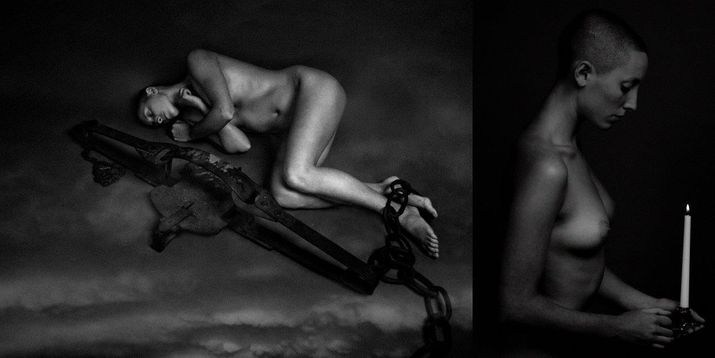

Carnivore – Photographic Exhibition.
Consumption, Beauty and Status.
Images about primates.
Artist: Duncan Giblin
Location: Tasman Quartermasters, 132-134 Elizabeth Street Hobart.
Dates June 11-30
Opening: Thursday June 11th 6:30pm
Context of Carnivore
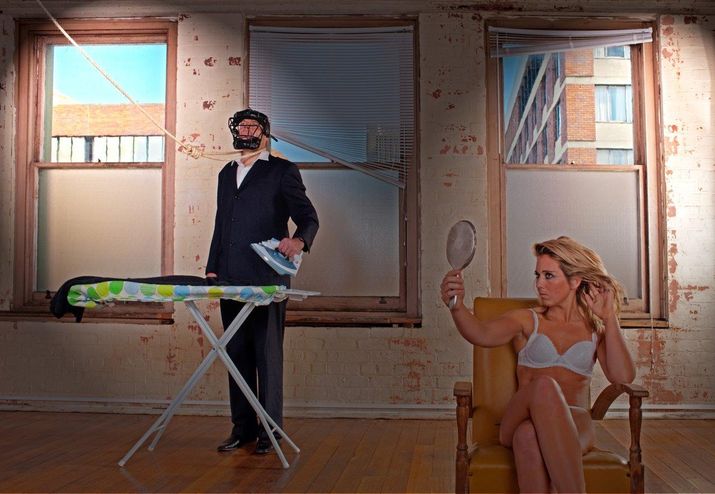
Presented are 20 surrealist conceptual images that explore my ideas around primate behaviour as the driving force behind status based consumption. The work follows several themes within this idea, these are: Beauty as status, the impact of status attainment on the environment, status attainment and relationships, the devaluation of identity in the pursuit of status and nationalism as status. My statement is that the beauty driven morality is coincidently the greatest threat to natural beauty, and individual beauty because our view of beauty is warped by primal traits.
The Making of Carnivore
Whilst working as a commercial photographer I was doing some sensual, erotic and occasionally explicit work both paid and as part of portfolio development. The more I pursued the idea of being a successful photographer creating images around both traditional and “alternative” ideas of beauty I found the work to be quite dehumanising and vacuous, particularly when the intent of the subject was for status creation, or wealth creation on my behalf. I started to wonder where this status drive came from and have always had strong beliefs around materialism and consumption. I decided to use the portraiture techniques I had learned during this process and use them to communicate my theories and explore these ideas.
Significantly at that time I encountered some people who wanted to collaborate and shoot to express ideas around significant human behaviours such as environmental harm and moral positions around beauty as value. The idea of the exhibition then grew from there and as the body of work grew I engaged other subjects for collaboration.
The models in these images are both untrained “regular” people and professional models. The “untrained” subjects are people who have contributed significantly to the content and story in their images. The professional models have also guided elements of the work based on observations and value discussions whilst working with them. This included the experience of their value being assessed against conventional ideas of beauty and how they personally manage this.
I use the medium of nude figurative photography using conventional ideas of beauty whilst challenging this construct and my own values. I like to question the idea of beauty as status and how when beauty is pursued for its place in a tribal headdress, it devalues identity.
Technically the images are shot with a mixture of artificial and natural light, some digital and some high grained film capture, with influences from traditional sensual and portrait photography. Processing is mixture of street press, monochrome and advertising treatments. The series is printed on either Dibond aluminium or Archival fine art paper and framed.
All images are single edition/unique state prints, printed by Luke Wagner on high quality archival mediums and framed by Wagner Frame makers.
Artist’s Statement
I am interested in the idea that the modern ego is a highly developed remnant of the fear-based behaviour that we share with monkeys in trees screaming louder and higher than other monkeys. As we evolved we needed to signify to other primates our ability as a hunter through trophies often worn as garments or jewellery made from prey. Old tribal trophies that were once attained to display hunting prowess and hierarchy in tribal communities are now being replaced by status driven icons. The difference between the “savage” and modern primate is that in the past when apes postured and screamed there was no lasting environmental damage as a result, no body dysmorphic responses and no need for stickers saying “I bought a jeep.” There also is a vast gap, a vacancy between these types of primate validation and genuine fulfilment. The other difference is that much of the early primate posturing was necessary for survival.
These photographs are about my thoughts on this progression from the primitive beings that survived by competition over other primates and about our progression to tribal icons that indicate our ability and intent to dominate other primates.
My belief is that the need to protect ones self and tribe from times of famine is hard wired into the psyche of humankind to such a degree that it drives much of modern consumption. We have been unable to cease the primal behaviour only rather we use different opportunities for display. People, manufactured goods and social media status are all hoarded for the purpose of ensuring or demonstrating ones status in the tribe. Concurrently this activity is temporarily reassuring the ape within that they are safe from times of scarcity. In my work I try and expose the cost of this now generally (but not always) maladaptive behaviour. How our drive for inner ape security ignores the damage to beauty caused in the process of attainment. The impact of status attainment on the individual, the environment and the community is what interests me as an artist.
The use of the female form and discussing body dysmorphic ideals included in the exhibition themes by a male photographer is possibly a controversial one as my privilege as a male ape in our society means I am not as vulnerable to my worth being assessed on my beauty (what little I had to begin with).
A review of my own values and thoughts has come about through the work and these images are not judgments of individual choice and behaviour; this is not an exhibition telling others how to respond differently to morale traverses created by our inner monkey climbing higher in its tree. Or demanding viewers strive towards a utopian egalitarian society, rather observations for contemplation. In fact it is as much an observation of my own behaviour and conditioning as it is about anyone else’s. To give the work a moral frame work using conventional ethical references I would describe it as this: The behaviours driven by cultural relativism and individual’s ethical egotism are counter intuitive to both Kantianism and utilitarian moral positions when prescribing status as worth, beauty as status and defining beauty. Cultural relativism is driven by a collective of the self-serving nature of individuals and the ethical egotism that creates this is as hard wired into us as it is to eat.
To deny the ape within is delusional to allow the ape to take control would be foolish.
There are some confronting images in the works but they are contextually equally as important as the more peaceful sensual and environmental images.
The Simple Explanation.
We crave things that we think are beautiful, based on primal hoarding beliefs to protect us from scarcity and show the other primates we ae not to be fucked with. We remain unfulfilled and none of these modern headdresses we have signify any real link to our survival needs, in fact many would argue the pursuit of such status provides more risk than protection. At some stage if we want outcomes to lack moral corruption then we need to reassess the impact of basic primate functions.
Content warnings
Adult nudity
Surgical images
Injured livestock
Un-photo shopped skin tones of real human beings.
Artist’s Bio:
Duncan Giblin
Hobart, Tasmania.
I have multiple occupations these include AOD Counsellor, Event Manager and Photographer, I put this down to being easily bored and also frightened of unoccupied time.
As a commercial and editorial photographer I have been regularly published nationally internationally and locally. Recent publications include Rolling Stone Magazine, and commercial clients include Adidas and I have had previous successful exhibitions – none of this information makes the images more interesting but given that we live in a status driven world if I don’t tell people this they won’t come and look at my strange ideas.
My main creative drive now is on my environmental and surrealist conceptual exhibition work.
Duncan Giblin