Economy
State Budget a Wasted Opportunity for Waste Management Reform

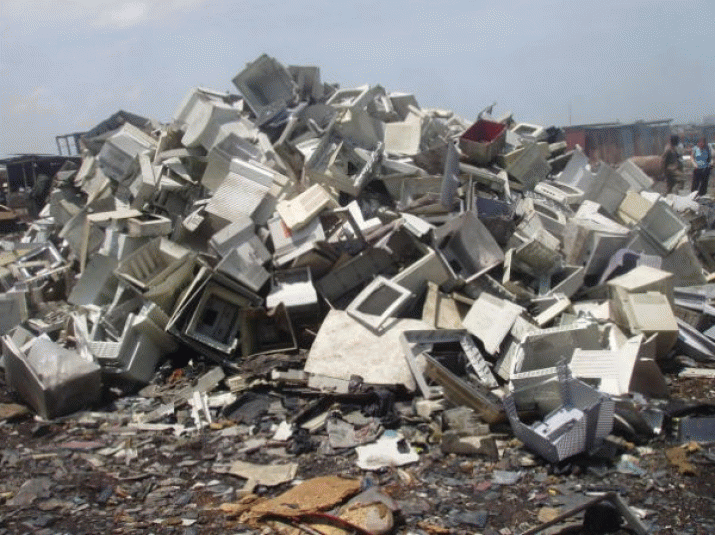

The tabling of the 2015 Budget last week by the Hodgman government was a wasted opportunity to reform waste management in Tasmania.
The government has missed an ideal opportunity to introduce a waste to landfill levy, recommended in a recent report commissioned by the Southern Waste Strategy Authority (SWSA). Delivered in January this year by consultancy firm MRA the Report recommends that relevant authorities seek to introduce a $10/tonne levy to all waste disposed of at landfill, as a matter of priority.
The report finds that there is both broad community and industry support for such a levy.
“This is a win – win outcome for the waste management sector, the environment and government,” said President of the Southern Beaches Conservation Society (SBCS), Shane Humpherys.
Specifically, the report found that such a levy would act as a market price signal in commencing the heavy lifting required in Tasmania to kerb the over reliance on landfill and lift the disappointingly low rates of waste recovery and recycling in the state.
“Furthermore, The Waste Levy Benefit Study found that such a levy would raise desperately needed revenue for both local and state government and create additional employment and investment opportunities.
Such jobs and investment opportunities were identified directly in the waste management sector and indirectly through the logistics support that comes with the ramping up of recycling and other waste recovery infrastructure.
The levy gives certainty to capital investors in alternative waste management infrastructure and technology, which is sorely required in Tasmania to reform our waste management sector,” said Mr Humpherys.
• Angela Marsh, in Comments: This article follows on so well from that by Charles Wooley ( Disasters, HERE ). Particularly as there is also a seismic fault line adjacent to the Copping landfill site. Geology aside, perhaps at our future generation’s peril! If Government does not intervene and take some control over disposal of the exponential growth of our “affluent waste,” as Charles describes, potentially, costly minerals confined to landfill will contaminate our waterways leaving an expensive legacy for future generations to clean up.