*Main Pic: Lewis Hore, left and a mate out in the wilds …
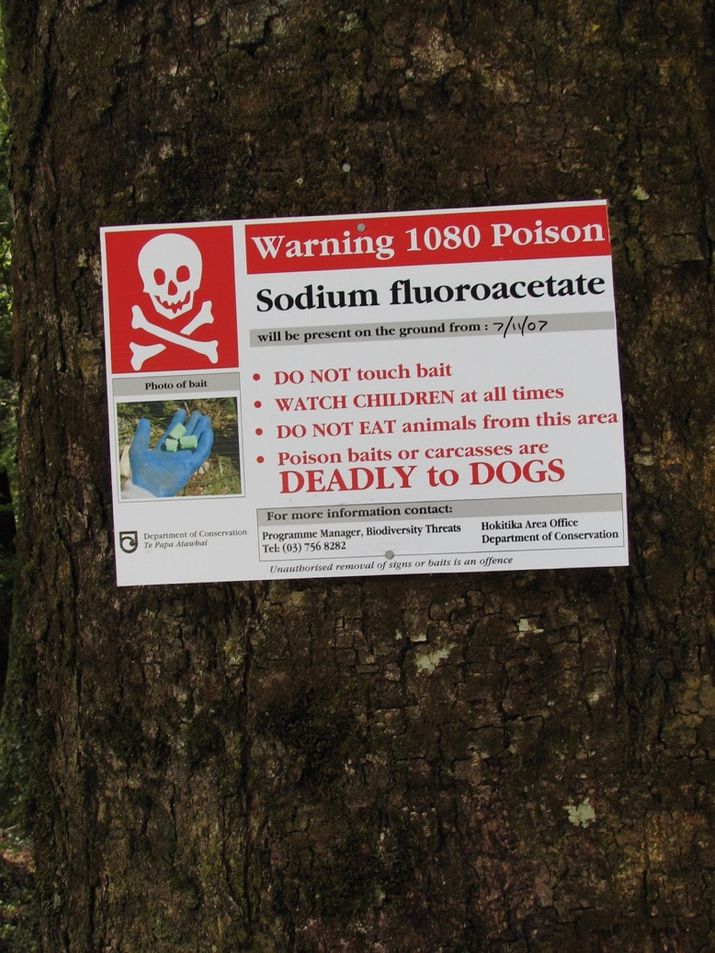
1080 poison warning notices are commonplace – contradicting New Zealand’s “100% pure” marketing brand
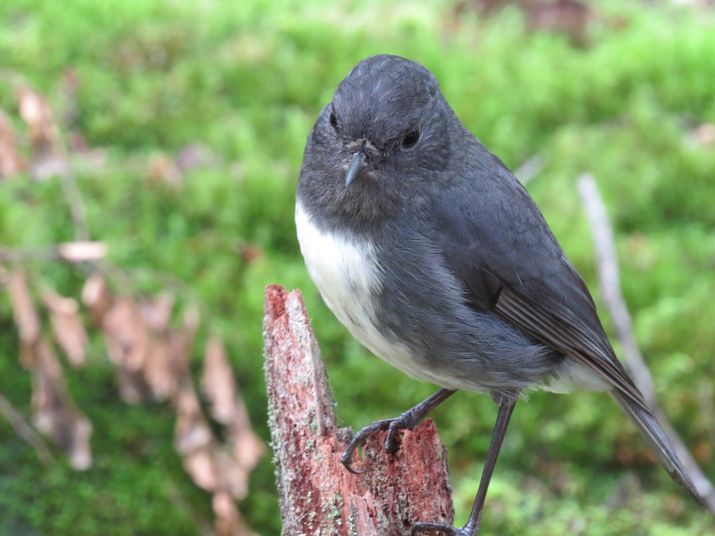
Birds like the South Island bush robin are very vulnerable to 1080
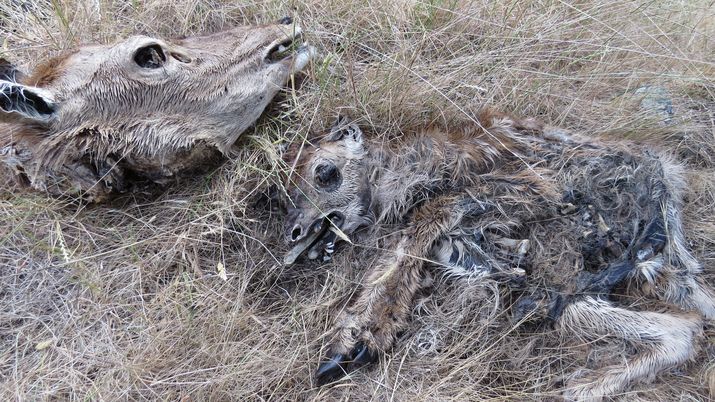
The red deer hind (left) suffered a 48 hour ordeal of dying by 1080. It’s fawn (right) without its mother died slowly of starvation.
1080 poison is a hot-bed of controversy in New Zealand with an increasing number of Kiwis angry at the ecological devastation and waste of public money. Author Tony Orman profiles one Kiwi outdoorsman to ask what really motivates the opposition
Sixty four year old Lewis Hore of Oamaru on the east coast of New Zealand’s South Island, has fished and hunted for most of the last 50 years. During that half century he has probed into wilderness areas such as the rugged mountain massif of Fiordland, the forest-clad Stewart Island and similar other places.
He is one of many Kiwis firmly against 1080 poison. Frequently Lewis goes public with his vehement opposition. It’s not just 1080 either, as bad as 1080 is, for he rates brodifacoum as “even worse”. It’s a matter of bitter experience that has motivated Lewis to take such a strong stand against the mass poisoning of New Zealand.
“When you’re out there in the bush and forests and seen the carnage by 1080 and examine the shonky way government agencies try to justify using the poison, then anyone would be stroppy,” he explains.
The two agencies responsible for spreading 1080 poison mostly from the air is the Department of Conservation and the Animal Health Board. The department known by the acronym DOC, bases its drops on killing predators such as rats and herbivore animals like the Australian brush tail possum. The Animal Health Board now restructured into Tb-Free says possums spread bovine Tb
Near the coastal town of Oamaru is the Wainanakarua reserve an area of kanuka forest and native shrubs. Once farmland many decades ago, in 1980 it became a 4,100 hectare scenic reserve. About 20 years ago, Lewis chanced to stumble upon it.
“It was a magical spot,” he recalls. “The dawn choruses by the bird life were beautiful.”
Now at dawn, it is silent due to successive aerial drops of 1080 first in 2000 then 2002 and 2008. Every drop of the deadly poison, Lewis was angered for as a hunter he knew possum numbers were very low and the 1080 contractors (Southern Pest Management) admitted over 80 percent of deer were poisoned.
“Possum numbers were naturally low plus because of easy access for off-season meat workers who trapped for for skins and fur. As far as Tb reactors in nearby farm cattle, there were none,” he explains.
He reflects on the bird life which before 1080, featured tomtits, rifleman, brown creepers, robins, bush warblers, fantails, falcons, pigeons, tuis and bellbirds while among lizards was the jewelled gecko. One favourite ridge Lewis would regularly see 20 or more tomtits. Now – after 1080 – he might see one or a couple more – “if I’m lucky.”
There was a family of falcons – two adults and three juveniles – Lewis got to know well. After 1080, one solitary falcon remained.
Three days after 1080 had been dowsed over the reserve, Lewis and a friend walked the area and found dead birds comprising 16 tomtits, four brown creeper, swallows, grey warblers, thrushes, blackbirds and chaffinches.
Yet the Animal Health Board claimed there were no bird deaths. Flawed science was used to back the deception. A scientist was then employed by the board, commissioned to carry out a tomtit study but found no dead birds. At the end of three years the scientist could not come to any conclusions as to the benefits of 1080 to tomtits.
“1080 is actually an ecosystem poison,” says Lewis. “The toxin was first developed as an insecticide in the mid-1920s. So it kills insects, birds, animals – everything that lives.”
Complaint Laid
Having found numerous dead birds, Lewis was incensed so he laid a complaint with the Department of Conservation. The reply was the dead birds found by Lewis were due to “natural dieback in winter.”
Later at a “pest management” strategy meeting hosted by MAF Bio-Security Christchurch, Lewis talked to a senior Landcare Research scientist. DOC and AHB had declined to attend the meeting. Lewis showed the Landcare Research scientist a map of grid references of the dead birds found at Wainanakarua and asked him to extrapolate so as to estimate the total kill in the reserve.
The scientist’s reply was “probably several thousands.”
As for possums, in contrast to dead birds found, Lewis and his companion found just nine possums after three days searching.
“That’s not surprising,”says Lewis. “It’s not ideal possum habitat being a lot of manuka and kanuka. Its natural carrying capacity is low. So possum numbers were naturally low. Yet the reason for dropping 1080 was possums.”
As for deer in the reserve, after the initial drop in 2000, Lewis and friends found 18 dead deer. After a subsequent aerial drop of the toxin, four dead deer were found.
“It was already a depleted herd from the 2002 drop anyway. Besides deer do not drop where they take in the poison. They go away and die so we only found a fraction of those killed,” says Lewis.
Repellent Useless
Deer repellent had been used but Lewis describes it as “a waste of time – it doesn’t work.” Deer hunters are sometimes accused by the government agencies as being selfish in opposing 1080 because it kills deer. Lewis rejects that – totally.
“That’s total garbage. I spend my time in the hills and bush because I love the total environment and bird life,” he counters. “Yes I am incensed by deer deaths, but birds, insects and everything else that suffers too.”
Lewis enjoys just being there in the hills and bush. Often a highlight is not so much the deer but other incidents with birds. He tells of waiting in the bush at Stewart Island still-hunting for a whitetail. A kaka came down a ponga and landed on his rifle peering down the barrel.
“That was so neat. How many have seen that?”
Once he watched a fantail in “quite a battle”, killing a wasp. On Stewart Island a kiwi wandering down a deer trail and probing Lewis’ boot, realising it wasn’t soil and emitted a growling noise.
“Really comical stuff and lovely,” he enthuses.
Another time he watched entranced as a family of robins took turns to pull a 22 cm bush worm from the soil. The two adults did the hard work and then called their juveniles to come and have a feed.
“Delightful! It’s those things that are so memorable and will be remembered long after any shot deer are forgotten,” he says.
In one bay in Fiordland which had never been poisoned Lewis said birds were everywhere of all species. The only ones not seen were blue ducks.
“At Poison Bay -ironic name- I counted 21 different bird species including a few sea birds. Kaka and weka were numerous and falcon, kea and kakariki were all there along with stoats and possums. We never saw a rat.”
1080 review Jack-up
Lewis says the possum pest” scenario is simply hype-generated to keep annual vote allocation money flowing. As for TB and the Animal Health Board (now Tb Free) Lewis says the disease (now a miniscule 0.2 percent infection) could be eliminated totally by stopping herd movement, not using the 20 percent error prone skin test and instead using a blood test (99 percent accurate) to identify the few infected animals.
“Within six months, TB would be history, but then so would the bureaucrats and their well salaried jobs,” he wryly comments.
In 2007 the New Zealand government’s Environmental Risk Management Authority (ERMA) carried out a review into 1080 and gave the poison a “green light” for future use.
“That review was a jack-up, asked for by the then Animal Health Board (AHB) and Department of Conservation (DOC), the two big users of 1080. They wouldn’t have asked for the review if there was a risk it would go against 1080,” says Lewis.
It transpires the New Zealand government is deeply involved in the use of 1080. New Zealand a small country the size of the US state of Colorado, uses 90% of the world’s 1080.
He points out that Tb Free NZ, DOC and ERMA which conducted the review are all government agencies funded by government. On top of that Animal Health Products Ltd the company that sells and distributes 1080 from its Wanganui centre in the North Island is actually a government-run company i.e. a State Owned Enterprise (SOE) charged with making a profit.
“The 1080 ‘industry’ is simply a gravy train”, says Lewis. “Government hypes up 1080 to give business to its SOE. They don’t give a stuff about birds, game animals or the environment in total. But the reality is 1080 was originally an insecticide and kills not only birds and animals but native bees, worms and organisms vital to the forest ecosystem.”
Lewis says New Zealanders are increasingly fronting up publicly and loudly on the 1080 issue because it has no justification, is destructive ecologically and wastes valuable taxpayers’ money.
“The more I see, the more I become more defiant of the gross stupidity and waste,” he says.
Over recent years Lewis has at much personal expense, travelled the country with visual displays that show the dead birds killed by 1080 – ironically the very birds DOC claims it is trying to protect from predators such as rats by dropping poison. He’s not afraid to go public.
And he continue to do so. Lewis Hore intends to keep fighting the senselessness.
• George Spearing, in Comments: Lewis Hore is on to it. I am not a hunter, but I do on occasion ‘go bush’ here in NZ and have seen the inhumane and blanket results of 1080 drops. I have also seen many baits that have ended up in waterways, something they insist is avoided. 1080 is indiscriminate, kills non target species and does it painfully. If more people actually saw these results they would be less inclined to believe the government funded propoganda that is spouted. How they can also hypocritically promote a ‘Clean’ tourism image when they are continuously bombing the landscape with a deadly and vile poison that has no antidote is beyond me. And now brodifacoum frequently joins the contamination.