Opinion
They are too busy writing badly to read well …

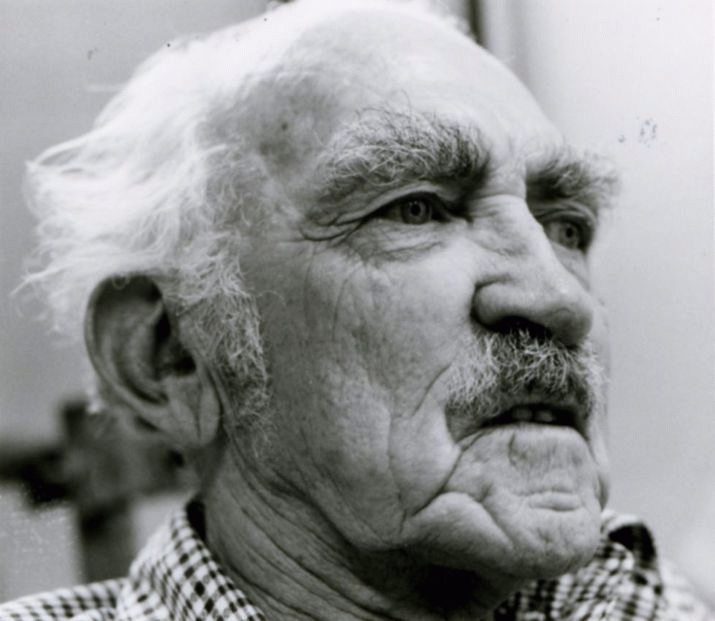


Charles Wooley

From my youth I remember that the longest Australian books written came from a cantankerous, whiskery old outback warrior, named Xavier Herbert.
Firstly I suffered ‘Capricornia’ which seemed an endless and rambling read, until along came ‘Poor Fellow My Country’ with 1463 pages. (God help me. I was only 19.)
In classrooms and lecture theatres around the nation the book was, without affection, better known as ‘Poor Fellow My Reader’. In the early eighties, I met the writer in a shack in far north Queensland by which time I had only just recovered from his books and was reading again. I remember he offered me a consoling large can of beer, which I accepted. It was warm and took forever to drink.
Reading has always been a big part of my life and these days, naturally, I am deploring that the kids don’t do enough of it.
On the other hand some of my adult friends are not helping the situation by doing too much writing. I don’t want to name, or fall out with, anyone here and maybe its only because I’m a journalist, but it seems everyone I know is writing a novel. Worse, many are even publishing them. And still worse, most of the work, proverbially, isn’t worth the paper it’s written on. It just devalues the literary coinage.
I say, “Enough! People, stop all the scribbling!” Why can’t they accept that not everyone can be a Flanagan or a Keneally. Why can’t they restrict their ramblings, as I do, to just one small weekly ration of tight and reasoned, modest and un-opinionated, temperate prose? Why are these people so absurdly lacking in self-knowledge?
I avoid book launches. It’s not just the interminable self-important speeches, the putrid wine and the (mostly) bad writing. It’s the onerous responsibility of helping to unleash yet another unnecessary book on a planet that is already groaning under a vast, excess weight of print.
Every year in English alone, hundreds of thousands of new titles are published. That is too much to comprehend, so let’s just stick to our own country. Twenty-eight thousand, two hundred and thirty four titles were published in Australia last year. For only twenty-three million people that’s ridiculous. I think I know who is writing them, and even now I can hear them dementedly scratching away out there.
But who is buying? And is anyone reading? The fact that a book is purchased in no way implies that it will be read, any more than buying a lottery ticket automatically confers a cash win.
At home you probably wouldn’t admit a clergy-man these days and doctors don’t make house calls any more, so now it’s television journalists like me, and carpet cleaners and electricians who are the new elite with special access to the living rooms of the nation.
I’ve never seen a well-thumbed copy of any Peter FitzSimons book either …
I’ve always been a ‘Book Perv’ and so I have managed to sniff out a few of the titles common to every Australian home. Usually they are big books and always one of them is by Peter FitzSimons; a well written, but (I think) over-long dissertation on some aspect of Australian history. Another big book everyone owns is Les Carlyon’s ‘Gallipoli’. I often find it alongside one of a variety of large folio illustrated editions of ‘The Man from Snowy River’.
Curiously, also popular in the national bookcase is a much smaller read, ‘How to Hypnotise a Chook’ by a former Tasmanian, the cricketer, Max Walker. The book, these days, is quite old, but still funny and well thumbed.
On the other hand Carlyon’s classic, ‘Gallipoli’, I find, has most often been read only in parts. You can tell this with any book. Close it and study the edges of the pages and you can see just what has and what has not been read.
I’ve never seen a well-thumbed copy of any Peter FitzSimons book either, even though they are best sellers. I read his ‘Mawson’ (737 pages) before a trip to Antarctica. It was page 394 before Douglas Mawson even got to the ice, and with global warming slowly advancing, I feared the whole continent might defrost before I finished.
Why are so many books so big? It’s all a matter of marketing. Most books are designed to be given, rather than to be read. The selling strategy is that a slim volume of exquisite, ancient Persian love-poetry, might actually look stingy, while a massive paper brick appears substantial, expensive and therefore a more caring gift. Getting sold, more than getting read, is what it’s all about.
In my own sneaky Aussie-book-shelf research, I found that a study of the edges of copies of ‘Mawson’ revealed that most readers never made it much beyond the first chapter, and few, to the last. Indeed I may be the only person apart from the writer who remembers how the book ends. I don’t want to spoil Peter’s excellent story, but (unlike his readers) most of the cast survive, and Mawson gets back home to tell his heroic tale.
With Carlyon’s only slightly slimmer (600 page) ‘Gallipoli’, which I know that most of you never finished, I can confide that we lost that battle but we went on to win the war. The bad news is that twenty years later we had to fight the whole thing all over again and I’m afraid this only created thousands more publishing opportunities, among them many dreadful novels and only a few great ones.
My problem is not with the over-long professional works of good factual writers. And I have grudgingly come to appreciate Xavier Herbert. No, my greater concern is with the horde of untalented amateurs, now scarily publishing their second novels.
I’m already dreading their third! We are literally obese; overweight with badly written books and the art of reading is being submerged by a rising tide of mediocrity. Blame the indiscriminate publishers, blame the compliant booksellers and blame the poor bewildered gift-buying public, but mostly blame those writers who don’t know the limitations of their own talent. If they read more wisely, they would know that they shouldn’t write. But they are too busy writing badly to read well.
Would-be authors everywhere! Will most of you, please, just stop doing it? The world is already drowning in an ocean of bad literature.
Know your limitations.
Get a newspaper column.
At least it’s brief.
• Steve Biddulph, in Comments: Wonderful article, Charles. For the most part, carbon storage and thermal mass are the true role of bookshop content. Let me add The Long Walk (Read) to Freedom and Stephen Hawkings A Brief History of Time to the list of decorative unread books. But its the endless flow of novels that is truly frightening. As Desiderata teaches us, and printing technology makes possible “Even the dull and ignorant, they too have their story”.