Economy
The Waterloo Bay proposal and the Southwood site …

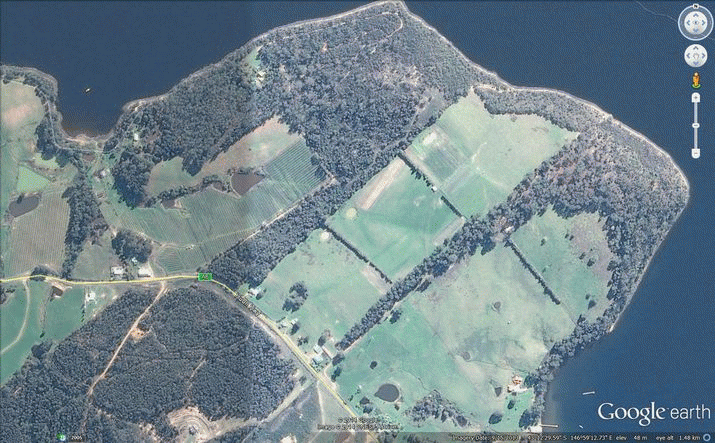

The Waterloo Bay Crown reserve foreshore. A significant part of the north western part of that reserve is up for development.
A changed mindset
Waterloo Bay is a sleepy small picturesque place on the Huon River opposite places like Petchey’s Bay, Wattle Grove and Lymington. If Huon Valley Council Councillors had a different mindset, the existing road around the peninsula from Cygnet and back to Cradoc is a wonderful day tripper tourist route for national and international visitors.
This is one of those unforgettable landscape experiences that can be easily achieved from Hobart, helping towns like Cygnet and Huonville economically where visitors might pause awhile. One might travel back along the Old Huon Road witnessing further amazing scenery.
A longer, different day tripper experience might utilise the Channel Highway, from Kingston to Huonville, thence the Huon Highway, deviating to follow the coast B class road to Dover and return along the Huon Highway. Again villages like Franklin, and Dover would benefit economically. These parts of the Channel offer the tourist wonderful scenic views as their gaze extends across the evolved landscapes along the way, sights that many other countries could only dream of, a photographer’s dream.
In the consistently passing, diverse, panorama(s) of changing pastoral, agricultural, topographical and woodland landscape character, perceptions and aesthetic consideration of place becomes all important.
In the sometimes reflected stillness of the waters, the beauty of the colours of dawn and dusk set against the landscape, what is seen, what is experienced and what is taken away as memory, requires appreciation of evolved cultural landscape values.
Forestry and the Southwood site; a potted background
Southwood (as it was first called and will be called in this article) was mooted over 15 years ago.
The first of the consultant reports for Forestry Tasmania for Southwood was issued in July. This was produced by SEMF Holdings P/L. Called the Southwood Resources-Huon Wood Centre Development Planning Report, Project 14759, it was dated July 2001.
In the nearly 15 years the name Southwood has undergone numerous name changes which might dazzle many. It was to be developed as an “investment-ready site,” publicised by Evan Rolley then Head of Forestry Tasmania. Situated in the Upper Huon Valley far from prying eyes, surrounded as it was then by much ancient forest, Southwood became – at the time – the focus of widespread community angst.
Just as with Waterloo Bay, the matter arrived at the door of the then Resource Planning and Development Commission (RPDC) in 2001 with a decision by 2002. In the community argy bargy and intimately connected to the Southwood proposal was the Electrona wharf, situated just south of the then small town of Margate. As now, critical to the success of any Southwood development in 2001-2002 was an associated southern port for woodchip and residue export. In the long past, other places like Port Huon and Whale Point had been put up but rejected.
Proposed at Electrona was a 75,000 tonnes per annum woodchip stockpile with an anticipated throughput of 300,000 tonnes per annum. There was to be a long, daily procession of log trucks through Margate, along B and C class roads. The local Kingborough community (Channel Citizens Inc.) voted with their feet and voices across 2001-2002 and said “enough is enough.”
The salmon industry became involved. Electrona died a rather sudden death. From that point forward with greater costs, and longer turn-around times, whatever waste or woodchips came out of the Southern Forests and the “investment ready site” had to be shipped to Triabunna. When that closed, waste had to be transported to the north of the state.
Macquarie Wharf site? Really? What about Waterloo Bay?
Heritage and landscape is not presently on the government’s radar screen nor a part of its culture … but forestry is. In the 2014 Forestry (Rebuilding the Forest Industry Act) what is intended is made very clear.
Paul Harriss in his Securing the future of Forestry Tasmania (29 April, TT) speech noted for example some key paragraphs regarding the problem of shifting waste and woodchips from the south…
“The Government will, through an Expression of Interest process, look to the private sector for an industry-led solution to the lack of an effective southern residues outlet – be it for export or on-island use; ….”
“Madam Speaker, finding a solution to the southern residues problem remains a key to rebuilding the forest industry and a key priority for the Government….”
“However, it is not in the interests of the industry or of the Tasmanian community for Government to compete with the private sector in areas where private enterprise, private capital and private expertise are well equipped to do the job.”
…. Harriss then moved on to comment about Macquarie Wharf as a site for potential export of residue and woodchips.
Meanwhile further south …
In the latter half of 2014 Dennis Bewsher put in a proposal for development at Waterloo Bay.
Nearly 190 people objected to the Waterloo Bay proposal. The proposal is described by the TPC as follows: Draft amendment PSA-1/2014 and Permit DA-65/2014, Esperance Planning Scheme 1989.
Transport Depot, Huon Highway, Waterloo. Under planning regulations a specified Departure had to be made to allow the Crown foreshore reserve (PID 1542899) the adjoining Huon Estuary and Land at 5647 and 5649 Huon Highway Waterloo to be used as a Transport Depot (a marine bulk handling facility, including an access road) and construction of a bulk handling facility, wharf, access, road, car parking and associated works.
The hearings by the TPC for at Waterloo Bay will take place this week, 5-8th May 2015.
The “bulk” products apparently were to be sourced from places unknown by Mr Bewsher, up to 500,000 tonnes of them per annum. From these unknown or not mentioned sources, the products were to be loaded onto trucks, which then disposed of their load onto barges, which then again transferred “the product” to export vessels, waiting in the D’Entrecasteaux Channel. Seamlessly executed … no noise, no dust, no stockpiles, and apparently not a development seen in planning circles as a potential Class 2 industrial use.
The Southwood site development started slowly, very slowly indeed, but in recent times has been a busy, very busy developing place.
Let’s examine some facts; a time line being useful
2000-2002, the original Southwood proposal was in full swing. Newspapers were full of I t… Tours of the site were conducted and I went on at least one of these. Pamphlets and glossy information were issued by FT. On the front page of one small pamphlet was the face of Dennis Bewsher, holding up a document, he listed as Engineer, SEMF. The pamphlet with the FT logo was called “The Wood Centre; New Ways with Wood.”
2002. Newood Huon Pty Ltd was established. Its address is 79-83 Melville St. It is listed as a private real estate developer and has two employees.
2004. ITC or Integrated Tree Cropping (July) had merged with the Neville Smith Group; James Neville Smith to become CEO. ITC had acquired 19.9% of FEA or Forest Enterprises Australia.
2005. ITC’s chief Neville Smith is replaced by a South African, Vincent Erasmus; Smith to continue as a non-executive director. ITC was then a listed company, majority-owned by Futuris Corporation.
2006. Harriss talks up the Southwood site; stating that Ta Ann had already commenced capital works on the site. (Hansard 22 June 2006, L.C.)
2006: Rolley: “The good news for Tasmania out of last year was the finalisation of negotiations for the production of rotary veneer. I have, right beside me here, this product to show you and share with you. Paul Harriss has seen the company meeting its production targets in Sibu. They are now building their first plant here in Tasmania and, as of a few hours ago, I can share with you the reality of this. So that is the new plywood mill that is taking shape in the Huon.” (Hansard, 25 July. L.C)
2006. John Holland had completed around $3 million of construction and infrastructure works.
2007. Tim Morris put in an FOI re Forestry Tasmania and Ta Ann over contracts.
2007. A woodchip terminal was proposed in Western Australia for the port of Esperance by ITC.
The ITC consultant was listed as Dennis Bewsher.
2008. Mr Bewsher is mentioned as part of the team of a new company called Innovative Shipping.
A particular expertise of the engineer and project manager was seen to lie “particularly with bulk shore-to-ship interface.”
2009. Disclosed is that Newood Energy Pty Ltd is a subsidiary of Newood Holdings Pty Ltd, itself a subsidiary of Forestry Tasmania.
2011. The “sawmill” at Southwood (apparently languished) was sparked back to life courtesy of Del (Dell) Vista, a Victorian company. The sawmill had been in the recent past operated by Gunns. Ken Last had purchased the mill from Gunns Limited. Del Vista didn’t last very long (see 2012) at Southwood.
2011. November. Neville Smith returned to the Southwood site. The company was now called Neville Smith Forest Products (NSFP) with a registered address at 49 Best Street Devonport, (the offices of AG Synectic P/L.); a joint venture company with John Gay (25% share), sawmiller Ken Last, James Neville Smith, father Richard Smith, Directors.
2012. Bob Gordon when questioned about $3.3 million to Dell Vista defended the purchase; the company went into liquidation and was being wound up by September 2014.
2012. April. Evan Rolley former chief of Forestry Tasmania, joins Ta Ann as CEO.
2012. Activity increases at the Southwood site.
The title which had originally been 87.64 ha (as per the permit from the RPDC) is increased to 136.3 ha, this change possibly occurring as early as 2004. Originally Crown land it now has a title issued to Forestry Tasmania. There is a Caveat by the Westpac Banking Corporation over parts of the land, this registered in 2008.
2012. A series of Environmental Protection Notices were issued and signed off by the EPA. There may have been many prior to, and after the dates mentioned below as the original RPDC 2002. Permit had stipulated the following: 38,000 tonnes of sawlogs, 7,000 tonnes of dry timber, 344,000 green tonnes of wood fibre, 57,000 tonnes dry rotary peeled veneer with packaging, 267,000 tonnes of fuel in the merchandising yard… all totals per annum.
2012. July. Permission is given by the EPA for Forestry Tasmania to construct on the Southwood site a static wood fibre mill and operation of a mobile wood chipper. EPA Notice 7596/3. Regulatory limits, 344,000 tonnes of woodchip per annum.
2012. August. Permission given to Ta Ann Tasmania Pty Ltd. For the operation of a rotary veneer mill. EPA Notice 7599/4. Regulatory limits. 100,000 cubic metres per year of product.
2012. September. Permission given by the EPA for NSFP for the operation of a sawmill. EPA Notice No 8784/1. Regulatory limits 14,000 cubic metres p.a. product produced. 30,000 tonnes per year of woodchip.
2014. January. Cresswells Transport P/L indicates an interest in the Ta Ann/Southwood site, this for a dolomite crusher to be established there. This process now appears to have permission from the EPA. Regulatory limits: 30,000m3 per annum of ground rock product for use as a soil ameliorant and for road construction.
2015. March. Newood Sustainable Systems at the Huon Wood Centre propose a Laminated Veneer Lumber plant for Oak Tasmania. Input veneer volume Stage 1:- 20,000 m3 per annum; Future additional input volumes Stage 2:- 20,000m3 per annum; Total input volume for both stages:- 40,000m3 per annum; Output volume Stage 1 estimated:- 15,000m3 per annum; Total output volume after Stage 2:- 35,000m3 per annum; Assessment of the development is requested at the Stage 2 operating volumes. The address for Newood Sustainable Systems is 79 Melville Street.
2015. May. Environmental and other requisite expert attachments have been forwarded to the Huon Valley Council and or the TPC to the present time to support Mr Bewsher’s proposal.
These include the following expert attachments: a Visual Management attachment completed by Bruce Chetwynd (ex Forest Practices Authority) an Environmental and Biodiversity attachment completed by Van Diemens Land Consulting (Richard Barnes ex Forest Practices Authority), a soils assessment for the foreshore completed by P.D. Macintosh (still with the Forest Practices Authority).
Waterloo Bay a planning proposal which demonstrates integrity, transparency and honesty?
Can we please stop the pretence, the dressed-up appearance of a planning proposal that is not what it purports to be?
Questions which must be answered:
• Mr Bewsher you don’t know where your source of “product” is coming from? Really?
• There no connection between your proposal at Waterloo Bay and what is happening at the Southwood site in the Upper Huon?
• 500,000 tonnes pa of throughput at Waterloo Bay? We appear to be up to at least 410,000 tonnes p.a. (from the Southwood site) but that’s a conservative estimate surely? Always room for expansion in this game. Will the EPA sign off yet again to the increase product or woodchip residue… ?
• How big is big enough for the Southwood site?
• No stockpile at Waterloo Bay? Think Electrona with less throughput per annum?
• Possibly multiple stockpiles, woodchips, wood residue, gravel and dolomite…?
• The image centre front on an FT pamphlet 2001 or 2002 this pamphlet with the FT logo attached; Mr Bewsher are you the front for FT and its subsidiary companies?
• Who is paying who? Private enterprise or some subsidiary company of FT or Ta Ann?
• With exceptionally carefully selected experts to help rattle the proposal along?
• You know nothing of the intent of the Waterloo Bay proposals, Mr Groom, Mr Harriss?
• All: How is it feasible to put 67 semi-trailer (and B-double) loads of woodchips (is this just one way or is it “vehicle movements” of 134 per day, thus 20,904 return vehicle trips p.a?) on C-class roads, (including the Arve Road), with dangerous intersections of same to other roads?
• As the ITC consultant in 2007 in WA for a woodchip terminal at Esperance, can you elaborate?
Do you think Mr Harriss, we all have rocks in our head? Perhaps it must be the dolomite speaking .
Mr Green, Opposition Leader, you are supposed to be the opposition? Where are you?
*Gwenda Sheridan is not a Feral, not a Green member, but an almost-retired member of the PIA, and an active member of the ICOMOS-ISC CL working group. For twenty years she has produced a multitude of reports, (including for WHA), original research, submissions, published work, re heritage, cultural landscape, forestry, historic gardens and more. And I’ve lived in Tasmania nearly 30 years … ‘sufficient to understand the shenangians that are endemic to this state, well explained by Quentin Beresford in his book, The Rise and Fall of Gunns’
• John Maddock, in Comments: The timeline in this article is like gold: it reminds us yet again of the nonsense which passes for “best practice” in Tasmania. I was a founding member of Channel Citizens Inc. and have wondered many times why the Electrona woodchip export port proposal was “shelved” – not abandoned – by the then Minister, Lennon. Could it have possibly been because of the nasty stuff we discovered, but which was never acknowledged officially? It disturbs me that the same culture prevails in other areas of government – in this case around the last of the Huntingfield land at Kingston, when the Minister of the day and her bureaucrats denied a commissioned report on the area was contrary to all the published literature.