Economy
Peter Jones: It’s also brave to stand for peace

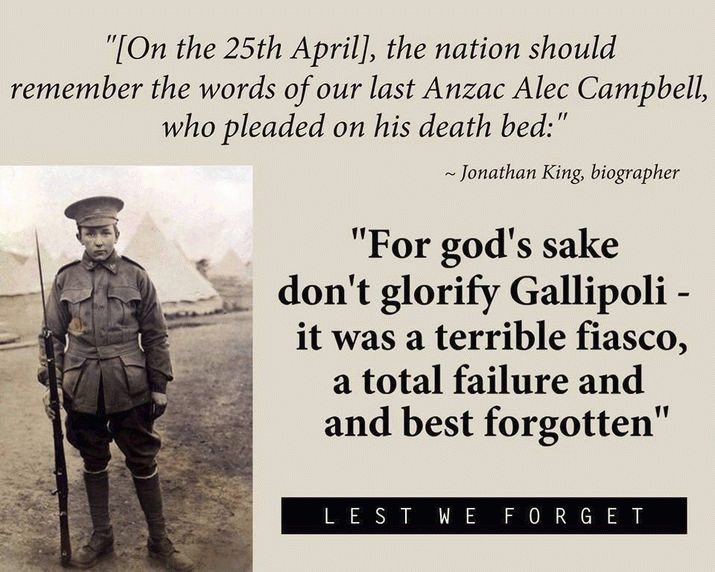

As we approach the anniversary of the Gallipoli landings and then the shift of focus to the Western Front, it is worth reflecting that there is another side to the story.
This is the story of those Australians who not only opposed conscription in the two referendums, but those who opposed the war from the start.
Some of this story is told in a travelling exhibition now on display in the Farrall Centre at The Friends’ School in Hobart, which was opened by Professor Henry Reynolds on February 18.
The Religious Society of Friends or Quakers are one of the three Historic Peace Churches, although, contrary to popular misconceptions, not all Quakers are pacifists, and some indeed fought in the Great War.
As there was no conscription in Australia, the Quaker witness against war as a means of resolving conflict did not involve registering as conscientious objectors or being sent to jail.
Resisters were treated very harshly in Britain and New Zealand where there was conscription, and a number died as a result of their brutal treatment. However, the right to conscientious objection to military service was recognised by the time of World War II, partly as a result of the resistance during the Great War.
Quakers had taken an early stance against the spirit of militarism that was prevalent for many years prior to the Great War. They had warned in 1908: “‘War does not end war, but engenders hatred and sows the seeds of future strife.’’
When the Cadet Corps for boys over 12 was set up as part of the Defence Bill in 1909, they had already spoken out against this fostering of a warlike spirit among children: “Our children ought not to be taught the necessity of war, much less its glory.’’
• Chris Harries, in Comments: ANZAC is Australia’s only real spiritual day in the calendar year. Whereas Christmas now almost totally revolves around shopping and the retail industry and Easter to the fortunes of the chocolate industry, ANZAC is sacred. So sacred that it should not be commercialised. That’s our national sentiment. A sizeable minority is offended by this religiosity, it is the status quo. Pointing arrows at this was the media and public’s reaction to the SBS reporter, Scott McIntyre, who blasphemed by tweet. He blasphemed simply by pointing out that war crimes are committed in all wars and our wonderful diggers did some of that too. He blasphemed because he said that on our most holy of holy days. Now we could ask: what’s the difference between Scott McIntyre’s tweet and Charlie Hebdo magazine’s offensive cartoon that caused so much consternation. The answer is: not much. Both equally offended the sensibilities of deeply religious people. The ironic thing is that depending on where their politics lies, Australian will tend to back Charlie Hebdo and criticise Scott McIntyre for being irreverent and stupid – or vice versa. In fact, they were as brave as each other, the only real difference being that one was conveyed by cartoon and the other by tweet. Both had tried to make a point about mindless belief and they paid the price for their blasphemy.