Economy
New Zealand is stockpiling pure Compound 1080 …



North Island – 114,690 sq km. South Island – 150,460 sq km. Forest area 1080 baited annually – ~5,000 sq km

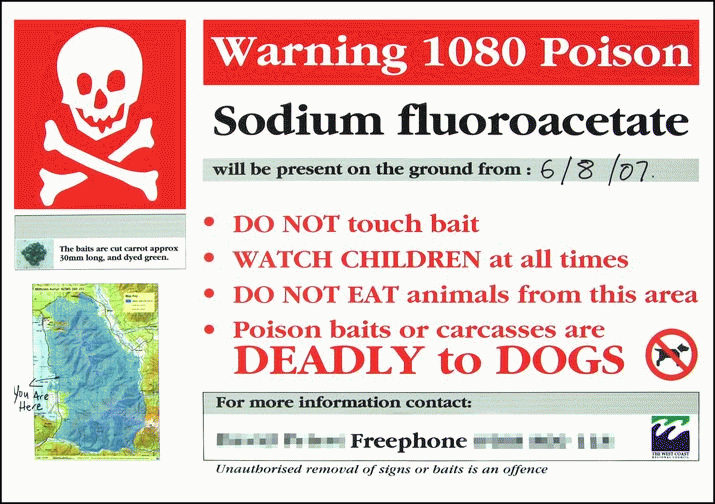
In March 2014 [i]New Zealand Herald[/i] reporter Andrew Stone revealed that a NZ Government-owned business called [b]Animal Control Products Ltd/Pestoff[/b] had stockpiled 7.67 tonnes (7,670 kg) of pure sodium fluoroacetate [Compound 1080].
Andrew Stone wrote:
[i] ‘This country is the world’s biggest user of 1080. Each year we [New Zealand] use about 80 per cent of world production in relentless attacks on pests including possums – which both imperil native birds and spread TB [tuberculosis] among cattle – rats and rabbits.’[/i] [Reference: ‘1080 to rain down on native forests’, March 1 2014 – New Zealand Herald]
Animal Control Products Ltd in their June 2011 ‘Statement of Corporate Intent’ confirms that they are wholly-owned by the NZ Government with just two share-holders: the Minister for Finance and the Minister for Agriculture.
ACP Ltd is New Zealand’s principle manufacturer of 1080-based products – the main NZ users are the Animal Health Board (70%) [a part of the Ministry for Primary Industries, NZ] and the Department of Conservation (30%).
ACP Ltd has a large investment in the manufacture and sales of a range of 1080- and anti-coagulant-based products to kill unwanted vertebrates.
The principle objective of ACP Ltd is stated as:
‘Purchase, manufacture and sell animal or insect poisons or other preparations or products to both public & private sector clients. Activities and products will be for internal New Zealand use and for export.’
ACP Ltd’s ‘Statement of Corporate Intent’ – June 2011 states:
[b]1080 stock reserve[/b] – ‘The target for 1080 buffer stock is approximately 4 year’s national usage.’
‘The company holds reserves of 1080 stocks “in the national interests” and exceeding normal commercial requirements. At this time [June 2011] a potential [financial loss] could occur should severe restrictions be imposed on future 1080 use and the 1080 stocks become valueless.’
This statement was referring to any subsequent restrictions imposed by a regulator – the Environmental Risk Management Authority (ERMA) – on 1080 use in New Zealand.
The Company’s June 2011 statement includes:
‘[b]Given ACP’s reliance on 1080-based products, any materially adverse impacts which may arise from the implementation of ERMA’s recommendation could present severe implications for the company and the industry in general.[/b]’
Now roll forward to another report in the NZ Herald by Andrew Stone 12 months ago (March 2014):
[i]’The company [Animal Control Products Ltd based in Wanganui], which did not return calls, said in its 2013 annual report that it held [b]7.67 tonnes of 1080 powder[/b], which would appear more than enough to meet the increased poisoning operations planned for later this year and the next few years.’[/i]
[i]’DoC intends to drop some 650 tonnes of bait containing 975kg of 1080 on 500,000ha of native forest, most of it in the South Island. The targeted areas cover some of the country’s most dramatic settings – and where high-value, backcountry freshwater fishing spots can be found.’[/i]
How astonishing! Do the math – that’s just [b]under 200 gm of Compound 1080 per square kilometre[/b] over the aerially treated New Zealand lands and water catchments.
[b]Where does New Zealand’s 1080 stockpile come from?[/b]
As far back as 2002 questions were being asked by New Zealand politicians in the NZ Beehive Parliament about the quantities of 1080 used in New Zealand.
In a series of Parliamentary questions and answers it was revealed that ACP Ltd [b]produced[/b] between 2 and 3 tonnes of Compound 1080 annually from 1997/98 to 2001/02.
To put this admission into context, it has been widely assumed that the ‘sole manufacturer’ of sodium fluoroacetate was a plant called [b]Tull Chemical Company Ltd[/b] situated in Oxford Alabama USA. The US Department of the Interior registration of 1080 as a field rodenticide was withdrawn following a 1972 Executive Order [Presidential Order] prohibiting its use on all federal lands. In 1988 the US EPA cancelled the registration and use of 1080 as a rodenticide throughout USA. Since 2001 the use of 1080 in the USA is tightly controlled, and is now restricted to use in livestock protection collars [LPCs] to protect sheep and goats from coyotes in eight western US states. Apart from New Zealand’s usage, countries like Israel and Australia are known to use or stock pile this poison. The largest number of manufacturers of 1080 [CAS No. 62-74-8] and fluoroacetic acid [CAS No. 144/144-49-0] are now located in China. According to the US Wildlife Services the amount of 1080 officially used in LPCs is down to 23 grams a year! Compare that USA figure to New Zealand’s annual manufacture and usage of 1080.
These are astonishing admissions that are decades old!
A few additional questions to ask are:
How much Compound 1080 – in pure powder form – has been exported from New Zealand to other countries?
Do Australia’s pest control authorities source its pure Compound 1080 from this substantial New Zealand stockpile?
[ Since the Tasmanian Government decided to ban the use of 1080 in State forests (later 2005) and restricted its use for crop protection purposes, the quantity of pure 1080 used and controlled by DPIPWE annually is now less than 5 kgm. The new Liberal state government decided to rescind the phasing out of 1080 use in Tasmania after the long-running [i]Alternatives to 1080[/i] program failed to convince commercial farmers to accept cost-effective alternatives to 1080 poison. ]
• ABC: Pesticide banned worldwide still used to grow 70pc of Australian strawberries About 70 per cent of Australian strawberries are being grown on runners that have been fumigated with an environmentally damaging pesticide that has been banned around the world. Methyl bromide is an odourless and colourless gas which was banned under the United Nations Montreal Protocol in 1989 because it depletes the ozone layer. Australia agreed to phase it out by 2005 but a decade later, nine strawberry runner growers at Toolangi, in Victoria’s Yarra Valley, are still using nearly 30 tonnes a year. And, in Tasmania … ?
• Guardian: Pesticide residue on food could affect sperm quality, says Harvard study
• Ian Rist, in Comments: I hope the local supporters and purveyors of 1080 are watching this and all the ramifications very closely. On today’s ABC Country Hour it stated China has stopped importing all milk powder with Fonterra NZ particularly hardest hit. I will add link as soon as it becomes available online.