Arts
Tasmania. Little island, little interest

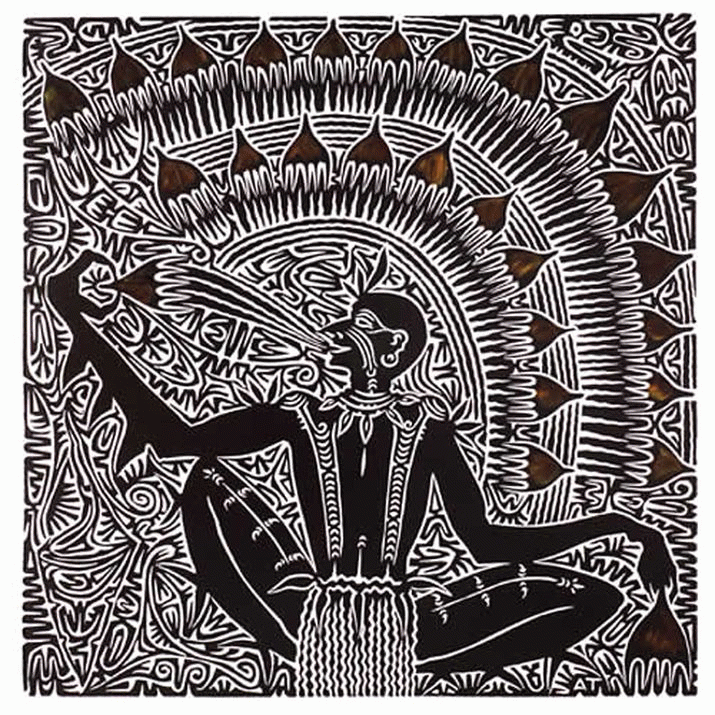

*Image: Alick Tipoti lino-print. Story: Kamu Sagul is a term for playing with mangrove pods. Kamus were often used as toys on the beach when traditional stories were told. The kamu were like toys at the daycare for kids play with. They were used to represent people.

*Image: Alick Tipoti lino-print. Story: Koenaik means sneaking. This print shows the expression of the inner being of a man sneaking up to his female partner. It appears the that the spirit of this man’s creeping is lustful.

I am writing this sad little note to express some almost ambivalence and a predictable disappointment in the Hobart-based mainstream media and the University School of Art.
The events described took place in 2012, and it is only at Lindsay’s invitation that I can be bothered to briefly recount them.
I was managing the Badu Island Art Centre in the Torres Strait. Badu is Australian territory and a completely closed, remote island near New Guinea with about 400 people living on it. It has been the home of some world famous and significantly-emerging Australian indigenous artists.


They include Alick Tipoti (above), Laurie and Dennis Nona, (the late) Milly Matasia and Job Kusu. Torres Strait art is powerful stuff, and has been highly regarded since AC Haddon first visited in the 19th century.
Until 2012 there had not been an exclusive ‘whole of Badu artists’ exhibition. Ever. Some Badu artists had shown across the world, others were collected similarly. Currently Badu work is represented in many heavyweight international galleries. A Tipoti mask, amongst other Bafu work, featured in the all-encompassing BP-sponsored show of Indigenous Australian art and artifacts in London.
It’s a blockbuster.
One of the most significant commercial indigenous galleries in Australia “Art Mob” agreed to support the first exclusive show ever of Badu work. Getting people to Hobart from Badu takes a few days, and the work takes a couple of weeks. It’s so far, if you can be bothered looking at the ABC weather map on television. it’s not even shown. Euan Mills, Managing Director of Art Mob is one of the most regarded and respected men in the contemporary indigenous art scene, and literally moved mountains to make things happen. Euan flew to Badu at my invitation and his expense to see the work before we set out a plan to show it.
One of the elegant representations to media for the exhibition was that the northern-most indigenous Australian artists were to complete their first collective exhibition amongst the southern-most.
That hit the deck with a thud. Local Tasmanian indigenous squabbles between a number of groups seemed to make that somewhat fraught. Each claimed to be more indigenous than the other, and after some confusing posturing from Tasmania and in the light of possible conflict, that plan was dropped. Personally I couldn’t see why it needed to be exclusively one tribe or the other, but I left Tasmania decades ago, where it seems there is often only ever room for one.
To mount an exhibition of this kind took months of planning. Whilst some of the artists were at the time travelling internationally with their work, many others had only been as far as Cairns and in either case moving to Hobart was a major uplift. The journey from Badu to Thursday Island often involves 6 hours in a tinny and two flights.
It took us 2 days, stopping at Brisbane and Sydney. Culturally, geographically and climatically the change for some Badu people was as challenging as a kid from Taroona High taking their first solo overseas trip to Beijing for their summer holiday . But the Badu artists, with enormous support in all forms from Art Mob, were unbelievably excited and ‘busting’ to get to Tasmania. We didn’t know at the time, but Aunty Milly was in the last year of her life and already very unwell. Her legs filled with fluid and in Sydney i bought her new shoes. The option of stopping over was emphatically refused.
She wanted to see her beautiful ghost net baskets in the Tasmanian exhibition.
In the Torres Strait – there are a couple of powerful pillars forming local media. ABC FNQ (Far North Queensland) runs weekly sessions to interview and speak with island artists on any topic they nominate. The Torres Strait newspaper publishes any article and photographs celebrating art, myth, stories and events. The Indigenous Radio Service is devoted to the same. In 11 months, Badu artists and their projects achieved no less than 40 ‘media events’ (print and radio).
I was staggered at the indifference …
Media releases were prepared for the Tasmanian show. Emails were sent to all major Tasmanian media outlets. Phones were called and producers and editors advised. People had to be chased, over and over. I know this because I was doing the leg work and somewhere I have a full set of diary notes on this showing the multiple calls made, and emails unanswered.
I was staggered at the indifference. The worst seemed to be the Hobart ABC. But at least they responded. The Mercury just seemed to be in hibernation, or worse – had slipped off the face of Hobart and was staring up its jacksie at Lune River. No doubt lamenting the glory days (as the late Edmund Rouse described his Examiner), when dailies in Tasmania ran stories of the greyhound races and enjoyed the elevated quality of being the ‘butcher’s preferred sausage wrapper’.
My contact to the media commenced 6 weeks prior to us leaving Badu. I knew something was wrong when a producer at the ABC admitted that she had simply forgotten to pass a phone message on to a reporter, and forgot who I was.
I persisted. Alec Tipoti was, from memory flying back from an exhibition in Japan. Art Mob had secured showing rights of a superb Dennis Nona Bronze and one of Tipoti’s unbelievable 6 metre lino prints – which tells complex stories and has a similar purpose in Badu culture as the Bayeux Tapestry. Badu has the only and northern-most Bronze-casting foundry in Australia and other Bronzes were being shown. The foundry was commissioned and the artists trained by Dr David Hamilton, Tasmanian, and former head of the Art School. The show was to be a major event with nice synergies and connections between the two tiny islands.
The University School of Art had been contacted. The school is just 20-odd metres from Art Mob Gallery and I’d floated the idea of establishing an artist exchange program and possible collaborative residencies in carving, casting and weaving along with fabric printing to the University. I’d also done this with the prestigious Victorian College of the Arts (VCA) and at least one post-graduate student was straining to come up to Badu.
On opening night Alick and Laurie Nona performed a traditional dance. These are deeply intense and deal with stories of the wind, the ocean currents, the stars and the spirits of the dead . The dance requires the artists to tap into ancient stories and spirits and its delivery is exhausting. Their unbelievably intense and beautiful performance was a gift to Tasmania.
The ABC didn’t attend, instead cancelling and heading off to cover another MONA award, this time the self-confessed ‘arse-o-holic’ received an architectural award. Good for David … a big arse in a little puddle.
The Mercury didn’t show, and didn’t publish the photographs and story sent to them by email. The university didn’t attend the opening and only 3-4 students trotted along but for their efforts were able to engage with some of Australia’s most successful and wonderful indigenous artists. It was about this time a Dennis Nona Bronze was reportedly sold for over a million bucks, and the BBC sponsored Gryf Rhys-Jones to produce a program on masks of the Torres Strait with heavyweight emphasis on Tipoti’s printing and his traditional masks.
The Badu artists were gobsmacked. Deeply offended. Never ever before had they been ignored, especially on such an auspicious occasion. Aunty Milly asked me “don’t this mob care?”
I wrote to the Managing Director of the ABC (Mark Scott) and the letter got flicked to the Tasmanian state manager.
I didn’t bother with the Mercury, which I’m sure remains soft, strong and very absorbent.