Economy
Mother Mountain: The Symphony of Birdsong (50)

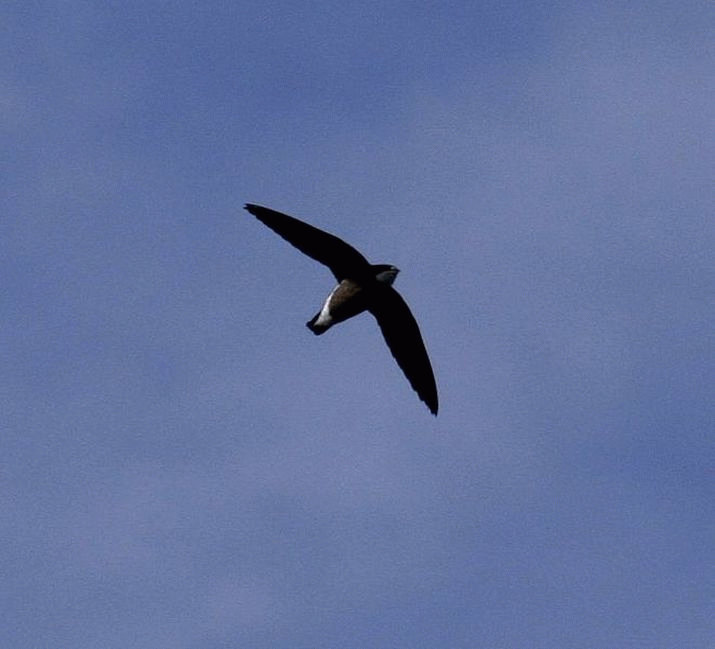

*Pic: A Needletail Swift in full glorious flight …
The “Respect the Mountain” forum ( here, here, and here ) at the Hobart Town Hall earlier this year prompted Don Knowler to return to a diary he compiled after daily rambles on Mt Wellington during the previous year. In what promises to be a momentous year in the modern history of Kunanyi, the weekly diary gives the mountain and its wildlife its own voice. All Don’s Mother Mountain columns – and much more by this superb writer – can be found under the Category, Don Knowler, here
Thunder in the mountain, it sounded like a Bob Dylan song, not the thunder but the refrain. I should be seeking shelter, in a cave and not under a tree. I stood in the open, however, my eyes on the heavens. It was just the sort of storm front that would bring with it the mysterious and magical needletail swift. That or the rising hot air from a bushfire.
The swifts breed in Asia and migrate to Australia for our summer, guaranteeing a supply of their flying-insect prey year-round. For the swifts, it is an endless summer.
I’ve only seen swifts on two occasions previously in Tasmania, but I am always on the lookout for them when conditions are right. And so it happened in early February, purple rain clouds tumbling and rolling towards the mountain from the west, and the turning and rolling and twisting swifts carried before them, like flying fish riding the surf.
The swifts usually appear high in the sky, very high so they are mere dots, but the elevation of the mountain put them at eye level. They were moving closer ahead of the storm clouds, chasing insects disturbed by the gathering winds. The needletail is one of the biggest swifts, about the size of new yellow holland honeyeater and, along with its 100 or so family members worldwide, represents a group of the most aerial of birds. Larger species are among the fastest fliers in the animal kingdom, with the white-throated needletail having been reported to fly at up to 170 kilometres an hour.
From my vantage point at the Chalet about a two thirds of the way up the mountain I was treated to the best of aerial displays. There must have been 20 or 30 birds in the flock – it was impossible to count them reliably as they criss-crossed the sky – and as I watched them wheeling and diving, I considered the remarkable journey that each years brings the swifts to Australia, and a lifestyle that sees them spend most of the time on the wing.
It was once believed they never came to ground out of the breeding season – when they build mud nests in caves – but the latest research suggests they do indeed roost in trees, if only for short periods. They certainly feed exclusively on the wing, and drink, and there is a commonly held theory they also mate on the wing. No one has ever proved otherwise.
As soon as these birds had appeared, they were gone again on their journeys across mountain and plain and, later, ocean and desert to nest in the rocky hills of central Asia and southern Siberia.
The bubbling, chortling song of the yellow-throated honeyeater drifted down from the stringybark gums a few days later as I stood at a special spot beneath the summit of Mount Wellington, trying to envision a similar sunny, hot day on February 11, 1836.
I often stand at the location at the top end of the Waterworks Reserve when I retrace the steps of another nature lover 177 years previously.
It’s no secret that Charles Darwin visited Hobart during the epic voyage of the Beagle, the nearly five-year journey that fuelled his ideas about evolution, but I tend to reveal the significance of this location only at the end of the bird walks I occasionally lead in the reserve. The information on Darwin for those who don’t already know it is a handy bit of knowledge to impart if the birds have been in short supply, or I have run out of birding anecdotes.
I have a few stories about Darwin of my own, particularly a gem on how he dumped many of the rocks and fossils he collected after his climb up the mountain because they were too heavy to carry. Along what used to be the Huon packhorse trail is a treasure trove of rocks that once belonged to Darwin, which cries out to be found.
Huon packhorse trail …
February 11, and I stand on the remnants of the Huon packhorse trail to contemplate the sights and sounds Darwin would have experienced. Certainly the birdsong would have been the same – including the songs of the yellowthroats and yellow wattlebirds which are unique sounds to Tasmania although Darwin might not have known this at the time. The mountain itself would not have changed in all those years since, except for the concrete communications tower and visitor viewing centre at its summit.
Darwin described Mount Wellington as “the most conspicuous feature in this neighbourhood” and the “noble forest” on the mountain slopes he described in his journal would no doubt have looked as it does today, although most of the meandering trail through the lower Waterworks Valley leading to the mountain has been lost under the glass and concrete of suburbia.
As Darwin wrote in his journal: “ … In many parts the Eucalypti grew to a great size, and composed a noble forest. In some of the dampest ravines, tree-ferns flourished in an extraordinary manner; I saw one which must have been at least twenty feet high to the base of the fronds, and was in girth exactly six feet. The fronds forming the most elegant parasols, produced a gloomy shade, like that of the first hour of the night.”
In my latest Darwin pilgrimage I discover new facts about the great man.
I knew that Darwin had failed in his first attempt to reach the summit, and that he had succeeded on the second day, but I didn’t know how far he had got in that initial attempt. Reading all I could about the mountain during the year I compiled my diary, I learned that Darwin’s first try ended when he was forced to turn back somewhere above the head of Myrtle Gully near Crocodile Rock.
The second, successful, attempt took five and a half hours. He blamed this slowness on the guide who led him via the wetter gullies on Wellington’s southern flanks, rather than up the drier northern slopes. He said in his journal, recording his latest exploit: “Our guide however was a stupid fellow, and conducted us to the southern and damp side of the mountain where the vegetation was very luxuriant, and where the labour of the ascent was great.”
Darwin had as great an interest in geology as biology and of the rocks he studied in the Waterworks Valley on his way to the summit, he commented “there is such a confusion of strata”. He was confused because the area lies within the central portion of a huge fault zone where the rocks are much disrupted.
Darwin sampled fossils (mostly snails and shellfish) along the Sandy Bay Rivulet beneath Turnip Fields in a rock series Permian in age (about 280 million years old) but its fragmented structure would have been difficult to read to the Victorian geologist’s eye. He would have also seen the quarries in the area which comprise Triassic sandstone (about 240 million years), a stone used in local buildings and later to build the infrastructure of the Waterworks.
The age of the rocks unpinning the Hobart area put the mere 177 years since Darwin’s visit into a different sort of perspective. If Darwin could return to Hobart in the 21st century he would see that man’s capacity to change the landscape is a lot faster than the slow hand of nature.
The fledgling city of Hobart and its immediate bucolic environment below the mountain might have been transformed largely beyond recognition from Darwin’s days but we still have the wildlife that he observed, especially the birds. Today he would still recognise the call of the yellowthroat and the black-headed honeyeater in the valleys leading to the mountain and, further up its slopes, the trumpeting of the Tasmanian currawong.
The people of Fern Tree are well aware of Darwin and his historical link with their hamlet but, on the anniversary of his meanderings, he could not have been further from their thoughts. The Molesworth fire around the far side of the mountain was still raging out of control, and Fern Tree folk had been summoned to a meeting in the community hall over the road from the Fern Tree Tavern.
The news was not good. The residents were told by Tasmanian Fire Service officials not to await for an evacuation warning if the Molesworth fire approached the mountside suburb. The fire officials said the heavily wooded residential area was so dangerous in the face of fire that a “safe place” could not be identified where residents could shelter. “No hiding place”, screamed the Mercury’s headline.
On the mountain next day, the smoke still hanging heavily from the Molesworth fire, I found creeping tea-tree at the summit, still in flower. Tea-tree on higher elevations is fashioned by wind, shaped so it grows low around rocks, and grows from fissures cutting into dolerite. The shrubs grow bigger at lower altitudes, sheltered from the wind and already these had passed their flowering stage. The last creeping tea-tea bloom I would see this summer, with its small white flower, had anchored its roots in the sandstone floor of Sphinx Rock and when I gently squeezed one of its leaves, it released a pleasant scent.
Within days there was relief from the heat, and relief from the fear of fire for the people of Fern Tree. Clouds spilling over the mountain summit, tumbling fast and furious across the face of the Organ Pipes and into the valleys heading to the estuary, signalled rain, and it started to fall in buckets.
As soon as it stopped I headed to the mountain. The summit was still clouded in mist, to below the Springs, and I had to settle for the Fern Glade Track.
Lovers were not the only visitors …
A cruel, harsh summer had left its mark right down to the edges of Dunns Creek, at the heart of the Fern Glade Track. Ferns were scorched in places where they had been exposed to the sun. Snow berry was still in flower in sheltered spots deep in the ravine. There the sun and hot, dry air had not reached them.
The birds there were in full voice, joyous, that the drought had broken and the threat of fire had retreated for another year. Yellow-throat, scrubwren, Tasmanian thornbill, mountain and grey currawong, pink robin, grey-shrike thrush; a symphony of birdsong again as though it was spring. And from the highest eucalypts the keening of the yellow-tailed black cockatoos.
The summer song of the striated pardalotes, though, had fallen silent, and within days other birdsong would die. The end of summer, the end of the breeding season. Flowers turning to fruits and seed, young birds well on the wing, their downy juvenile plumage growing more and more like their parents. Mother Mountain sent out a message, heralding shorter days and colder nights. It was a message lost on a male strong-billed honeyeater. He engaged in a courtship display in a silver wattle close to the Springs, chirping merrily and dropping his wings to his sides, then flapping them rigorously. He resembled a demented penguin in the treetops. No one paid him any attention, especially females of the species. It was too late for all that. Love was definitely in the air, however. It was Valentine’s Day, February 13. At the Springs, a parked car was emblazoned with kisses and hearts, and a message taped to the rear window which read: “Happy Valentine’s, Margaret”.
Lovers were not the only visitors to the mountain that week. The cable car proponent, Adrian Bold, was checking out possible sites for the terminal at the summit with a team of experts.
Investors, planners , architects and engineers had chosen a sunny, wind-free day to check sites below the existing observation cabin. The manager of a major construction company said the terminal had to be the best and most environmentally sound for the mountain and have minimal visual impact on the Pinnacle …