Economy
Mother Mountain: The Symphony of Birdsong (48)

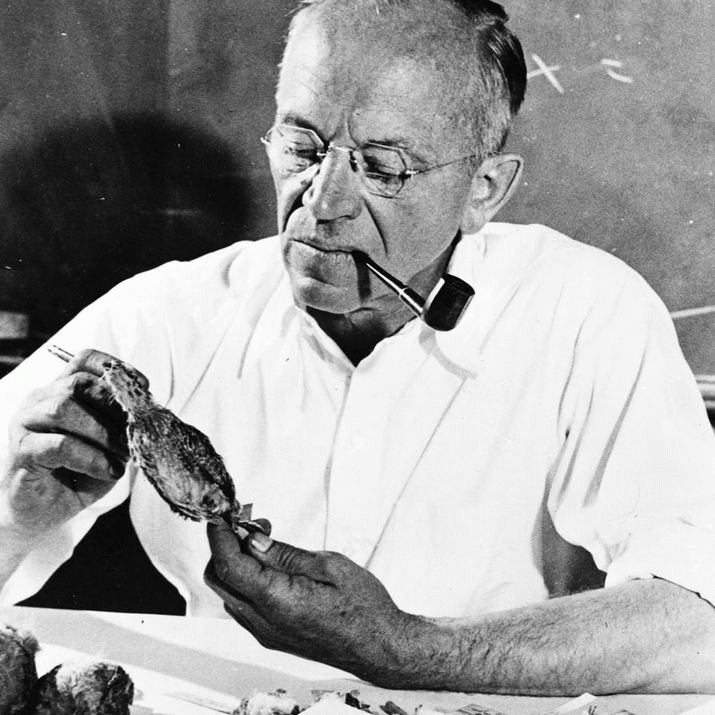

*Pic: The great American environmentalist Aldo Leopold
The “Respect the Mountain” forum ( here, here, and here ) at the Hobart Town Hall earlier this year prompted Don Knowler to return to a diary he compiled after daily rambles on Mt Wellington during the previous year. In what promises to be a momentous year in the modern history of Kunanyi, the weekly diary gives the mountain and its wildlife its own voice. All Don’s Mother Mountain columns – and much more by this superb writer – can be found under the Category, Don Knowler, here
The mountain calls to me. She looms silent from a distance, just beckons from beneath shafts of sunlight that roam like theatre spotlights upon her stage. But up close she speaks through the wind rippling the forest canopy, through its murmur in the scree. And not just the wind. The birds and the chirruping insects also speak on her behalf, utter her words.
A mountain with a voice; I was thinking one summer’s afternoon that this was in fact a foolish notion, the kind of thing I might say after a few beers at the end of an exhilarating mountain adventure, resting now in the Fern Tree Tavern or another post-mountain watering hole, the Cascade Hotel in South Hobart. Tired and emotional they might say in my trade of journalism. Then I remembered the great American environmentalist Aldo Leopold and something or other he had written about a mountain with a voice in his Sand Country Almanac. I dusted down a copy sitting on my bookshelf, and sure enough an essay was titled Thinking Like a Mountain.
It was an account dating from Leopold’s youth in the American mid-west, when he had been out hunting wolves with a friend. He shot a female, they tracked the wounded animal and wrote Leopold: “We reached the old wolf in time to watch a fierce green fire dying in her eyes. I realised then, and have known ever since, that there was something new to me in those eyes – something known only to her and to the mountain. I was young then, and full of trigger-itch; I thought that because fewer wolves meant more deer, that no wolves would mean hunters’ paradise. But after seeing the green fire die, I sensed that neither the wolf nor the mountain agreed with such a view.”
A bright, sunny day, a thin veil of cloud hanging over the mountain, the Organ Pipes etched in deep shadow as they always are early morning with the sun sliding around to the north-east.
I didn’t do the mountain that morning, preferring instead to go to the Waterworks Reserve to contemplate the mountain’s beauty from what I believe is the best vantage point to view it on such summer days.
It’s glorious, breathing-taking, spell-binding, awe-inspiring: I can never find enough superlatives and clichés to describe it.
Days previously I had been to the summit, to check out the site of the proposed cable car station and observation deck, or more precisely to assess what impact they would have on a patch of land already holding an observation cabin, a cabin that can be seen from kilometres way, along with the concrete communication tower.
I looked up at the observation cabin and its deck from far down in the Waterworks Valley, and I could see the shapes of people looking out over the city. These people are easy to see because clear sky is behind them, and you can see visitors coming and going and raising their arms to take pictures of each other, with the city as a backdrop.
Someone in a yellow top …
As I looked up I could see something I had not witnessed before. I made out the shape of someone in a yellow shirt or T-shirt making their way down the Zig-Zag track well to the south-west of the observation deck.
I raised my binoculars and could see a woman with a backpack, alone, hurrying down the slope, as in a mad rush to reach the Springs. On my walk down part of the Zig-Zag Track a few days previously I had noticed that it was festooned with summer flowers, unusual flowers of the alpine kind and I had taken my time on this part of the walk to find and study them. In fact I had taken so much time that I had run out of time to complete the walk down to the Springs and return.
On my walk I came across the white and pink erect flowers of the mountain rocket, a hardy small shrub with grey-blue serrated leaves on branches as erect as the flower. The cylindrical leaves of yellow bush waved in the wind; a dense cluster of the dense shrubs swaying in unison in the breeze, like waves on some great ocean.
The flowers emerged from the end of the leaves, small and creamy white. The ubiquitous spice bush, was there, of course, along with the lilac flowers of eyebright thrusting skyward on thin stems and the silvery, spiked leaves of pineapple grass rising from the mat it forms on the alpine floor.
These wonderful, interesting plants so different from the vegetation of the mountain’s lower slopes, and the hiker in a hurry missed them all.
It took her only about 25 minutes to descend from the upper slopes, and I watched the hiker as she went zig-zagging down the Zig-Zag Trail. It was my own Where’s Wally moment, spotting her yellow top amid the sun-burned brown and yellowing vegetation lower down; one moment I could see her, and then she vanished, behind a dolerite boulder, a satinwood bush or the tight tangle of a clump of waratah, the plants losing their brightness, losing their sparkle, as the summer began to fade.
Next day, another sunny one, I was in the same spot in the Waterworks Reserve. For some reason I was drawn to view the Zig-Zag Track from afar again and viewing walkers coming down it. There was only one and even from that great distance I could make out the figure of someone I knew. It was the elderly gentleman I had seen so many times before, the hiker who appreciated the flowers in the summer.
He was harder to see than the woman in the yellow top. He wore the khaki shirt I always saw him wearing, when he was not wearing an anorak of yesteryear, and I could see him taking his time. Stopping and stooping – no doubt to look at flowers – and then gazing about him, down at the valley and across at the distant ocean. And sometimes turning to look back, to survey the route he had come.
An apt metaphor for an elderly hiker on a mountain …
Turning back, to survey the route you have come – it’s an apt metaphor for an elderly hiker on a mountain, as apt as the season that in a month would encroach on summer, the autumn of the year, the autumn of a life.
The flame robins had rebuilt and refurbished their nest, and I found the female brooding eggs again. The fan-tailed cuckoos were silent now but I knew they were about. I could see them, more easily now because they didn’t need to remain hidden to raid the nests of prey species, although I’m sure it was still going on. The frantic breeding activity of spring and early summer was over, territories established, mates found, nests built and a first brood of young on the wing. The second brood of those rearing two sets of offspring were well on the way.
The familiar song of the flame robin, “you may come if you wish to the sea”, rang out across the scatted dry woodlands, through the yellow gums, the tune coming to rest in the kangaroo grass. Did the male feel the need to re-establish his rule over his domain, re-establish his bond with his female? Whatever the reason, the song of spring made a pleasant refrain towards the end of summer.
I lingered longer on the mountain than usual. It was eight o’clock and the sun was still up, although tucked behind the mountain. A possum was out and about, too impatient and hungry to wait for nightfall to feed. A day later I would find another, dead on the Pinnacle Road at Shoebridge Bend.
January 28, the height of summer, Australia Day. A celebration of the European settlement of Australia with the Christmas bush still in flower. Snow gums carried fluffy white blooms on red stalks, and hikers sported Australia Day hats given out by the Mercury.
A family had gathered at the Springs BBQ site and in the cabin someone had lit a fire. The morning had been chilly but by late afternoon the sun had burned off the cold.
The black currawongs knew it was a public holiday. They hovered and hopped around the BBQ site and the hut, looking for snags and lollies. The kids in Australia Day hats obliged.