History
The storm clouds gather; the goal posts recede …

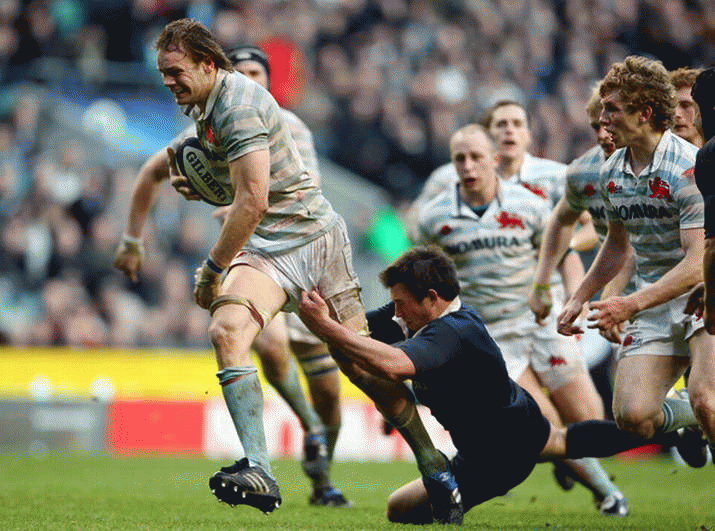

S.S.McKeen of Oxford University can not stop Will Jones of Cambridge University scoring a try during the Nomura Varsity Rugby match between Oxford University and Cambridge University at Twickenham Stadium on December 10, 2009 in London, England.
LONDON, WEDNESDAY. The Oxford-Cambridge Rugby match has intrigued me since I read Archie Macdonell’s description in England, Their England.
From memory, it went something like this: the teams sat down for the photographer; stood up for the Prince of Wales; and, in the fog, were thereafter only intermittently visible to the 45 000 wildly excited spectators. By contrast, the University Soccer match was played with extraordinary skill in brilliant sunshine before 5000 silent spectators.
The standard of University Rugby has recently suffered an alarming declension; something to do, I believe, with an admission system that lets in academics only, rather than the occasional games player. In their preliminary twenty canters this year the contestants managed only one win, to Cambridge, between them.
Shuffling in the queue at Waterloo ($2.24 off-peak return), I heard a young man wearing a red and black scarf intone, as if quoting:
The storm clouds gather;
The goalposts recede;
Twickenham itself recedes.
It’s a bit of a slog: half an hour from Waterloo to Twickenham Station and another fifteen minutes in a chilly eight degrees to the ground via Whitton Road and Chudleigh Road.
The match program, 80c, shames Australian varieties at twice the price: all sorts of data, and a number of charming and literate memoirs by old Blues (you only get a Blue if you actually appear in the University match).
From the program I learn that the celebrated Australian, Dr Phil Crowe, 28, is shooting for a PhD in surgery and will thus, in due course, become Doctor Doctor Crowe. In addition, his team-mates aver that he is doing another PhD on the contribution of the Muppets to modem medicine, which of course would make him Doctor Doctor Doctor Crowe.
And this epicurian note contributed by Mr Derek Wyatt (Oxford 198l). After the match against Mickey Steele-Bodger’s XV, half a dozen of the Oxford team, including Crowe and the captain, Nigel Roberts, stopped on their way back to Oxford at the Old George, Stoney Stratford:
“The chef arrived with a pole of game pheasant, partridge, woodcock, duck and guinea fowl. We selected. He cooked. It was a magnificent evening. Richard Luddington, the Blues’ scrum half, had been unable to make Bodger’s. On meeting Roberts the next day he asked him how the game was. Roberts’ reply took him by surprise: “Oh, delicious, really tender.”
Despite the feeble record of both teams, I estimated that the ground was about three-quarters full, getting on for 40 000, which suggests that the English are as fond as ever of tradition and the great occasion.
The watery sun dropped below the west stand at 2.15 pm and the game got under way. After the cynicism displayed in not a few Test matches, at least they were trying; the match was immensely enjoyable, if not notably skilful.
Two internationals were on view: H. P. MacNeil, 25, of Trinity College, Dublin, St Edmund Hall, Ireland, and the Lions, and the familiar blocky figure with the reddish hair and moustache of P. J. Crowe, of Scots College, Sydney University, and University College, Oxford.
MacNeil, the Oxford captain and fullback, was on one leg, a knee injury some weeks ago having restricted his preparation for the match to a round of golf last Sunday. Left wing Crowe, capped six times for Australia (and rather more if I’d been a selector) and handicapped by a hamstring injury, hadn’t played since 20 October.
Cambridge were clearly the better team, notably in the forwards. Even so, in a match of such intensity, I thought the old heads of Crowe and MacNeil might have just turned the scale, had it not been for a painfully slow delivery from their halfback. Cambridge ran in a couple of late tries to win quite comfortably. This gave them 46 wins to Oxford’s 43 of the 102 matches played since 1871.
For Crowe it was the last of his three University matches, in one of which he was a captain, and he has never been on a winning side, a matter about which he is quite philosophical.
On the other hand, for break-away Angus Graham Rainey Harper, 26, of Sydney Grammar, Sydney University and Downing College, Cambridge (I assumed the banner reading “Downing More Ales” was for his benefit, since he was the only Downing man aboard) it was his first appearance, and in the winning team.
As a player who turned out for seven years in Sydney first-grade Rugby without exciting undue interest from representative selectors, Harper turned in a tradesmanlike game and did his best work in the tight. I asked him afterwards what it was like to play in the University match.
“Unbelievable,” he said. “The experience of a life time. And the noise. Of course, there was a lot of headless-chook play, as you saw.”
I asked: “How long did it seem?”
He moved a hand rapidly from one side to the other: “It went like that.”
Harper is up at Cambridge, doing a Master of Laws degree, for only a year, so this is his first and last University match. The goalposts and Twickenham may recede, but his record must remain forever perfect …
8 December 1983
From Amazing Scenes, Fairfax Press, 1987