Opinion
Science Increasingly Makes the Case for God

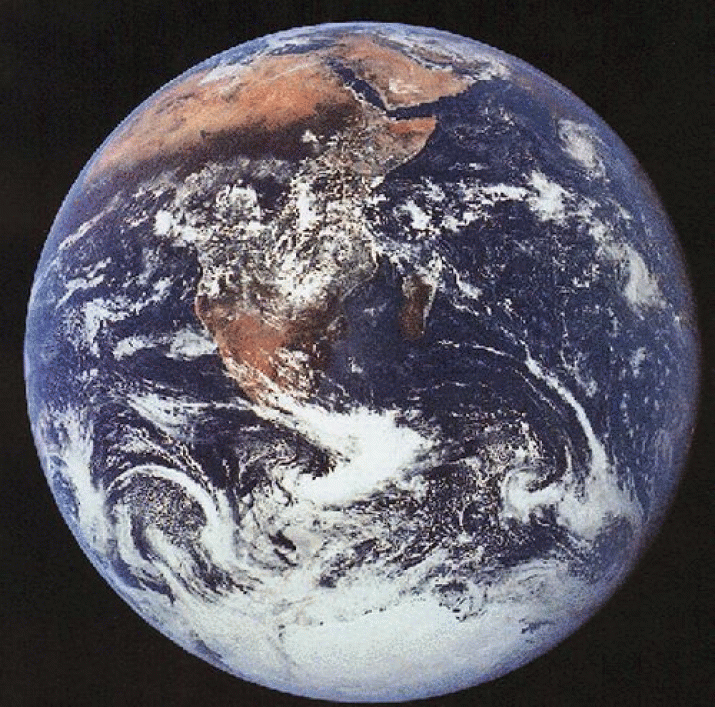

The odds of life existing on another planet grow ever longer.
In 1966 Time magazine ran a cover story asking: Is God Dead? Many have accepted the cultural narrative that he’s obsolete—that as science progresses, there is less need for a “God” to explain the universe. Yet it turns out that the rumors of God’s death were premature. More amazing is that the relatively recent case for his existence comes from a surprising place—science itself.
Here’s the story: The same year Time featured the now-famous headline, the astronomer Carl Sagan announced that there were two important criteria for a planet to support life: The right kind of star, and a planet the right distance from that star. Given the roughly octillion—1 followed by 27 zeros—planets in the universe, there should have been about septillion—1 followed by 24 zeros—planets capable of supporting life.
With such spectacular odds, the Search for Extraterrestrial Intelligence, a large, expensive collection of private and publicly funded projects launched in the 1960s, was sure to turn up something soon. Scientists listened with a vast radio telescopic network for signals that resembled coded intelligence and were not merely random. But as years passed, the silence from the rest of the universe was deafening. Congress defunded SETI in 1993, but the search continues with private funds. As of 2014, researches have discovered precisely bubkis—0 followed by nothing.
What happened? As our knowledge of the universe increased, it became clear that there were far more factors necessary for life than Sagan supposed. His two parameters grew to 10 and then 20 and then 50, and so the number of potentially life-supporting planets decreased accordingly. The number dropped to a few thousand planets and kept on plummeting.
Even SETI proponents acknowledged the problem. Peter Schenkel wrote in a 2006 piece for Skeptical Inquirer magazine: “In light of new findings and insights, it seems appropriate to put excessive euphoria to rest . . . . We should quietly admit that the early estimates . . . may no longer be tenable.”
As factors continued to be discovered, the number of possible planets hit zero, and kept going. In other words, the odds turned against any planet in the universe supporting life, including this one. Probability said that even we shouldn’t be here.
Today there are more than 200 known parameters necessary for a planet to support life—every single one of which must be perfectly met, or the whole thing falls apart. Without a massive planet like Jupiter nearby, whose gravity will draw away asteroids, a thousand times as many would hit Earth’s surface. The odds against life in the universe are simply astonishing.
Yet here we are, not only existing, but talking about existing. What can account for it? Can every one of those many parameters have been perfect by accident? At what point is it fair to admit that science suggests that we cannot be the result of random forces? Doesn’t assuming that an intelligence created these perfect conditions require far less faith than believing that a life-sustaining Earth just happened to beat the inconceivable odds to come into being?
There’s more. The fine-tuning necessary for life to exist on a planet is nothing compared with the fine-tuning required for the universe to exist at all. For example, astrophysicists now know that the values of the four fundamental forces—gravity, the electromagnetic force, and the “strong” and “weak” nuclear forces—were determined less than one millionth of a second after the big bang. Alter any one value and the universe could not exist. For instance, if the ratio between the nuclear strong force and the electromagnetic force had been off by the tiniest fraction of the tiniest fraction—by even one part in 100,000,000,000,000,000—then no stars could have ever formed at all. Feel free to gulp.
Multiply that single parameter by all the other necessary conditions, and the odds against the universe existing are so heart-stoppingly astronomical that the notion that it all “just happened” defies common sense. It would be like tossing a coin and having it come up heads 10 quintillion times in a row. Really?
Fred Hoyle, the astronomer who coined the term “big bang,” said that his atheism was “greatly shaken” at these developments. He later wrote that “a common-sense interpretation of the facts suggests that a super-intellect has monkeyed with the physics, as well as with chemistry and biology . . . . The numbers one calculates from the facts seem to me so overwhelming as to put this conclusion almost beyond question.”
Theoretical physicist Paul Davies has said that “the appearance of design is overwhelming” and Oxford professor Dr. John Lennox has said “the more we get to know about our universe, the more the hypothesis that there is a Creator . . . gains in credibility as the best explanation of why we are here.”
The greatest miracle of all time, without any close seconds, is the universe. It is the miracle of all miracles, one that ineluctably points with the combined brightness of every star to something—or Someone—beyond itself.
Eric Metaxas is the author, most recently, of “Miracles: What They Are, Why They Happen, and How They Can Change Your Life” ( Dutton Adult, 2014).
• Neurosurgeon Eben Alexander, MD: The Map of Heaven … How Science, Religion and Ordinary People Are Proving the Afterlife …
…
The specific character of each of these worlds was determined by one factor above others: the amount of love or hate present in them. If you were a person defined by love, Swedenborg said, you ended up in one of the innumerable spiritual zones that together made up what Swedenborg understood as heaven. If you were defined by hate, you ended up in hell.
Swedenborg was a believer in the ancient idea of microcosm – that each of us is a kind of universe in miniature. If we look inside ourselves the right way, he said, we will not only find a map of heaven, we will find heaven itself. Our whole idea of what is ‘external’ and therefore real, and ‘internal’ and therefore imaginary, is based on our experiences here in the material domain, where consciousness is mediated by the brain and we move about in a physical body that we have become brainwashed into thinking is our total identity.
…
I know that mystics like Kobra, and mystic-scientists like Swedenborg, are right. Heaven isn’t an abstraction; it isn’t a dreamscape cooked up from empty, wishful thihnking. It is a place as real as the room or the airplane or the beach or the libarary where you are right now. It has objects in it. Trees, fields, people, animals … even (if we are to listen to the Book Of Revelation or the 12th century Persian visionary Suhrwardi or the 12th century Arabic philosopher and mystic Ibn ‘Arabi) actual cities.
But the rules of how things work there – the laws of heaven’s physics, if you will – are different from ours.
The one rules we need to remember from here, however, is that we end up, in the end, where we belong, and we are led by the amount of love we have in us, for love is the essence of heaven. It is what it is made of. It is the coin of the realm,
…
That’s also why the main quality required of us if we are to catch a glimpse of this zone while alive on earth is not great intellect, nor great bravery, nor great cunning. fine as these qualities are.
What it takes is honesty. Truth can be approached in a thousand different ways. But because, as Plato himself said, like attracts like, what we need in order to apprehend truth more than anything else is to be truthful ourselves, and honest about the goodness and waywardness at work inside us.
On this voices as disparate as Buddha’s, Jesus’ and Einstein’s are unanimous. Like understands like.
The universe is based on love, but if we have no love in ourselves, the universe will be shut off from us. We will spend our lives triumphantly declaring that the spiritual world doesn’t exist because we have failed to awaken the love in ourselves that alone will render this most obvious of acts visible to us.
You cannot come to truth dishonestly. You cannot come to it telling lies to yourself, or to others. You cannot come bringing only a superficial sliver of yourself, while your larget deeper self is left behind. If you want to see all of heaven, you have to bring all of yourself, or else just stay home.
…
• Chris Sharples, in Comments: No, causation – like time, space, energy, matter, the laws and constants of physics, and all the other properties of the universe – is an emergent phenomenon, not a fundamental one. The only fully satisfactory and non-contradictory explanation for the order of the universe (including causation) is that all order ultimately arises from the chaos (i.e., ultimately from the truly random quantum noise that dominates below the Planck scale) that is the ultimate ground state of reality. (Again, it is another misconception that “absolute nothing” would have to be the initial state of reality, from which “something” somehow emerged. Pure quantum chaos makes more sense – because unlike a state of ‘perfect nothingness’, pure chaos by definition requires no explanation.