Coroner & Legal
Fact-Checking Julia Jabour and Indi Hodgson-Johnston

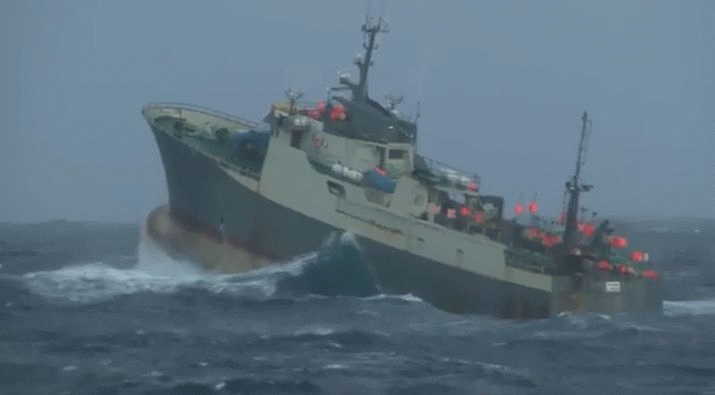

*Pic: The Bob Barker pursues the illegally-fishing Thunder through a gale …
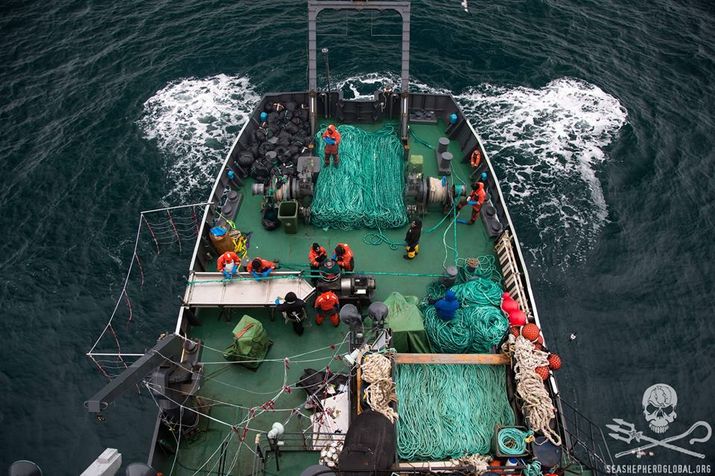
The Sam Simon has collected more than 60km of net weighing 70 tonnes

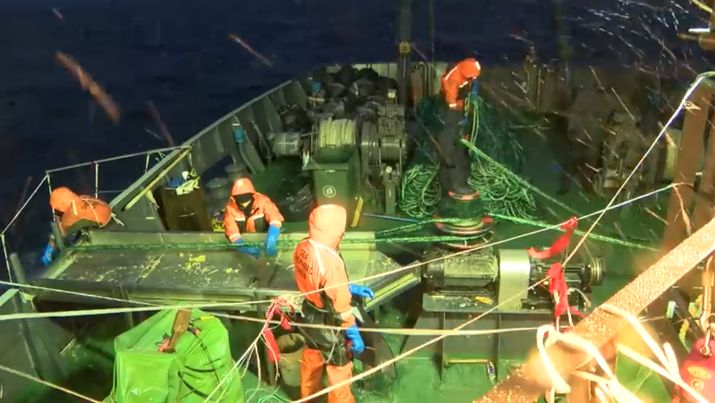
Net retrieval was 24 hours a day in all conditions on the Sam Simon

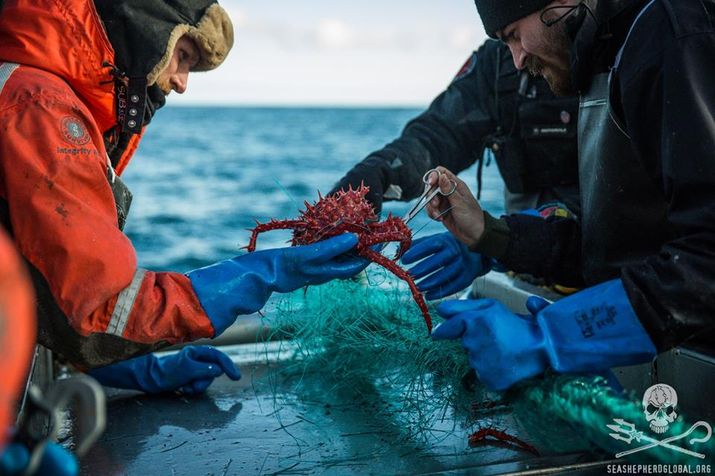
Sam Simon crew free a crab caught in the illegal net
Over the past few months, Dr Julia Jabour and Ms Indi Hodgson-Johnston have published media opinion pieces that are critical of the conservation group Sea Shepherd. Are all of their claims valid?
Factcheck 1
In an article on the website The Conversation, ‘Japan’s new whaling program is a small win for whales, but…’ (November 2014), the pair wrote ( http://theconversation.com/japans-new-whaling-program-is-a-small-win-for-whales-but-34420 ):
Direct action by environmental activists such as the Sea Shepherd Conservation Society is likely to resume, despite condemnation of the society’s actions in the judgment.
The article was discussing the results of the International Court of Justice (ICJ) case about the legitimacy, or otherwise, of Japan’s Antarctic whaling program. Why the ICJ would also take the opportunity to ‘condemn’ Sea Shepherd, since the case was not about Sea Shepherd, is curious. The Court’s decision consists of 12 documents; the judgement and eleven written opinions by the judges. There is also a separate summary of the judgement that makes up the totality of the Court’s ruling.
The 76 page judgement mentions Sea Shepherd twice. The first (paragraph 203) is where Japan argues that interference by Sea Shepherd reduced their take of whales. The second (para. 206) comes closest to the claim made by Dr Jabour and Ms Hodgson-Johnston:
In this regard, the Court notes that the actual take of minke whales in the 2006-2007 and 2007-2008 seasons was 505 and 551, respectively, prior to the regrettable sabotage activities that Japan has brought to the Court’s attention. In this context, the Court recalls IWC Resolution 2011-2, which was adopted by consensus. That resolution notes reports of the dangerous actions by the Sea Shepherd Conservation Society and condemns “any actions that are a risk to human life and property in relation to the activities of vessels at sea”.
In the 150 pages of the Judge’s written opinions, Sea Shepherd is never mentioned, and in the 35 page summary of the ruling Sea Shepherd is not mentioned.
Factcheck Decision: WRONG
The Verdict:
The ICJ did not condemn Sea Shepherd.
The way the phrase ‘despite condemnation of the society’s actions in the judgment’ is written it could appear to a casual reader that the International Court of Justice condemned Sea Shepherd. In fact the ICJ simply ‘recalled’ an International Whaling Commission resolution that mentioned Sea Shepherd but then condemns ‘any actions’ done by any ship that risks life and property; for example, the Nisshin Maru ramming the Bob Barker (below). Dr Jabour and Ms Hodgson-Johnston are incorrect to take a reference to a statement made by a third party and to then infer that the ICJ condemned Sea Shepherd.

Nisshin Maru rams the Bob Barker

Factcheck 2
Then in December of 2014, Ms Hodgson-Johnston went on Radio National’s program ‘The World Today’ and made this claim ( http://www.abc.net.au/news/2014-12-12/legal-question-over-sea-shepherds-campaign-against/5963774 ):
FELICITY OGILVIE: The Sea Shepherd Conservation Society is promising to use a variety of methods in its campaign to stop what it calls the poaching of Patagonian toothfish.
One method is to pull up fishing lines
But Indi Hodgson-Johnston from the Institute of Marine and Antarctic Studies in Hobart says the Sea Shepherd could be entering dangerous waters.
INDI HODGSON-JOHNSTON: If you actually call up the lines then maybe technically it could actually be fishing and obviously, well maybe, maybe they do have a permit to operate in the Southern Ocean to collect fishing gear, but then that would land them in a bit of hot water with the Commission for the Conservation of Antarctic Marine Living Resources.
And then in an opinion piece in The Mercury newspaper ( 14/1/15 Talking Point: Tough fighting crime on high seas ), Dr Jabour and Ms Hodgson-Johnston backed this up with:
CCAMLR’s Convention on the Conservation of Antarctic Marine Living resources controlling fisheries in the Southern Ocean technically deems Sam Simon to have been “illegally fishing” as its crew raised the abandoned nets, since raising nets is by definition fishing.
In the newspaper the two seem to have walked back from the claim that it is illegal fishing to that the actions of Sea Shepherd are ‘deemed’ to be illegal fishing, but the claim is still one of illegal fishing. The word, ‘deemed’, means to accept an event as having happened in the absence of evidence or facts which would normally be required to prove that status.
This is a nuanced argument since the CCAMLR Convention doesn’t define what is ‘fishing’.
The Law of the Sea Convention doesn’t define fishing, and the Australian Fisheries Management Authority doesn’t define fishing either. In the International Convention for the Conservation of Atlantic Tunas (ICCAT), fishing is defined as; ‘searching for, catching, taking, or harvesting fish’.
In common-sense use the word, ‘fishing’, does fit the ICCAT definition, people first cast a line or throw a net and then they pull or haul that fishing gear in. This definition is supported by the CCAMLR convention of a fishing vessel:
Any vessel of any size used for, equipped to be used for, or intended for use for the purposes of fishing or fishing related activities, including support ships, fish processing vessels, vessels engaged in transhipment and carrier vessels equipped for the transportation of fishery products except container vessels and excluding Members’ marine science research vessels.
Both the Bob Barker and the Sam Simon are not equipped for fishing, they are not intended for fishing, and they are not used for fishing or fishing related activities. Since the two Sea Shepherd ships are not fishing vessels they fall outside the CCAMLR rules.
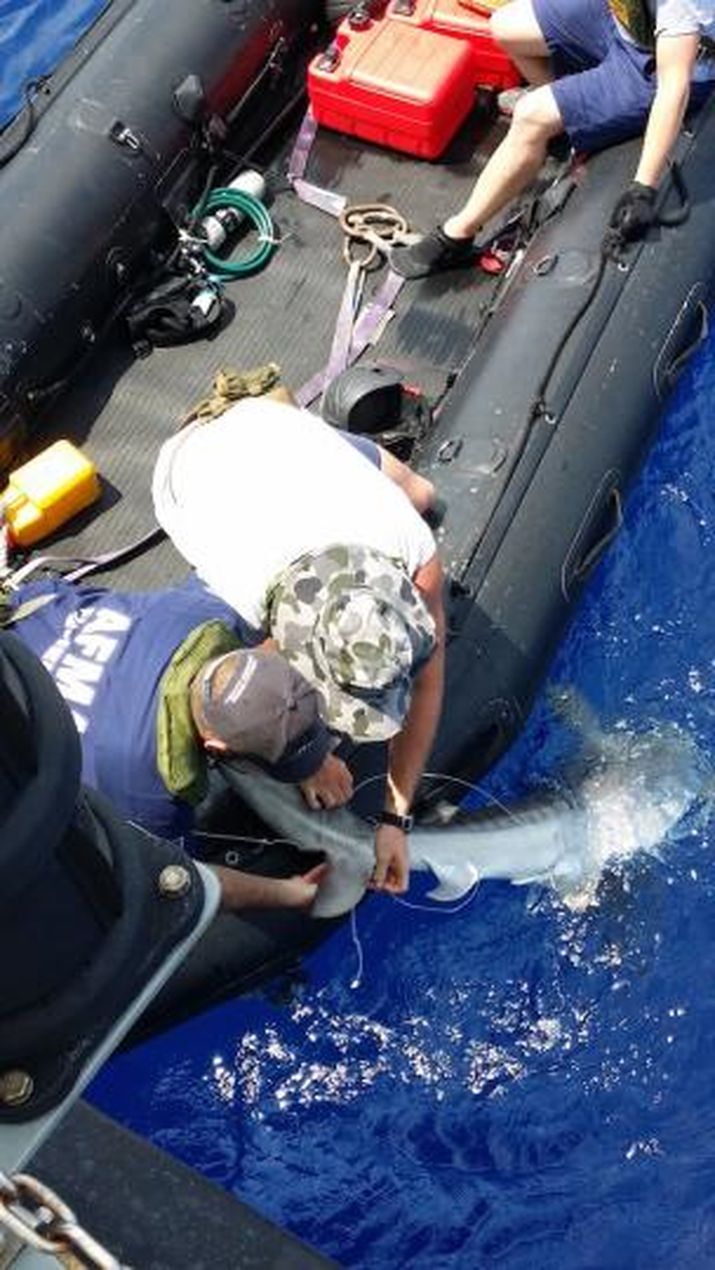
Illegal fishing? (Photo: RAN/Navy Daily)

If the act of fishing is simply hauling up abandoned, lost, or otherwise discarded fishing gear as Dr Jabour and Ms Hodgson-Johnston claim, then sailors from the Royal Australian Navy (above) were illegally fishing in December, 2014, when they worked in a similar manner to Sea Shepherd:
HMAS Huon, a Coastal Mine Hunter, discovered five abandoned longlines approximately two to three nautical miles inside the Australian Fishing Zone. The longlines retrieved were believed to be from foreign fishing boats suspected of fishing north of Australian waters and had drifted into the Australian Fishing Zone. Each line was approximately 400 meters in length with up to 25 hooks.
Using HMAS Huon’s sophisticated sweep deck, Navy personnel recovered all five longlines and cut free, two 1-1.5 metre tiger sharks and one 3 metre oceanic whaler shark.
Huon’s Diving Officer, Lieutenant Sam Mairs, said the crew jumped into action when the sharks were found to be alive and tangled in the line.
“Recovering the longlines can be hazardous due to their length and the number of sharp hooks attached,” Lieutenant Mairs said. (Navy Daily, 18/12/14)
Factcheck Decision: SPIN
The Verdict:
Sea Shepherd is not illegally fishing, Dr Jabour and Ms Hodgson-Johnston are incorrect to portray Sea Shepherd as committing a criminal act of illegal fishing. The usual definition of fishing is the setting and retrieval of fishing gear by a fishing vessel. Under the CCAMLR rules the Sea Shepherd ships are not fishing vessels and are therefore not fishing, they are recovering abandoned fishing gear found at sea.
Much of the opinion piece written by Dr Jabour and Ms Hodgson-Johnston is correct; the known difficulties of proving a transnational case, the scurrilous techniques used by the illegal fishing companies, and the lack of effective penalties are a barrier for effective fisheries management.
However, the pair’s contention that Sea Shepherd’s activities make it harder for the ‘Authorities’ to do their job is just their opinion.
Policing that area of ocean is often more in name only than in any actual reality. Right now, Australia’s purpose built ice-class, long-range, Southern Ocean fisheries patrol vessel, the ‘Ocean Protector’, has been operationally tasked off Northern Australia as part of the ‘Stopping the Boats’ policy.
Narelle Bonarski is known to the Editor