Economy
STATE: TFGA supports fracking moratorium

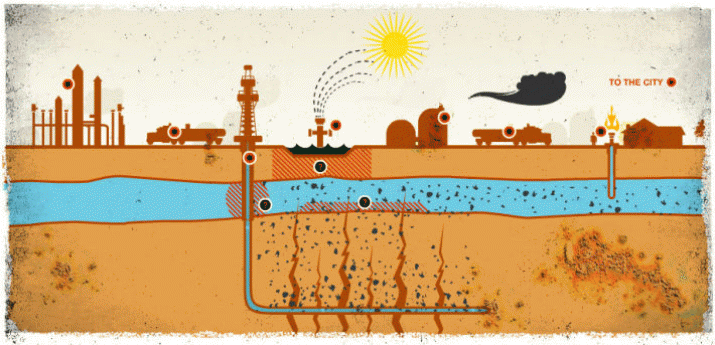

*Pic: From the anti-fracking movie, Gasland
The Tasmanian Farmers and Graziers Association (TFGA) has waded into the Tasmanian debate on fracking with their recent submission to the current government review, citing a need for taking the ‘precautionary principle’ when it comes to fracking and recommending a 3 year extension to the current moratorium ‘to provide adequate time to thoroughly undertake the required studies.’
The long-term issue of gas-well integrity is also highlighted in the submission.
The TFGA’s submission first summarises the economic importance of farmland in Tasmania. They cite that Tasmania’s agriculture, forestry and fishing industries collectively amounted to almost 9% gross state product (GSP) for the 2012 year, making agriculture ‘a more significant contributor to the economy than in any other state’.
With this in mind, the TFGA argues that with the number of issues that have arisen surrounding this method of gas extraction on the mainland, it doesn’t bode well for its potential here in Tasmania:
‘We note the recent report into coal seam gas from Mary O’Kane, the Chief Scientist and Engineer of NSW, which indicates concern surrounding a number of issues with this mining methodology. More importantly, it points to the need for a truly independent scientific review of shale gas extraction by hydraulic fracturing in Tasmania.’
‘Experiences evident from recent times on the mainland do not instil the farming sector with confidence. So it is important that we take the time to address the many issues that have been raised in that context. ‘
While others may concentrate on the environmental and economic impacts of fracking, the TFGA calls for a broader approach, studying not only these issues but also the social impact of fracking.
The farming communities of Tasmania are the backbone of economic and social life, they state.
‘The economic and social impact on affected families is immense, and needs to be considered far more carefully than has been the case in other jurisdictions.’
‘Anything which impacts negatively on these key stakeholders has the capacity to disrupt or even destroy the fragile nature of these communities. ‘
‘Experience in other areas where fracking activities have been undertaken is that the primary impact is on the landholders – and that these are generally farming families.’
They argue that the process by which mining companies gain consent from landowners to explore and subsequently drill for resources is ‘lacking strength’ and although it is mentioned in the Mining Code of Practice, it needs to be ‘formalised in legislation’.
The TFGA go on to draw attention to the number of legacy mining sites in Tasmania that ‘continue to cause environmental damage and social concern’. The track record for mine site rehabilitation in Tasmania is not good, and the TFGA’s concern is that landowners will be left to foot the bill for cleaning up after fracking.
‘We recommend that the establishment of an ongoing fund be considered to provide adequate resources to undertake remedial works into the future. It is not acceptable for landholders to end up bearing the risk and cost into the future for care and maintenance of wells on their properties. ‘
The integrity of the wells was also raised as a concern in the submission by the TFGA. The steel and concrete well casings are put under extreme pressure and a Pennsylvania study found that 6.9 – 8.9% of fracking wells leak immediately (Ingraffea, 2013). The TFGA highlight the long term well-integrity issues over many decades, with the danger that maintenance costs and impacts are borne by landholders left after completion of the mining operations.This has, on multiple occasions, resulted in leaking of fracking fluid which includes water, sand and a toxic mix of hundreds of chemicals, some of which are carcinogenic.
This influential body TFGA is the self-proclaimed ‘leading representative body for Tasmanian primary producers’ whose members generate approximately 80% of the value created by the Tasmanian agricultural sector.
Their submission indicates an awareness of farmers, of serious unresolved problems associated with the practice of hydraulic fracturing.
They are learning from the CSG experience on the mainland and shale oil and gas extraction in the US, where landholders are left dealing with contamination issues impacting on their ability to grow and sell products, their property values and the health of their families.
This submission is indication enough, that fracking is not welcome in Tasmania, until serious flaws can be fixed, in particular the propensity for gas wells to leak into aquifers and by connection, surface waterways.
Ingraffea, A. R. 2012. Fluid migration mechanisms due to faulty well design and/or construction: an overview and recent experiences in the Pennsylvania Marcellus play. http://www.damascuscitizensforsustainability.org
/wp-content/uploads/2012/11/PSECementFailureCausesRateAnalysisIngraffea.pdf. Viewed 18 Nov 2013.
TFGA submission:
( from the DPIPWE site, http://dpipwe.tas.gov.au/Documents/153%20-%20TFGA.pdf ):
• NATIONAL TOXICS NETWORK SUBMISSION
Review of hydraulic fracturing in Tasmania (2014)
The industrialisation of the rural landscape brought about by unconventional gas (UG) activities with its associated air and water pollution, would significantly damage the Tasmanian environment and its reputation as the ‘clean green isle’, without adding substantial economic or social benefits. As this submission will show after a decade in Australia, the UG industry still does not have effective ways to deal with its waste water, its solid wastes (eg salts, drilling muds) or its impact on groundwater aquifers.
As the federal government’s National Pollutant Inventory demonstrates, the industry cannot control its toxic air emissions, which continue to escalate. While improved regulation may to some extent reduce the impacts of hydraulic fracturing (fracking/HF), which is an essential part of shale gas production, the global alert released in 2012 by United Nations Environment Programme acknowledged that that unintended impacts are inevitable and it is impossible to regulate the UG industry into safety.
• NATIONAL TOXICS NETWORK SUBMISSION: Review of hydraulic fracturing in Tasmania (2014)
• Rohan Church, Mercury: Tread carefully or we risk fracturing our environment
• ScienceDaily: Fine particulate air pollution linked with increased autism risk
• Download Geoff Dickinson’s submission …