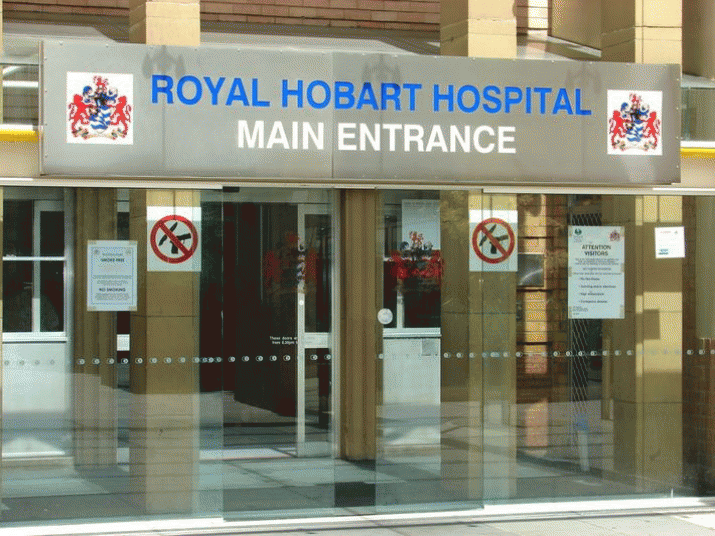
The Liberal Government has accepted and will implement the recommendations of the Royal Hobart Hospital Redevelopment Rescue Taskforce for the project to proceed on the current site.
The Rescue Taskforce has concluded that the project can proceed, with important additions to the redevelopment, without adding further to the $70 million budget blowout incurred before the redevelopment was put on hold.
The Taskforce has proposed a construction methodology and decanting plan that eliminate the major cost, time and patient safety issues identified as major risks during incoming government briefings.
Construction will recommence by early 2015, with the possibility of recommencing critical works sooner to be investigated. The project is now scheduled for completion by the end of 2018.
When the Royal Hobart Hospital Redevelopment Rescue Taskforce was established, it was identified that the likely cost to proceed with the redevelopment had already reached $70 million over budget. In its report to Government, the Taskforce identified a way forward for the redevelopment which now includes:
• The addition of a crucial helipad which was omitted from the former government’s original redevelopment;
• $2.4 million in additional funding for contemporary standards and outdoor areas for the Mental Health Services;
• Funding for a safe and achievable decanting plan involving the construction of a temporary facility onsite at the Liverpool Street forecourt;
• Scope for critical works to recommence almost immediately; and
• Accelerated replacement of the hyperbaric chamber, which is approaching end of service and was identified by the taskforce as a potential construction risk not picked up by the former government.
Through its work, the Taskforce identified substantial savings. It is a credit to the work of the Taskforce that even with these crucial additional components, the additional investment required for this project has been limited to $71.9 million, consistent with the budget overrun identified at the time the project was put on hold. $154 million has already been spent on the redevelopment.
The redevelopment will create 600 jobs and the total economic activity generated for the state’s economy will be $1.6 billion.
Although the budget overrun presents a challenge for the state budget, the Taskforce has identified that proceeding with the redevelopment is a significantly better option than the alternative proposal, both in terms of affordability and risk.
Without the Government putting work on halt earlier this year and establishing the Rescue Taskforce, there is no telling how far off the rails the project would have been by now. However it is clear that the project was in turmoil and would have exposed Tasmanians to unacceptable delay, cost and patient outcomes.
The findings and recommendations adopted by the Government provide a clear pathway for construction and decanting patients that mitigates risk and optimises space for clinical services.
They underpin a project that can be managed to budget and delivered on time, with minimal disruption to patients.
An pre-feasibility assessment of the CenoTas proposal was undertaken by the Taskforce for Cabinet, with advice taken from other agencies including Treasury. The Taskforce’s recommendation was that the financial and time costs to the Tasmanian Government to progress this proposal are prohibitive and that it suffered from unclear and inadequate health planning.
It was also noted that there were several major legislative and funding hurdles to the CenoTas proposal proceeding. Treasury identified that if the Government funded the project using TASCORP, which has lower funding costs than a private financier, then the State Government’s debt would increase by up to $2.6 billion by 2018, which would negatively impact on Tasmania’s credit rating.
It is important to place on record that the Government does acknowledge the effort of the proponent to bring this unsolicited proposal forward. Despite the absence of an unsolicited bid framework, the proposal was nonetheless carefully considered by the Taskforce and the Government – but we are obliged to make informed decisions based on a careful analysis of the options. Therefore the Government accepted the recommendations put forward by the Taskforce and will proceed with the best option that is within our capacity to pay.
This has been an important decision and the Liberal Government has followed a sensible, prudent course of action to get the project back on track.
I would like to thank the Rescue Taskforce and the members of the Project Reference Group for their fantastic work and commitment to ensuring that this exciting redevelopment can be achieved.
Key findings and conclusions of the Taskforce:
• The redevelopment of the RHH is feasible and can proceed.
• Substantial time, energy and money have already been invested in the redevelopment of the RHH site. Moreover, the time and costs of an alternative greenfield development are prohibitive.
• The scope of the project is consistent with the Commonwealth-State IGA requirement to provide 195 overnight beds and other outputs.
• A new construction methodology has been determined which provides better outcomes for patients, is safer and has the shortest construction program for K-Block.
• The completion date will need to be renegotiated with the Australian Government to the new completion date of late 2018.
• Work will recommence early in 2015, potentially sooner.
• The total cost of the project would be $657 million which would require a further investment of $71.9 million. This includes the costs of decanting, an improved design for Mental Health Services and the inclusion of a helipad in the project.
• The project will support the delivery of contemporary models of care for services located in K-Block and provide enough flexibility to accommodate changes identified during health reform planning, changes to models of care over time, or in response to future demand.
• The design of K-Block was based on significant clinical consultation but a small number of outstanding concerns remain which can be largely redressed by the design proposed by the Taskforce:
o An increase in single beds for women who have had caesarean or complex births can be accommodated through limited redesign; and
o A more contemporary design for mental health inpatients which provides more outdoor recreational space with a further investment of $2.4 million.
• The inclusion of a helipad is supported by clinicians and Ambulance Tasmania and is proposed by the Taskforce at an additional cost of $10.5 million.
• Andrew Wilkie: ‘I support the Government’s decision’
• AMA: Response to Government’s decision on RHH redevelopment site
• Rebecca White: Ferguson obliged to provide all the details
MEANWHILE …
• Lambie asks PM to release $110M of federal funds for Tas irrigation schemes