Economy
Mother Mountain: The Symphony of Birdsong (41)


The “Respect the Mountain” forum ( here, here, and here ) at the Hobart Town Hall earlier this year prompted Don Knowler to return to a diary he compiled after daily rambles on Mt Wellington during the previous year. In what promises to be a momentous year in the modern history of Kunanyi, the weekly diary gives the mountain and its wildlife its own voice. All Don’s Mother Mountain columns – and much more by this superb writer – can be found under the Category, Don Knowler, here
Summer arrived not with a bang, but with a blast, a blast of fiery oven-hot air.
Temperatures had been rising steadily towards the end of November and now there was not just the smell of summer blooms in the air, but eucalypt odour and the danger of fire.
Hot, gusting winds had burned the fiery blooms of the waratahs and they hung wan, wilted and lifeless on the branches, a tarnished maroon instead of crimson, the flowers eclipsed once more by the bright, glossy leaves of the foliage.
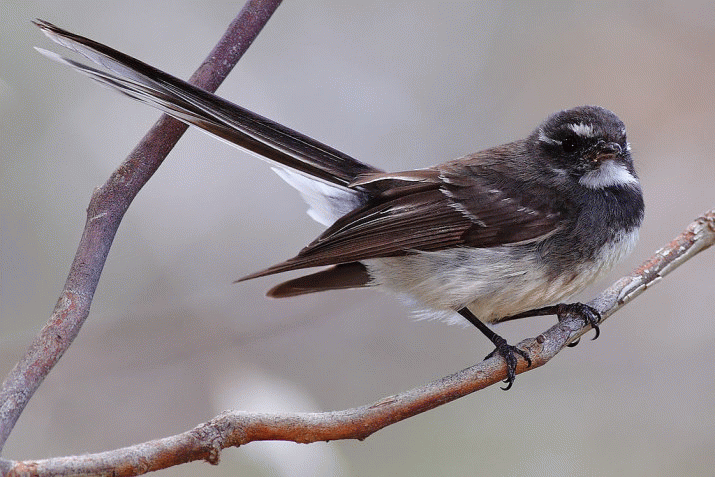
The grey fantails and their nest were safe, however. The fading flowers still offered cover and I could now see not one but three birds venturing from the nest, propping themselves on the twig holding it before dropping down again at any hint of danger.
All the while the parents flitted about, calling in warning or bringing a steady supply of food.
The waratah flowers, which bloom briefly at the best of times, may have seen their best days along the Silver Falls Track but now waratahs on the higher slopes were coming into flower. Driving the Pinnacle Road a little later the route was ablaze with colour as far as the Chalet just below the alpine zone on the way to the summit. Matching the scarlet waratah blooms in intensity were the bright yellow petals of golden rosemary, and the crisp whites of daisybush and snow berry. Mountain needle bush was also in delicate, spidery white flower, possibly three months after I saw its first blooms of the year on lower slopes at Sphinx Rock.
I had gone to the Chalet to check out the far end of the Organ Pipes Track that extends from the Springs, which I had been told held a mini-forest of silver banksias. My mission to explore the mountain for a year might have been primarily about birds but I was also keen to see as many mammals as possible, one targeted species being pygmy possums. These little creatures were unknown to me but a mammal expert I had consulted said that they were fond of the pollen and nectar of the flowers of the banksias when they bloomed in magnificent golden cones in the late summer. Sure enough the track tunnelled its way under a thick jungle of banksias, before crossing a scree field below the Organ Pipes on its way back to the Springs, via a junction that sends another route up the mountain, the famous Zig-Zag track. I would return to the spot at the end of summer and into autumn.
Filling my water bottle at a popular waterfall at the Chalet, I got talking to a couple of tourists who said they had retreated from the summit because the winds there were too strong to leave their car.
I had planned to head to more open country at Big Bend about a kilometres from the summit to check out two species listed as being seen there, Australasian pipits and striated fieldwrens. Although these small, fragile birds are built for a mountain existence, the pipit with long spur-like claws to grip rock in high winds, it soon became clear that humans were not: the tourists were indeed right in describing “hurricane” winds, which buffeted my car as soon as I left the shelter of the eastern face of the mountain and turned on the steep grade north-west. Instead of stopping to scout rock and kangaroo grasslands in a wet location that would be ideal for both the species, I pressed on to the summit. It was a glorious summer’s day and, even if I couldn’t leave my car for fear of being bowled over by the high winds, at least I would be rewarded for making the drive with a view over southern Tasmania uncluttered by lingering mist or cloud.
What I saw came as a shock. There might be clear skies, but in the far distance I could see thick plumes of smoke, rising like the ash from volcanoes high into the air. Fires were raging on Bruny Island, and on the Tasman Peninsula.
“Fire fury”, the Mercury reported next morning. Summer and the fire season had arrived.
Next day, the winds subsiding, a tiger snake brought me down to earth. I was walking the tracks around Junction Cabin, checking on the newly discovered satin flycatcher nest, when I saw a movement in the dry leaf matter of the woodland floor. I thought it might be scurrying scrubwrens at first but I could see the movement was slow and continuous, not jerky and sporadic. A big tiger snake, big, about a metre in length, shiny black, and I could see its blunt-shaped head, fused to the body without an apparent neck, a feature that separates it from the copperhead. I gave the tiger snake a wide berth.
The satin flycatcher female was sat on the nest, incubating her eggs. I could see the shape of her tail high in the tree jutting from the nest. The male coming and going with food. The woods were alive with flycatchers and their song, but I could not find any more nests.
Close by a young grey currawong was throwing its weight around, bullying smaller birds that happened to land on its perch, all the while crying out for a food supply from its overworked parents. I looked for other young and could not see any. Just one young, no doubt, surviving from the brood.
And now summerbirds were so common I wondered how I had missed them in the spring. A pair already had three young well out of the nest, well on the way to adulthood. They sat together on a bare branch of a white peppermint, their grey-brown feathers already showing signs of the black-face mask and striped chest which would later identify the species.
Tasmanians joke that in Hobart it is possible to get four seasons in one day. Now those visiting the mountain experienced the extremes of summer and winter in one week. The temperature dropped to minus 3 degrees on December 6, and next day the Mercury carried a picture of snow on the mountain. And a family visiting from United States had snowballs in their hands.
Still the butterflies flittered across the lower, drier and warmer mountain slopes to the east, brushing against tree, leaf, rock and scree. Little brown jobs, like the scrubtits and scrubwrens hard to tell apart without close inspection.
With butterflies and moths, it often requires at net. I have never been one for catching and netting, fish or fowl and now insect. Some future time – when time permits – I might try to make positive identification of Lepidoptera, but this would have to wait for future exploration and discovery. For now I merely delight in seeing fragile, paper-thin shapes dancing on the breeze. The fluttering wings appear small and I merely group them as “browns”, species within one of Tasmania’s five butterfly families.