

Before Auditor General Mike Blake begins his review on appropriate enrolment numbers for our state’s public schools, there are several questions that need answering.
Firstly, why are the 30% of schools which are in the non-government sector and are heavily taxpayer supported not included? 55% of these schools are more than 80% government funded. Herrick Presbyterian has an enrolment of 6 and it is 85% government funded. Whether schools are supported by state or federal funding, it is still taxpayer money.
Our non–public schools will receive 37% of the Gonski funding ($140 million of the $380 million), well above their entitled proportion, and many have low enrolment numbers. If they were public schools, they would have been closed years ago. Geilston Bay High closed at the end of 2013 when the enrolment dropped to 100 and it was 96% government funded. Far too few enrolments apparently to continue but a non-government school nearby in Warrane had an enrolment of 58 at the time and it educated children from Prep to year 10. It now has 91 students and is 72% government funded, 24% of this from the state according to the My School website.
This is not a public versus private topic, but it needs to be understood that the public school system as we know it, or knew it, is under threat. Since the middle of 2012 thirteen public schools have merged or closed, resulting in seven fewer public schools, and twenty-five others were closed or amalgamated in the preceding five years. Parents at Meander Primary are being asked to consider whether they support the closure of their school right now and they are not alone.
Australia is ranked third in government’s financing of non-government schools and only Chile and Israel subsidise private systems more. In high-achieving Finland there are no private schools and in New Zealand only 4% are private and these do not attract significant levels of government support. New Zealand’s Catholic schools are public schools so they operate within the public system. I mention New Zealand because it has a policy that Royce Fairbrother noted as a recommendation in his Ministerial Report on School Viability provided to the Tasmanian government in January 2012. Transport costs for students who travel beyond the local school gate are borne by the parents and a state government policy on this before the Auditor General proceeds with his review is needed.
Tasmanians support educational choice but they also believe that parental costs that arise from choice are personal and when exercising a right to choose, cost should not be borne by the public. Fairbrother’s committee noted that $20 million is provided annually by the Tasmanian Government to subsidise travel of students attending other schools beyond the local school gate and it recommended this be remedied. It should never have been in existence. The state P&F body have pushed for its removal and I challenge any politician to argue for its continuation. The state can no longer afford it.
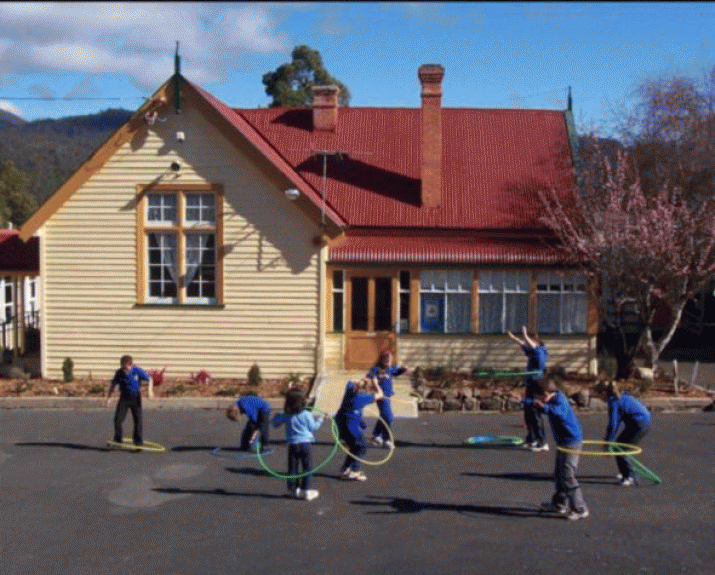
Tasmania has 50 government schools with enrolments less than 150. Cape Barren Island has an enrolment of 7 and Bruny Island 45. Many rural and isolated communities would be significantly disadvantaged through the loss of their school and travel to another school is not a practical option. Finally, before we talk of closing more schools in isolated communities, we need to be aware that across Australia, isolation and loneliness sees one male committing suicide every four days. Schools are vital for some communities and enrolment number alone must never become the sole determinant for closure.










