Economy
Mother Mountain: The Symphony of Birdsong (35)

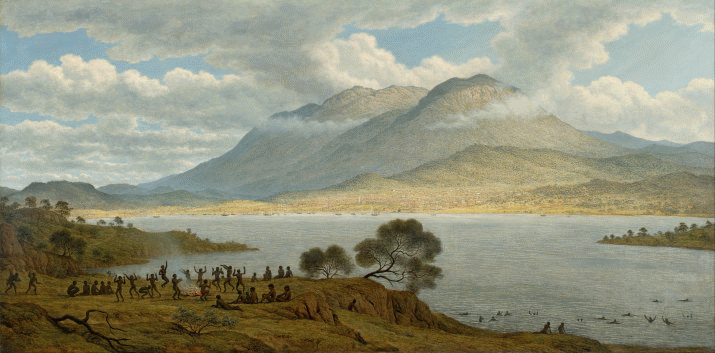

*Pic: The way we were … Mt Wellington by John Glover …
The “Respect the Mountain” forum ( here, here, and here ) at the Hobart Town Hall earlier this year prompted Don Knowler to return to a diary he compiled after daily rambles on Mt Wellington during the previous year. In what promises to be a momentous year in the modern history of Kunanyi, the weekly diary gives the mountain and its wildlife its own voice. All Don’s Mother Mountain columns – and much more by this superb writer – can be found under the Category, Don Knowler, here
The leaves of the yellow gums were rustled and tousled by a slight breeze and I was caught out yet again in my search for the flame robin.
Each species of gum has an idiosyncrasy that sets it apart from other eucalypts. It might be the imperfect, asymmetric base of the leaf of the stringybark, from which its Latin name of eucalyptus obliqua is derived; the leaf with a sharp pointed end which ensures that weighty clumps of ice and snow slide from the foliage of the snow gum, or the rutted, dark bark of the black peppermint that gives it the appearance of a European beach.
The yellow gum, or eucalyptus johnstonii, is during the year adorned with single dead leaves that resemble the colour of a flame robin’s breast, a field mark that to me is more important than the yellow-green colour of the tree’s new bark. These leaves can be distracting and annoying in the hunt for the flame robin. Every leaf has to be checked to ensure they are not in fact solitary flame robin males, sitting silently and still to cast their eyes over their domain .
Now I had found a robin territory along the Lenah Valley Track, and knew exactly where to find a breeding pair during the spring and summer months, the hard yakka of the robin hunt was over.
I’m grateful for the hunt each spring, though, because it has brought me in touch with the yellow gums. I might not have noticed them otherwise. If the mountain needed a symbol, an iconic image to use that overworked adjective, I would choose the yellow gum. Here is a tree, found only in southern Tasmanian, to stop the visitor to Mount Wellington firmly in their tracks.
The trees have small, tightly packed leaves that give them a full and rounded appearance. The bark is often grey and gently rutted, not unlike that of the black peppermint, and the truck is often twisted, where the trees have resisted the wind, instead of bending with it like the snow gums on higher slopes. Twisting into the wind, allows the trees to maintain their tall and straight aspect. For added strength, especially on hillsides largely formed of rock, the yellow gums are rounded and bulbous at their base. They remind me of trees not of the Australian continent, but of Africa. I call the yellow gum the baobab of the billabong.
The curious yellow gum …
The curious yellow gum is a worthy symbol of the mountain because not only is it found only in southern Tasmania but it attracts all manner of native birds, including endemic ones that are sought out by visiting birdwatchers.
If I hear the excited chortle of yellow-throated honeyeaters, I can guarantee it will be rising from the upper branches of a yellow gum. The same goes for strong-billed and black-headed honeyeaters, the green rosella and the attraction of the yellow gums also spreads to non-endemic species that make the higher, drier areas of the mountain their home.
My catalogue from a nursery specialising in native trees states that the yellow gum enjoys moist, peaty soils, but in my experience it is not a tree of the wetter areas of the mountain which are reserved for stringy barks, silver wattle and dogwood. They find a happy home among a shrub of the drier areas of the mountain, the prickly beauty, which was in yellow flower as I started to monitor the flame robin nest in earnest.
The yellow gum appears stately when I usually approach them from the closed confines of the wet forest that extends the first 100 metres or so along the Lenah Valley Track from the Springs. The landscape opens out and there are the yellow gums dotted across it, taking their place among boulders of dolerite that have tumbled over the eons from higher slopes.
In late spring and summer the gums rise above a sea of the tiny white flowers of daisy bush, along with prickly beauty, and this is when the flame robins can be seen swooping from the lower branches of the gums, and from rock perches, to pounce on insects hiding among the daisy flowers.
Amid the yellow gums, the female of the pair of flame robins I had discovered in previous weeks had finished building the nest. A finishing touch, flowers of daisy bush, had been added to the nest’s rounded shape, perfect camouflage, and now the female had begun the two-week process of incubating eggs. I kept my distance but could see her, or at least the top of her head. She sat tightly and snugly in the nest for long periods. The male was never far away and every so often he would bring her food. At such times I saw her beak thrush upwards, eagerly taking the food from the male’s bill.
All the while the fan-tailed cuckoos called. They remained largely hidden, and this was an ominous sign for the flame robins in the neighbourhood. I counted three pairs along about a 100 metre stretch of the track before it vanished into wet forest on the approach to Sphinx Rock. I knew the cuckoos would be looking and listening, for a chance to sneak into an unprotected and unattended nest to lay their eggs.
In the cuckoo world, many things are secret and private …
The male and female fan-tailed cuckoos hunted for food, sometime in pairs, but I never saw them in a mating ritual. In the cuckoo world, many things are secret and private.
Occasionally the female flame robin would leave the nest for a brief period, to defecate, and at these times the robin pair were vulnerable to cuckoo attack.
The female cuckoo is so fast that before the observer, or the flame robin, knows it an egg has been planted in the nest.
With so many cuckoos about, including shining bronze-cuckoos, I could never be sure that the flame robin nest had been compromised already. The flame robin eggs are pale green or blue, spotted with brown marks mostly at the larger end. Looking at pictures of fan-tailed cuckoo eggs, they were surprisingly similar.
False spring, snow on the mountain towards the end of October, but this didn’t affect the flame robins, and the indeed the wider breeding frenzy.
I rugged up warm to walk my normal route to Sphinx Rock. I did this at least once a week through the year, but made daily journeys now to monitor the flame robins. There were rewards besides these birds.
I found yellow-tailed black cockatoos feeding in, not a yellow gum, but a stringybark further down the mountain from the Lenah Valley Track. Close by a juvenile from last year’s breeding season was still calling to its parents, calling to be fed.
The swift parrots sped through white gums …
The summer migrants still disappointed me, though. No swift parrots, dusky woodswallows, pallid cuckoos, summerbirds and tree martins which I should have seen by now. I had to wait until October 27 to see swift parrots and dusky woodswallows – not on the mountain but on Bruny Island to the south.
There was some consolation in the fact that the mountain was in sight, at least.
Looking north from Adventure Bay, Mount Wellington stood blue on the horizon, in silhouette without contour and detail, against a pale sky.
The swift parrots sped through white gums on the coast, and a dusky wopodswallow hawked insects from a telephone line. And finally a pallid cuckoo called, but still no sight of Tasmania’s bird of summer, the black-faced cuckoo shrike.
My interest in the flame robins had caused me to, if not ignore, neglect the hunt for other nests.
Returning from a flame robin foray, I remembered the Bassian thrushes displaying along the Radford Track, and I took a stroll to what had clearly been a territory marked out by the singing male.
Sure enough, the nest of a Bassian thrush had taken shape in the roots of the fallen silver wattle. And I now regretted not visiting the site a little earlier, to see the complex building process in action. I was in time, though, to see the surrounding woodland adorned by love creeper, a slender vine with beautiful purplish-blue flowers that trails over vegetation in spring. It gives the woods a blue hue.
Nests are miracles of construction …
Nests are miracles of construction, of marvellous engineering and architectural design to rival building projects in man’s world. Not only do they incorporate the requirement for shelter – a house or home – they must counter the absolute extremes of temperature and weather, withstand storm and tempest. They must also be built with foresight, to meet the demands of a growing family and all the physical pressures of bulging bodies, and thrusting beaks.
Unlike mankind’s building projects, they are without solid foundation, driven into rock or built on a specially laid bed of concrete. A nest’s foundations generally rely on the strength of the host structure, a stout shrub or the roots of a fallen tree. A bird’s nest is more a question of balance, it must be able to move with a swaying branch in the wind, or absorb the weight of rain in a storm. It must sway and bend, but keep its shape. There must be some incredible mathematical calculations built into the design, as complex as those relating to a tower block or a suspension bridge in man’s world.
The basic knowledge, though, to build these structure is not contained in books and manuals, the calculations done by slide-rule or computer, the knowledge has been implanted into the bird’s DNA over eons. The knowledge comes from birds that have got it right, and studies of birds nests and nest-building reveal that birds are constantly honing their skills. Birds might attempt many nests before reaching what they regard as perfection, and built nests might be improved during the breeding season.
The Bassian thrush nest is how a nest should be, it’s a cliché of a nest, those depicted in children’s books and cartoon illustrations. Rounded in a high cup, the net is formed of interwoven sticks, stout and laying flat at the bottom, the sticks becoming twigs nearer the top and bent in a curved shape. Straw is woven around the twigs. The nest I had found, looking like a soup bowl, was finally decorated with moss, and inside I found more, drier moss and brown hair. The hair appeared to have been collected from a glade where wallabies and pademelons and the other animals of the forest congregate. The forest was thick and lush around the nest site, without clearings where animals usually feed, so I image the birds had to fly some distance to find the hair. I couldn’t see which one of the birds had built the nest, but suspected they had both done the work, because the male constantly busied himself with some of the minor detail, attaching the dried and dead, slender leaves of a stinkwood to it at one point.
I returned a few days later to see if the nest had eggs. The nest was only a metre off the ground and it would be one where I would get to clear view of the eggs, usually four of a dull green colour. I grew excited at the prospect of seeing them, reviving memories of my discovery of the similarly sized, but sky-blue eggs of the blackbird in my childhood.