History
Simply, the way we evolved …

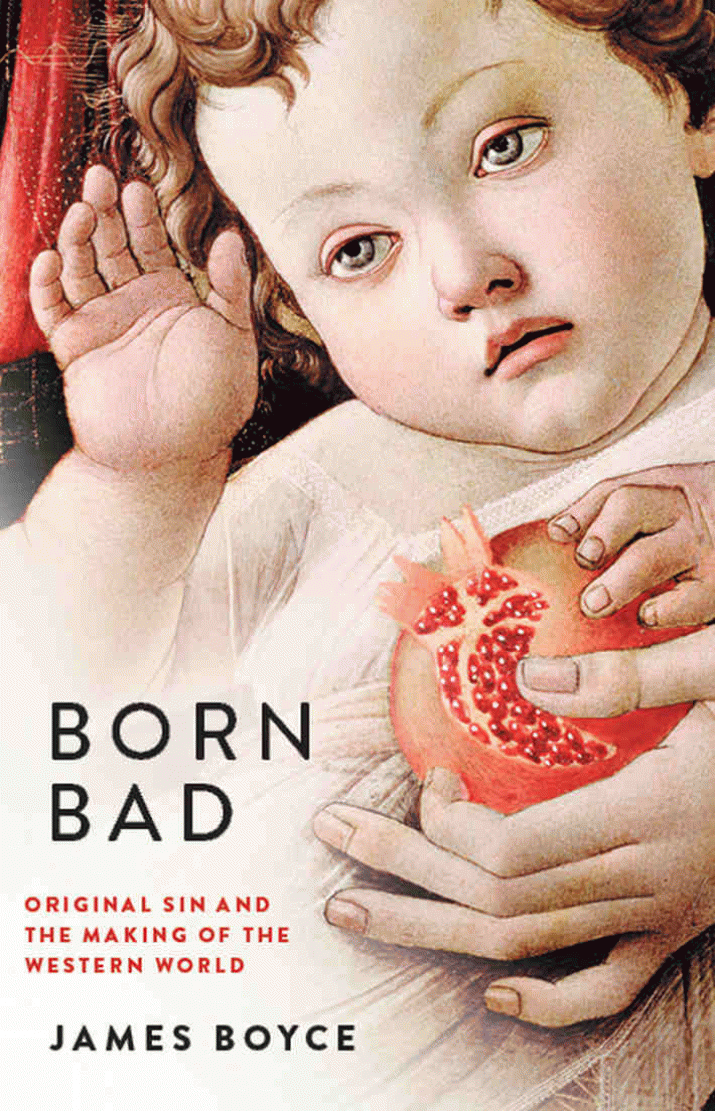

A response to: James Boyce, 2014: Born Bad: Original Sin and the Making of the Western World; Black Inc., 260pp.
If I have understood him correctly in his recently published book, James Boyce considers that modern western theories of human behaviour which assert that we have innate (i.e., evolved) tendencies to behave in dysfunctional ways are a direct ‘carry-over’ from the Christian doctrine of Original Sin into modern scientific thought, and that the scientists who have developed these more modern understandings are largely unaware of this intellectual legacy.
I would like to suggest that a slightly different narrative equally well accounts for the development of modern theories about dysfunctional human behaviour:
It is a fairly straightforward observation that some (but not all) of human behaviour is dysfunctional, and has been so throughout the history of human civilisation.
Alongside our tendencies to support, love and co-operate with those closest to us, we also have unfortunate tendencies towards selfishness, greed, self-aggrandisement, xenophobia and out-group aggression that have long hindered efforts to build more ideally harmonious and flourishing societies.
The best explanation
Thoughtful people have always been aware of this problem of the contradictions in our behaviour, and have sought to understand the reasons for them.
At the time of St Augustine, in the context of the religious ideas of that time, the notion of “Original Sin” was the best explanation of our dysfunctional behaviour on offer. We were bad because our forebears (Adam and Eve) had sinned against their maker (God), and the stain of that sin was inherited by us all, making us innately sinful.
However it is trite but also very true and important to note that in the centuries since St Augustine, our knowledge and understanding of human nature and origins has grown enormously.
The scientific study of human biology and evolution and of evolutionary psychology has indicated that many of our ‘bad’ behaviours are actually evolved behaviours which once served us well and allowed us to survive in the much harder and more insecure conditions of our pre-civilised evolutionary environment.
They weren’t ‘bad’ or ‘sinful’ behaviours, they were simply expedient and – on balance – successful ways of behaving, without which in all likelihood our distant ancestral groups could not have survived in the hard, competitive world they found themselves in.
These behaviours have only now become problematical because we have rapidly – over only a few millennia – developed ways of living in much larger, socially and technically much more complex societies that we call ‘civilisation’.
In the short time that our technical brilliance has enabled us to develop civilisations, there has simply been insufficient time for our long-evolved behaviours to change and evolve into behaviours more suited to our new social environments.
We live in large civilised societies but still behave as if we were small groups struggling to survive on the African savannah. In the modern evolutionary science perspective, this mismatch between our soaring modern technical capabilities and our Palaeolithic moral behaviour is the source of our dysfunctional behaviour.
Lingering legacy of the doctrine of Original Sin?
I suggest that this modern understanding of dysfunctional human behaviour is not simply a lingering legacy of the doctrine of Original Sin translated into modern scientific theory.
Rather, it is a new and quite different effort to answer a persistent problem which remains just as real and as in need of an answer as it was in St. Augustine’s time, namely the problem of why humans often behave badly. There really are dysfunctional aspects to human behaviour that require understanding.
Just because the doctrine of Original Sin is now widely understood to be a cruel and false doctrine does not mean that our dysfunctional behaviour is not real. It is arguably and demonstrably very real, but we have found a better understanding of its causes.
I suspect it may be drawing too long a bow to suggest we found this newer explanation simply through a (perhaps unwitting) translation of the doctrine of Original Sin into a scientific perspective more acceptable to modern thinkers. Rather I suspect we arrived at it through an (essentially independent) ongoing effort to find a more reasonable and realistic explanation which the ongoing reality of the original problem demanded.
Perhaps the most important aspect of the modern evolutionary psychology understanding of dysfunctional human behaviour that most clearly differentiates it from the older religious notion of Original Sin is that it does not label and condemn humans as ‘intrinsically bad’ or ‘sinful’.
The causes of our poor behaviour are not an innate evil or sinfulness. They are simply the way we evolved, the most efficient and successful ways available to our distant forebears of ensuring our survival in the environments we found ourselves in.
It is very likely that if we did not have these behaviours, we simply would not have survived long enough to create civilisations at all. The problem with these behaviours is not that they are intrinsically ‘bad’, but simply that they are now no longer so appropriate in the socially much more complex civilised environments that we have rather rapidly created over what is from an evolutionary perspective only a very short period of time.
The fact that we recognise key aspects of human behaviour as being dysfunctional, and that thoughtful people have always sought to understand the causes of this ‘bad’ behaviour so that we might perhaps be able to improve on it, is evidence in itself that we are not intrinsically bad. The insight that we actually want to live better lives in a better society, but that our innate (evolved) behaviours hinder this, means that we are not ‘bad’ at all; rather we are ‘good’ in the sense that we aspire to live better lives, meaning lives which are more secure, mutually supportive, and in which we can flourish.
And unlike the cruel methods of child-rearing and the useless doctrine of redemption through God’s grace that arose from the religious notion of Original Sin, a naturalistic understand of the causes of the more dysfunctional elements of our behaviour may just give us the ability to find ways to do so.
EARLIER …
• Jo Flanagan’s launch speech: Well sinners … welcome to the launch …
• Dr Clive Marks: Democratic hemlock: saving earth from our animal selves